
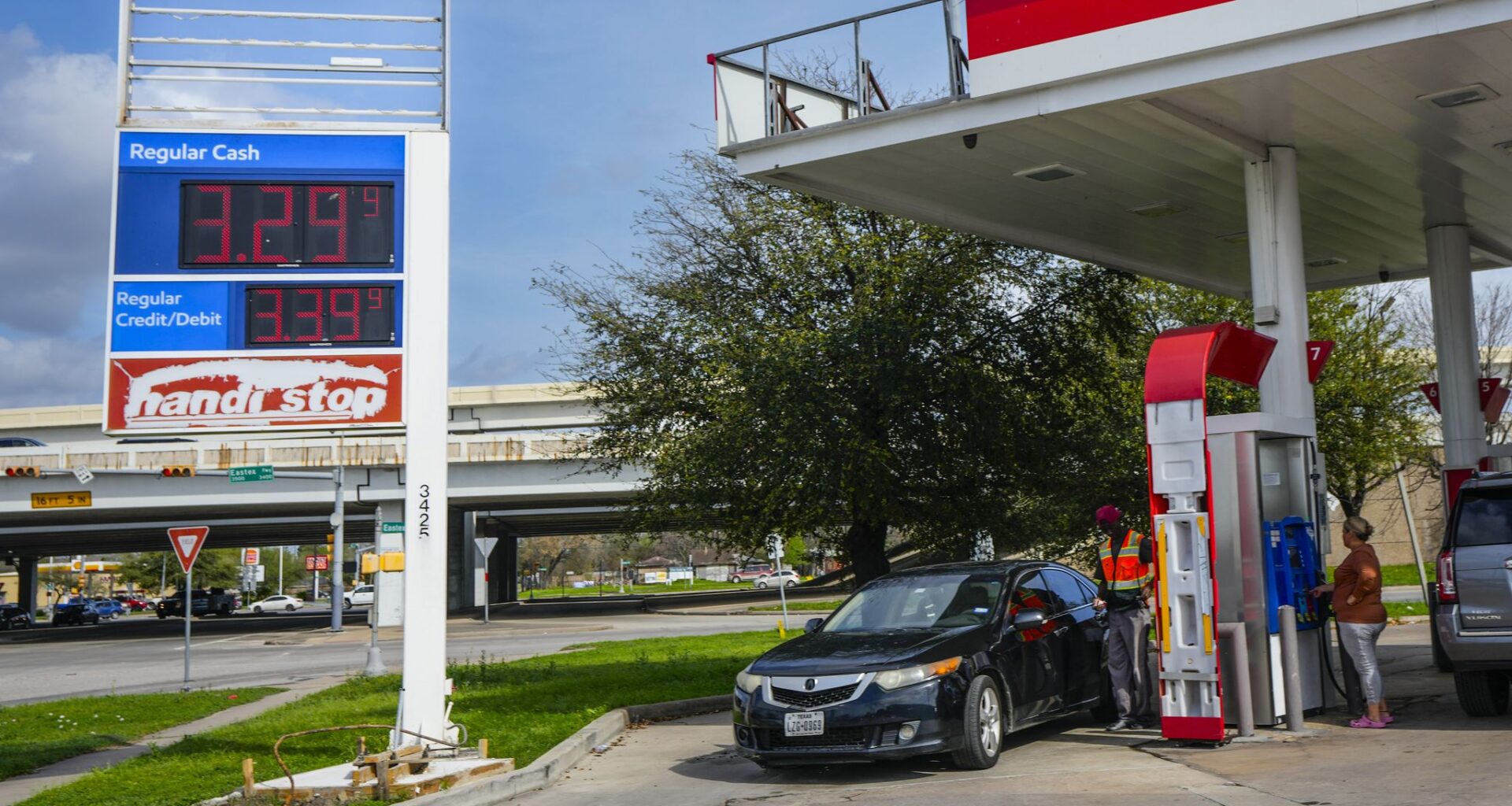
Gasoline prices are shown in Houston on March 9. While Houston continues to outperform much of the country in job and population growth, rising costs and global instability are weighing on how residents feel about the economy.
Brett Coomer/Houston Chronicle
As anxiety over the national economy rises, fueled by concerns about war, inflation and uncertainty, experts broadly agree on conditions in Houston: things could be worse.
“Houston is in a pretty good position, even though we find ourselves in a somewhat weaker national environment,” said Colin Baker, manager of economic research for the Greater Houston Partnership, at an economic outlook event last week.
“Let’s face it, the nationwide story is muddled. But the Houston story is strong,” said Paul Egge, CFO of Houston-based Stellar Bank, in a keynote speech at the event.
Article continues below this ad
“The Houston area has a lot of advantages,” said Gus Faucher, senior economist for The PNC Financial Services Group, in an interview with the Houston Chronicle last month.
War, oil prices and inflation add pressure
The war in Iran, which began in February, sent oil prices soaring from the mid-$60s to more than $100 a barrel, where they have remained for more than two months. As a result, inflation accelerated in March to 3.3%, its highest level in recent years, according to data from the Bureau of Labor Statistics released in April.
All of this is playing out against a background of uncertainty over federal policy, particularly on issues such as interest rates and tariffs, contributing to a “low-hire, low-fire” stasis in the U.S. job market.
Article continues below this ad
Even in Houston, where the economy continues to grow, it is affecting consumer sentiment. The long-running Kinder Houston Area Survey, released April 27, found that respondents most commonly identified “the economy” as the biggest issue facing the region, beating out concerns such as crime or traffic, which have often taken the top spot.
Houston’s economic outlook remains strong
Baker, of GHP, pointed to population growth and productivity growth as factors driving Houston’s GDP growth. Between 2022 and 2024, he said, Houston saw GDP growth of more than 10%, second only to Seattle among the nation’s largest metros.
ECONOMY:Why the Houston economy is making residents anxious about the future
“Houston has shown itself to be one of the most dynamic places in the entire United States,” he said. “That was certainly the case a few years ago during the big COVID-19 bounce back, and it’s even held up now that we’ve seen the nation facing a few additional challenges. Houston has consistently outgrown the rest of the country.”
Article continues below this ad
Population and job growth are closely linked, Baker said. In 2025, Houston led the nation in population growth, adding about 127,000 residents. It ranked second in job growth, behind Dallas, with 17,500 net jobs.
Faucher, of PNC, also emphasized growth as a factor bolstering the Houston area. An April 20 analysis of the regional economy from PNC noted that population growth slowed “significantly” in Houston in 2025 “in large part because of restrictions on immigration and increased deportations.”
Even so, he said, Houston is still seeing population gains, driven by domestic migration, and has room to grow — a positive sign for both the near term and long term.
“Houston has strong population growth, as we’ve been talking about. There’s a lot of developable land in the Houston area compared to other parts of the country — that’s not true in some of the older Northeastern metro areas or coastal metro areas,” Faucher said. “And there’s a virtuous cycle where you have strong labor force growth, and that in turn attracts employers — and that, in turn, means strong job growth and strong labor force growth.”
Article continues below this ad
Energy sector outlook remains uncertain
As of April, the state had not seen a significant increase in oil and gas production, despite the rise in prices, nor has data shown a surge in hiring or spending by oil and gas companies. The war in Iran could have unique effects on the Houston economy, given the importance of the oil and gas industry to the regional economy.
In December, for example — with the price of oil sitting at around $60 a barrel, and a number of energy companies having announced layoffs — the GHP forecast that the region’s oil and gas sector would likely see net job losses in 2026. Things have changed, Baker noted last week: “With the bounce back in oil prices we’ve seen in 2026, it seems likely we might see that trend reverse as we get further into the year.”
“I think that higher oil prices are, on net, a positive for the Houston region. The area still has a lot of energy-related companies, and we do expect to see more activity in the industry taking place with oil prices up,” Faucher said. “That being said, I think that for a few reasons, the benefit to the Houston economy will be more limited than during previous oil price cycles.”
He gave two key reasons. First, the economy is more diversified than it once was. Second, the energy industry is “more disciplined” than it was in the past: “It used to be that there would be a big increase in oil prices, and there’d be a rush of activity taking place. I think that the industry has learned from previous cycles.”
Article continues below this ad
Rising costs hit consumers
Many Houston households are feeling the pain from the war’s immediate effects, even if sustained high oil prices could boost the regional economy overall. A March report from Oxford Economics noted that the rise in oil prices will have a disproportionate impact on lower-income households in the United States, regardless of where they are located, as high oil prices lead to higher prices for necessities such as gasoline and groceries.
“Any kind of increase in prices will disproportionately hurt low-income families far more than middle- and upper-income households,” said Barbara Denham, lead economist at Oxford Economics and author of the report, in an interview in March. “The good news is that households are spending less on fuel today than they did, say, 20 or 30 years ago, but it’s still substantial — and, of course, it’s more so in regions where they have to drive longer distances.”
ECONOMY: Oil prices surged past $100 this week. Why is Texas oil still on the sidelines?
Houston is one such region, where rising gasoline prices may be driving growing concern about the economy. As of May 1, the average gas price in Texas stood at $3.896 a gallon, according to AAA, and had nearly surpassed $5 at one gas station in River Oaks.
“Sentiment is so often driven by what hits your pocket on a daily basis,” said Egge of Stellar Bank, at the GHP event.
Still, among experts and consumers alike, there is a sense that the Houston economy is proving relatively resilient in the face of the uncertain national outlook.
A quarterly index published by the American City Business Journals, released last month, found that although consumer sentiment in the Houston area dipped in the first quarter, it was still positive — and that Houston consumers are more optimistic, as things stand, than peers in San Antonio, Austin or Dallas.
Or, as Faucher put it: “The problems in Houston are less severe than they are in other parts of the country.”