
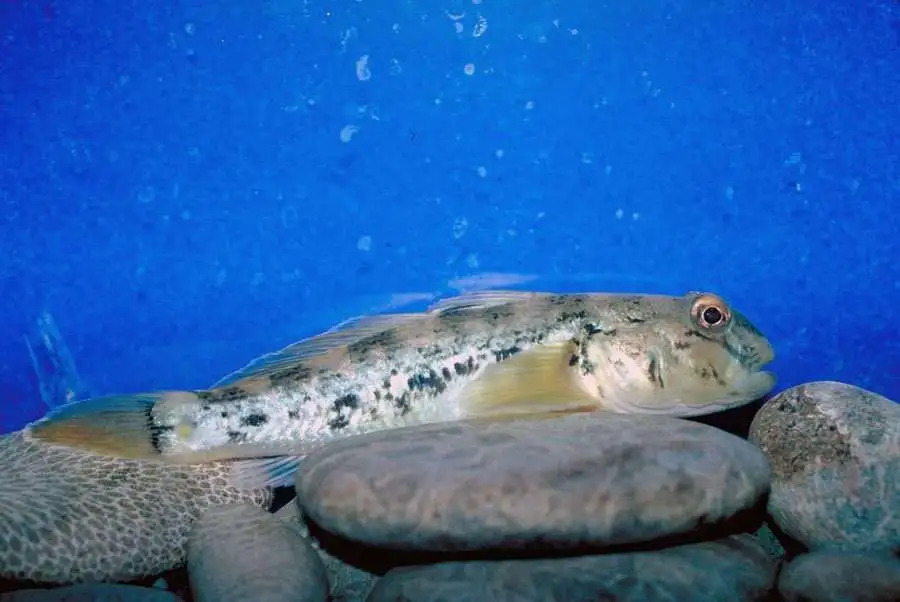
The small, bottom-dwelling round goby fish feed on the eggs of other fish species.
Courtesy state Department of Environmental Conservation
Scientists are trying to prevent the spread of invasive species to Lake Champlain.
Adirondack Explorer
There’s a place in the Richelieu River where a fish suspended in the water column can simultaneously be present in two states and two nations. It will be a bleak day for Lake Champlain if a round goby is ever captured there.

Fish and other species, of course, don’t recognize international borders, so neither can the biologists and lake managers working to prevent invasive species from spreading to new territory.
Article continues below this ad
With invasive round goby threatening to invade Lake Champlain from both the north and south, researchers and managers in New York, Vermont and Quebec are combining forces to monitor the gradual advances of goby’s invasion front.
The small, bottom-dwelling fish feed on the eggs of other fish species. Lake Champlain is considered good habitat for them, and researchers are concerned that a round goby invasion would threaten the successful reestablishment of self-sustaining lake trout and other species in the lake.
“It is a challenge, but it’s great to know each other and have this channel of communication,” Jesica Goldsmit, an aquatic species biologist with Quebec’s environmental ministry, said in a recent interview. “We don’t always do things in the same way, but we are able to collaborate and get results.”
How scientists are tracking goby
Researchers on both sides of the border in recent years have been capturing fish and collecting environmental DNA samples to survey the movements of goby through the two main waterways connecting Lake Champlain to goby-infested waters in the St. Lawrence, Hudson and Mohawk river systems. Goby has been present in the St. Lawrence River since the mid-1990s.
Article continues below this ad
Make the Times Union a Preferred Source on Google to see more of our journalism when you search.
Add Preferred Source
Researchers in Quebec in September captured a live goby between Saint-Ours and Chambly dams, the major barriers between the established goby population in the St. Lawrence River and the northern portion of Lake Champlain — the southernmost capture of a goby in the Richelieu.
“We knew eventually it was going to move upstream, but it is going quicker than we expected,” Goldsmit said.
Scientists monitoring round goby use various methods of capturing them, as well as collecting environmental DNA (eDNA) samples from the water. The DNA sampling, which essentially searches for molecular patterns in a vial of water that matches the DNA of a specific species, provides researchers a secondary signal of the goby invasion — but one that is hard to draw definitive conclusions from. Researchers in Quebec also detected DNA evidence of round goby near the U.S.-Canada border, past all barriers on the Richelieu and essentially in the northern part of the lake.
Article continues below this ad
Goldsmit said this summer, researchers for the Quebec environmental agency will focus on increasing work to capture live fish as a definitive marker of their invasion status.
“We think at this moment, more eDNA will not answer things, it will just give more questions,” Goldsmit said. “We will focus on trying to increase the fishing efforts.”
What’s next for researchers
To pass the Saint-Ours dam, goby could have traveled through a series of locks or used a fish passage in place for native species. To pass through the Chambly canal, goby would have to navigate another series of eight locks. Goldsmit said it’s not clear how easily the species could do so.
Article continues below this ad
Researchers at the Université du Québec à Chicoutimi are conducting a study focused on fish passage in the Richelieu River. The study aims to better understand how native fish like yellow perch, northern pike, brown bullhead and others use the canal system for passage. The Chambly canal system itself is managed by Parks Canada, a federal agency.
“It needs to be studied before we will prevent fish passage,” Goldsmit said. “Would that affect that natural connectivity for nature fish?”
Just as lake managers in New York caution residents from inadvertently transporting invasive species, so do environmental authorities in New York. Unlike in New York, though, the use of live bait fish, a potential pathway for introducing invasives to a new waterbody, is strictly prohibited in Quebec.
Spotless goby found in St. Lawrence River
The Quebec scientists may have also identified a unique type of goby, ones without a dark spot often used to identify the species.
Article continues below this ad
Spotless gobies in 2023 and 2024 were caught in the St. Lawrence and Richelieu rivers, according to a 2025 study authored by Goldsmit and colleagues, accounting for 1% or less of the captured gobies.
DNA analysis confirmed they were round goby, but perhaps a phenotype variant that didn’t have the dark spot on its first dorsal fin. The black spot is considered one of the most distinctive features used to distinguish round goby from other goby species or similar-looking natives.
“The existence of spotless round gobies may challenge public awareness and monitoring efforts,” the study concluded.
Article continues below this ad
This story originally appeared in the Adirondack Explorer, a nonprofit news organization covering people and policy inside the forest preserve.