
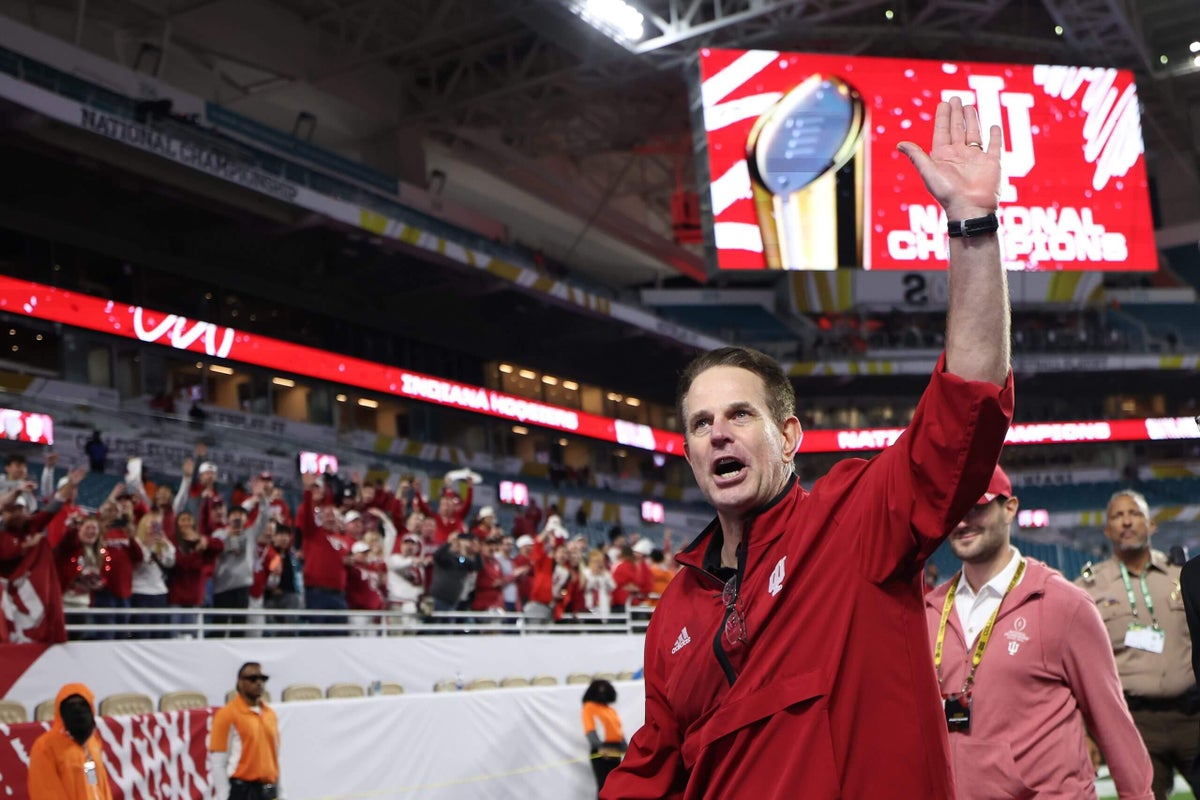
BLOOMINGTON, Ind. — Nearly 50 years before he would lead Indiana to the most unlikely national championship in college football history, Curt Cignetti got a harsh lesson about the perils of losing.
In November 1978, during Curt’s senior year of high school, his father, Frank, then the head coach at West Virginia, came down with a mysterious illness. Curt idolized his dad, who he would later say “had a little John Wayne and Clint Eastwood in him.” Curt had been on the Mountaineers’ sideline with Frank since he was 9, back when his dad was an assistant under Bobby Bowden.
But his 40-year-old tough-coach dad was unusually exhausted at the tail end of a 2-9 season, months before Cignetti would join his father’s team as a freshman quarterback. Frank was hospitalized and had surgeries, first for an enlarged spleen, then a bowel obstruction. After the latter one, his wife, Marlene, told Curt and his three siblings, “I don’t think Daddy’s going to make it.”
“He was given his last rites twice,” said Cignetti.
Clarity finally arrived in June 1979, when Frank was diagnosed with lymphoid granulomatosis. He began daily oral chemotherapy treatment and started feeling better.
West Virginia athletic director Dick Martin was already down on his coach following three losing seasons and initially tried to kick Frank to an administrative job, but Frank insisted on returning. He was back on the practice field that August as if nothing was different.
Despite being in an active fight with cancer and fielding a depth chart composed almost entirely of underclassmen, West Virginia improved from 2-9 to 5-6 that season. Martin still fired him.
Somehow, that cutthroat moment did not dissuade Frank’s son from going into coaching.
“I don’t know what else I’d have done,” said the now 64-year-old Cignetti. “I just knew you had to win.”
Frank, who died in 2022, earned induction into the College Football Hall of Fame for his 20-year run leading Division II Indiana (Pa.). At the Division I level, he only got four seasons as a head coach. All of them ended with losing records.
Curt, on the other hand, just closed out the first 16-0 season in FBS history, at a school that until recently had the most losses in FBS history. But long before he would become the “I Win, Google Me” guy, before he could stand victorious on the stage at Hard Rock Stadium after winning the national championship, Cignetti, like the Hoosiers, had to endure a lot of losing.
Cignetti will tell you his greatest coaching influence besides his father was Johnny Majors, who won the 1976 national championship at Pitt before spending 16 years at Tennessee. When Majors returned to Pitt for a second stint in 1993, he hired 31-year-old Cignetti as tight ends coach and recruiting coordinator.
“(Majors) used to always say, ‘The fun is in the doing,’” said Cignetti. “So, you’ve got to love the process.”
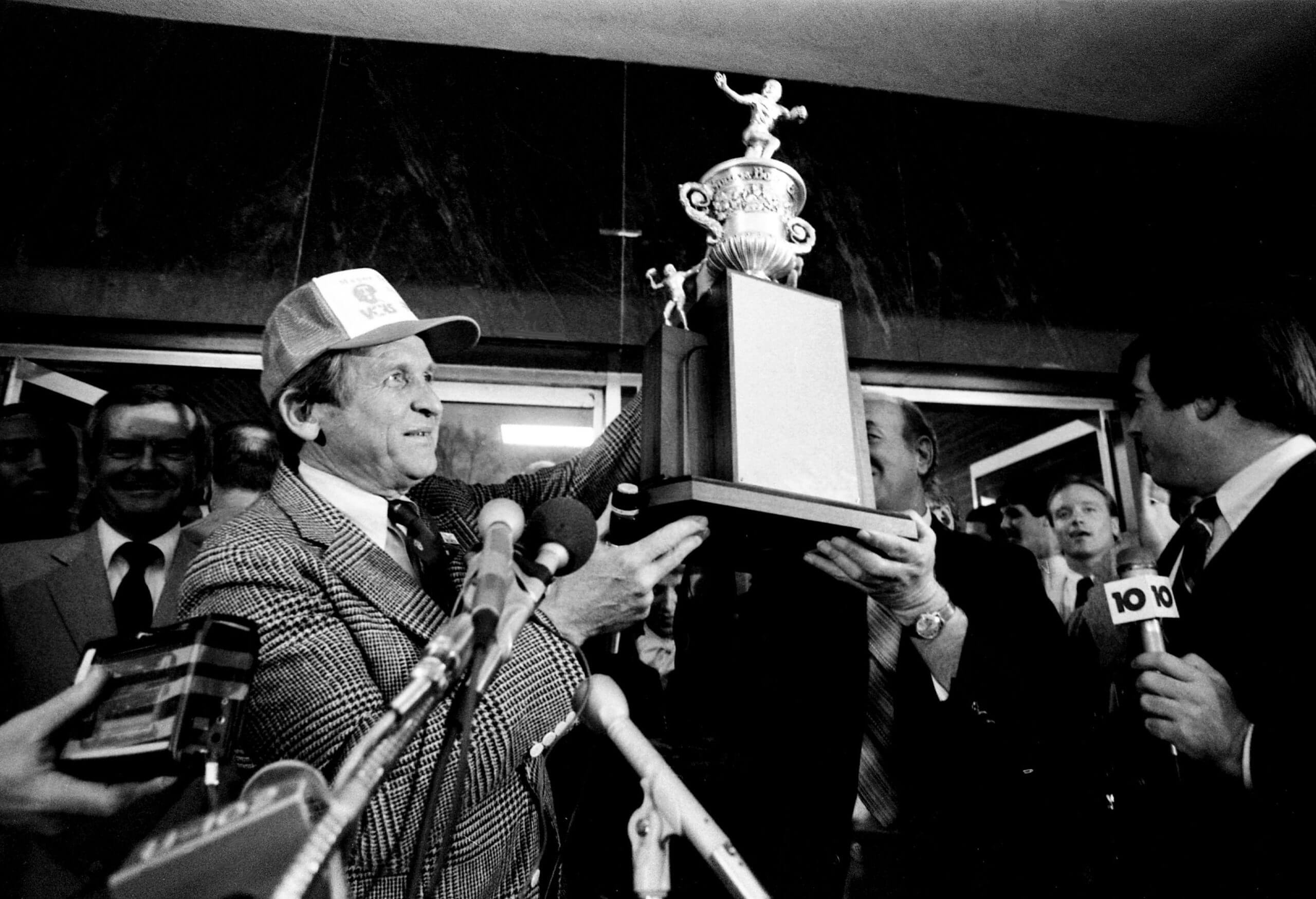
Curt Cignetti cites Johnny Majors as one of the biggest influences in his coaching career. (P. Casey Daley / Imagn Images)
But first, Cignetti had to work his way up in football, and football was not particularly kind to him.
In his first 15 years as an assistant, at Davidson (1985), Rice (1986-88), Temple (1989-92) and Pitt (1993-99), Cignetti experienced just one winning season. Eight of those teams finished 2-9, 1-10 or 0-11.
“We were the laughingstock of the Big East (in the ‘90s),” said former Pitt quarterback Pete Gonzalez, who was there with Cignetti from 1993-97.
But even so, Cignetti’s coaching ability stood out. In 1997, he moved from tight ends coach to quarterbacks coach and helped turn former third-string QB Gonzalez into a record-setting starter. Gonzalez led the Panthers to their first win in six years over rival West Virginia, vanquishing the school that fired Cignetti’s dad.
“He was happier than a pig in s—,” said Gonzalez.
But not until he became Philip Rivers’ QB coach at NC State in the early 2000s did Cignetti finally reach a bowl game. He stayed for seven seasons, until head coach Chuck Amato got fired following a 3-9 season. He was 45, and out of work again.
“People don’t hire assistants from schools that don’t win,” he said.
But one of his dad’s old defensive backs coaches at West Virginia did: Nick Saban. In February 2007, Alabama’s new coach hired Cignetti as receivers coach and recruiting coordinator. In Year 1, the Tide endured a rough 7-6 rebuilding year, defined by a home loss to Louisiana-Monroe. But behind the scenes, Cignetti helped secure a historically great recruiting class — Julio Jones, Mark Ingram, Dont’a Hightower, Mark Barron — that launched a dynasty.
The Indiana Hoosiers also went 7-6 in 2007 — and their fans stormed the field after the seventh win.
Coach Terry Hoeppner, hired two years earlier, pledged to lead IU to its first bowl game in more than a decade, creating the mantra “Play 13.” Hoeppner died of complications from a brain tumor that June before he could fulfill his vision. The Hoosiers would make a bowl after a last-second win over rival Purdue, and Hoeppner’s widow, Jane, celebrated on the field among a sea of jubilant students.
That triumph proved to be a blip. Indiana didn’t reach another bowl for eight years. The Hoosiers enjoyed a brief renaissance in 2019-20, when coach Tom Allen led the program to the Gator and Outback bowls, respectively, but from there Allen went 2-10, 4-8 and 3-9.
“We were right there (in 2019-20), and it all just disintegrated,” said Galen Clavio, co-host of the CrimsonCast podcast. “We almost shut the podcast down, that’s how despondent we were.”
Cignetti, meanwhile, got his first taste of dominance beginning in Saban’s second season at Alabama. Over Cignetti’s last three seasons, the Crimson Tide went 36-5 and won the 2009 BCS championship. Cignetti got to be immersed in “The Process,” Saban’s 365-day-a-year program for building champions. Saban’s unrelenting standards, his attention to details, his recruiting methods and motivational tactics — Cignetti geeked out on all of it.
“My dad’s a Hall of Fame coach, but after one year with Nick I felt like, ‘I got what I need,’” Cignetti says. “I learned a lot, and quite frankly, early in my career, being with those ‘looters’ — man, I wanted to enjoy winning.”
Saban, like all the bosses before him, never promoted Cignetti to offensive coordinator — in large part because he was too good a recruiting coordinator. “You had to get to the coordinator level to be in a position to get a (head coaching) job,” said Cignetti. “I was always, like, the ‘in-house candidate,’ but some (ADs) just have a philosophy that they’re going to go outside.”
Saban recalled in 2010, his alma mater, Kent State, had an opening and called him about potential candidates.
“It’s not a very good job. Nobody wants it,” Saban said during a College GameDay visit to Indiana. “… So, I say in the staff meeting, (does) anybody want the Kent State job? First guy (to) put his hand up — right there (Cignetti).” Kent State instead chose Darrell Hazell.
Finally, in 2011, as Cignetti approached his 50th birthday, his dad’s school, IUP, called with a head-coaching offer. It would require him to leave the SEC for Division II and take a 60 percent pay cut.
“I just looked at him and said, you can’t take that job,” his wife of 37 years, Nanette, an Indiana (Pa.) native, said in a 2024 ESPN interview. “I’m going forwards, I’m not going backwards.
“A week or two later, he told me, ‘That job’s still open — and I really want to be a head coach.’” She relented, and they returned to her hometown.
“It was a very unorthodox move,” Cignetti admitted.
Over the next 13 years, first at IUP (2011-2016), then Elon (2017-18), then James Madison (2019-23), Cignetti implemented and refined his own version of The Process, built heavily on Saban’s methods but tailored to his personality. Whereas Saban delivered frequent “ass-chewings,” Cignetti was more even-keeled. Where Saban gave speeches to his team, Cignetti used as few words as possible to make a point.
He went 119-35, making eight lower-level playoff appearances and winning four conference championships.
Finally, at the end of his 40th season in coaching, the Big Ten called.
Indiana AD Scott Dolson began his career as a student manager for Bob Knight when Indiana won the 1987 national championship. He joined Indiana’s athletic department after graduating and never left, rising to AD in 2020. A new university president, Pamela Whitten, arrived a year later with eyes on a different sport than basketball.
“It was super important to her that we figured out a plan to win in football,” said Dolson. They commissioned a study to examine what other, more consistent programs had in common. When the time came to hire a new coach after firing Allen in late 2023, they wanted a sitting head coach with a history of developing quarterbacks and a background in recruiting and roster management.
Cignetti, who had just gone 11-1 at JMU in only its second FBS season, “was uniquely qualified for what we needed here,” Dolson said.
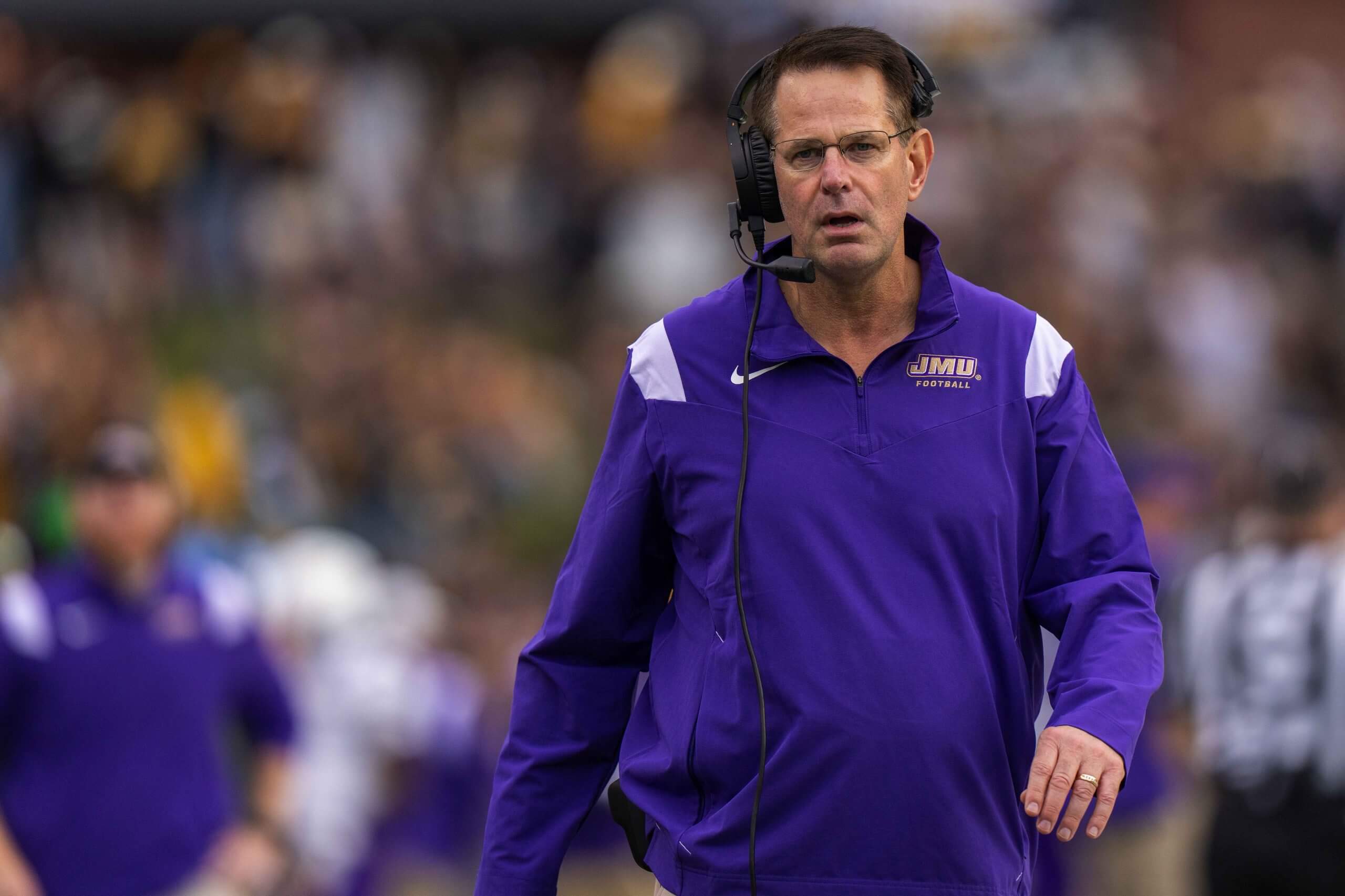
Curt Cignetti went 52-9 across five seasons at James Madison. (David Yeazell / Imagn Images)
Cignetti wasn’t certain he’d take the Indiana job if offered. It was, after all, a traditional doormat, albeit one with a whole lot of Big Ten TV money. Around 10 p.m. on a late November night in Harrisonburg, Va., as he sat in bed with Nanette, he told her he was leaning toward staying at JMU.
“And then Scott called, like, five minutes later, and he said, ‘Congratulations, you’re the new head coach of Indiana, man, and we’re going to kick some butt,” Cignetti recalled. “And I said, ‘hell mother f—cking right we are.’”
“My wife told me later, you should have seen the look in your eye, like, what did I just do?”
Cignetti carried that moxie into his introductory news conference. When asked how he convinced Dolson he was the right guy to develop quarterbacks, Cignetti chuckled and said, “It didn’t take much convincing. The proof is in the pudding.” Then that night at the Maryland-Indiana basketball game, he ratcheted up the act, shouting into a microphone, “Purdue sucks! And so do Michigan and Ohio State.”
Cignetti intentionally amped up his bravado to wake up Indiana’s sleepy fan base. But the supreme self-confidence? He said that’s always been there.
“I could feel the shift immediately from his first press conference,” said linebacker Isaiah Jones, who played his first two seasons under Allen. “At that first (team) meeting, he laid out his path and his record where he’d been, that his method worked, and all we needed to do was trust him.”
Cignetti’s most famous sound bite came later that month, at his first signing day news conference. He’d been working marathon days and nights for three weeks straight to close his first recruiting class. That morning at his temporary apartment, he woke around 4:30 a.m., so exhausted he believed he had fallen asleep for a brief moment on the drive in.
“I hit a curb and f—ed up the car,” he said.
So he wasn’t in the greatest mood when, 15 minutes in, a reporter on Zoom asked him, “How do you sell your vision to recruits?”
“It’s pretty simple,” Cignetti said, his eyes looking down at a laptop on the table. “I win. … Google me.”
College football hires usually come together rapidly. Cignetti took the job sight unseen. Several of his JMU staffers, like strength coach Derek Owings, came with him and saw the facilities for the first time when he did.
“The coaches’ offices looked like an old Motel Six with the carpet, the graphics hadn’t been touched for 20 years, and in the defensive staff room, every piece of furniture had stains all over it,” said Owings. “We were walking through it, and we were all looking around like, holy shit, our stuff at JMU was better than this.”
Inside those offices is where Cignetti and staff built Indiana’s 2024 roster in a matter of weeks. He got a jump start when 13 of his former James Madison players went into the portal and followed him, including leading tackler Aiden Fisher, 1,000-yard receiver Elijah Sarratt and lockdown cornerback D’Angelo Ponds. They, along with Ohio quarterback Kurtis Rourke, fit Cignetti’s belief in “productivity over potential.”
Cignetti didn’t have much choice but to take Group of 5 players in the portal. Indiana’s NIL budget that year was believed to be in the lower tier of the Big Ten, well below Ohio State’s $20 million roster.
Owings, now at Tennessee, realized within days, “the JMU guys were the strongest, most explosive, fastest guys we had,” he said. “Most of those 13 kids were signed when we were at the FCS level, and they were better than a team full of P4 recruits.”
Cignetti’s staff, led by 34-year-old offensive coordinator Mike Shanahan and 38-year-old defensive coordinator Bryant Haines — both with Cignetti for nearly a decade — got to work. Nine months later, the results came in.
In 125 years of football, Indiana had never won more than nine games in a season. Cignetti’s first team started 10-0. And they were crushing people — including 56-7 over blue blood Nebraska.
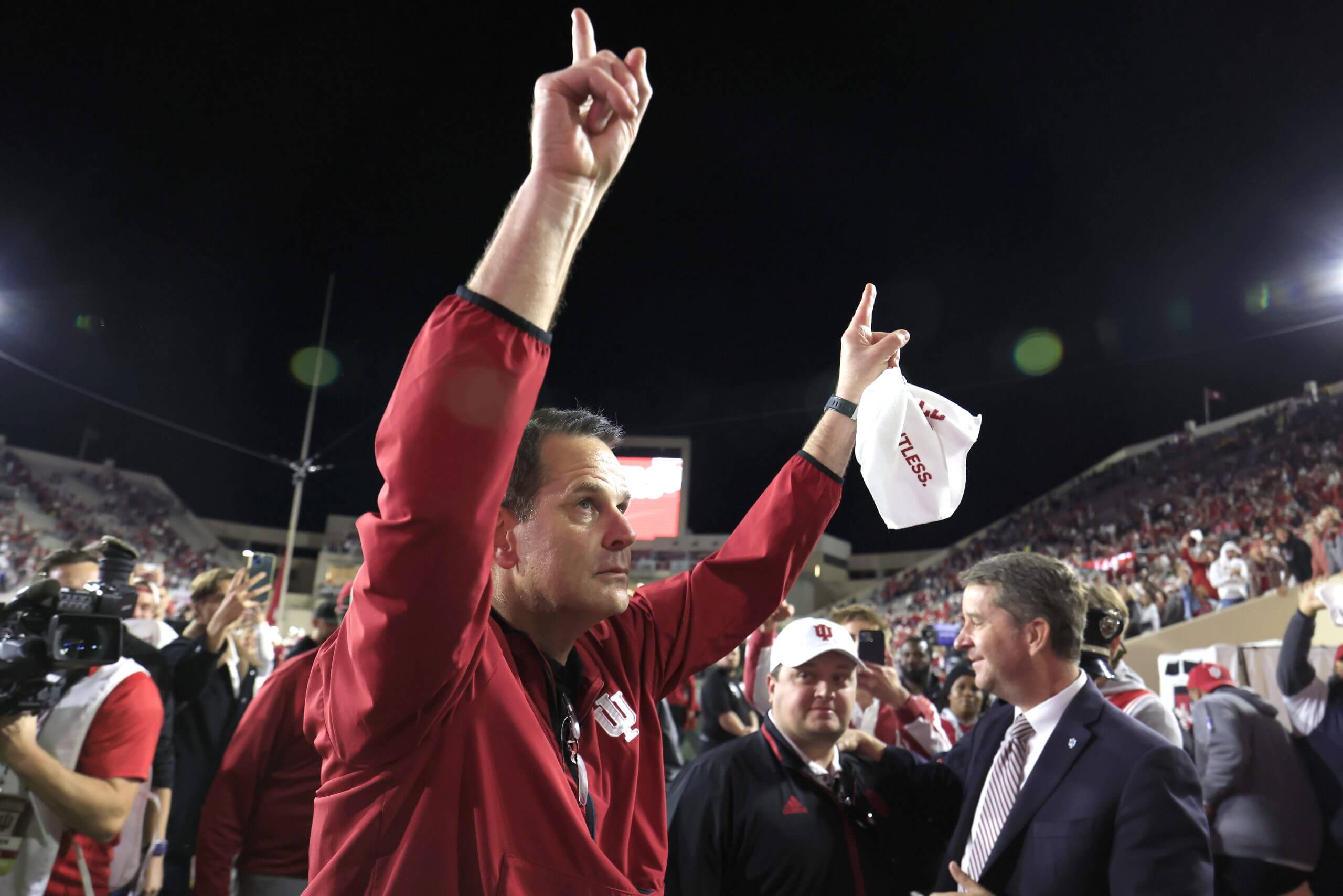
Indiana started 10-0 in Curt Cignetti’s first season. (Justin Casterline / Getty Images)
The Hoosiers seemed to know their opponents’ tendencies cold. They always were in the right place and rarely made unforced errors. It all started with the savant in the head coach’s office, who could be found holed up watching film nearly every minute of the day.
“That’s literally all he does, all the time,” said Owings. “He’ll sit there, and he’ll be watching film as you’re talking to him, and he can kind of do both. Say what you’ve got to say, let’s get to a resolution, and then, I’m back dialed in on film.”
Indiana would become the biggest story in college football that season, but not yet a universally beloved one. Critics chalked up the Hoosiers’ record to an unusually soft conference schedule. Their concerns were somewhat validated when IU’s offense went belly-up when playing its first elite foe, second-ranked Ohio State, losing 38-15.
Cignetti had been on the other end of blowouts before. One in particular stuck with him. In 2013, IUP started 5-0 and reached No. 7 in the country heading into a game at Slippery Rock, which came in averaging 50 points per game. Cignetti’s team gave up 676 yards and lost 42-16.
“That team was just a little big-headed, and I didn’t do as good a job,” he said. “I put the hammer down on that team. We would (stretch), and then run ten 40-(yard dashes) — and then practice.
“We were Hell on Wheels the rest of the year.”
Eleven years later, 10th-seeded Indiana went to No. 7 seed Notre Dame for a College Football Playoff first-round game. Appearing on College GameDay a few hours beforehand, Cignetti launched into his now-familiar wrestling persona.
“There’s a lot of skeptics, there’s a lot of doubters, I get it, (they) haven’t beat a Top 25 team,” he said. “Nebraska was 25th in the coaches poll, and we beat their asses 56-7. So, we don’t just beat Top 25 teams, we beat the shit out of them.”
That night, Notre Dame running back Jeremiyah Love broke a 98-yard touchdown, and the Irish held a 27-3 lead with 4:50 left before two garbage-time IU touchdowns made the final score 27-17. The backlash toward Indiana was immediate.
“I thought Indiana would put on a better show,” said the game’s play-by-play announcer, Sean McDonough. “I don’t know if they just had a bad night, or if they just weren’t that good.”
“Indiana was outclassed in that game,” Kirk Herbstreit said on GameDay the next morning. “They were not a team that should have been on that field when you consider other teams that could have been there.”
“We didn’t say much about it,” Cignetti said of those comments. “But we all heard it, felt it, and used it as fuel.”
The Hoosiers were about to become Hell on Wheels.
In August 2025, Dolson and his wife, Heidi, along with Nanette, sat watching a nighttime closed scrimmage late in Indiana’s preseason camp. Heidi, a Bloomington native who grew up going to Memorial Stadium, turned to the group and said, “I think we look even better than we did last year.”
Folks on the outside were more skeptical. Despite coming off an 11-2 season and returning stars like Sarratt, Fisher and Ponds, Indiana was ranked 20th in the preseason AP poll. But Cignetti had more money to play with for his second portal class.
And folks on the outside hadn’t seen the Hoosiers’ new quarterback.
Fernando Mendoza, a former two-star recruit from Miami’s Columbus High School, was an adorably dorky two-year starter at Cal, with modest production, a .500 record and minimal NFL buzz. He struggled for much of Indiana’s spring camp. But come preseason camp, he began wowing his teammates.
“Some of those deep out routes to the field (side) are really hard throws for a quarterback,” said Jones. “And I remember Fernando put one on the money, like 20 yards downfield from one hash to the sideline, right in the receiver’s hands, with the DB right on top of him. We were like, ‘Holy cow.’”
After opening with three cupcakes, Indiana hosted No. 9 Illinois in an NBC primetime game in Week 4. The Illini, a trendy preseason pick following their Citrus Bowl upset of South Carolina, came in 10 spots higher than the Hoosiers.
“The No. 1 thing Cig does is, he can find an edge for anything,” said Owings. “It could be an assistant coach he met one time 12 years ago, and the guy blew him off, and now he wants to kick his ass.”
Cignetti’s edge for Illinois week? “They were going to be ‘this year’s Indiana,’” Cignetti recalled.
Actual Indiana won 63-10, with Mendoza going 21-of-23 passes with five touchdowns.
After surviving a close call at Iowa the next week, and coming off an idle week, Indiana prepped for a much bigger road test at No. 3 Oregon, which had won 18 straight home games. The Ducks were known for their physical offensive line play under Dan Lanning, but the Hoosiers’ defense still felt they had the advantage.
“We’re gonna go out there and punch these guys in the mouth,” Jones predicted. “They’re not gonna know what hit them.
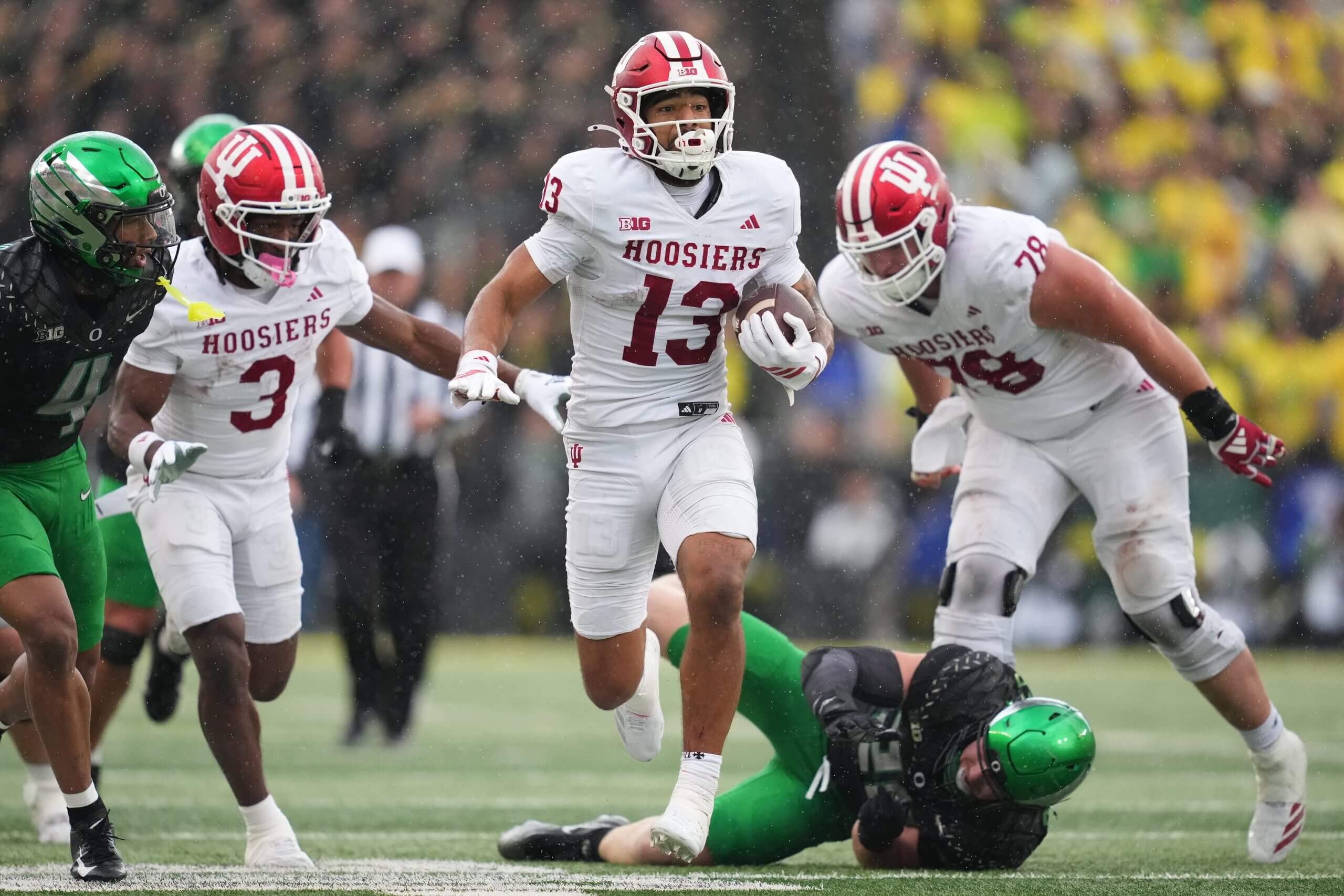
The Hoosiers’ regular-season matchup against Oregon was one of their signature wins of the season. (Soobum Im / Getty Images)
Indiana was indeed more physical than Oregon from the jump, but Mendoza threw a pick six early in the fourth quarter that allowed the Ducks to tie the score 20-20.
“On the sideline. Fernando’s standing right there, so I go up to him, give him a tattle tap on the ass and said, ‘Hey, you good?’” said Hoosiers left tackle Carter Smith. “He looks at me and goes. ‘We’re getting down there this time.’”
Mendoza promptly led the Hoosiers on a 75-yard touchdown drive to reclaim the lead. Indiana safety Louis Moore intercepted Oregon quarterback Dante Moore, and the Hoosiers wrapped up a convincing 30-20 upset.
“When we beat Oregon at Oregon,” said Owings, “I knew we could go beat anybody.”
But one moment galvanized the Hoosiers more than any that season: The game-winning drive at Penn State. Sacked on the first play from his own 20-yard-line, with no timeouts left, Mendoza recovered to lead his team inside the Penn State 10. On third and goal with 41 seconds left, Mendoza dropped back, felt pressure and launched a rocket to the back of the end zone. Receiver Omar Cooper Jr. jumped for the ball and somehow dragged the tip of his foot inbounds by a few inches.
It would go down as the play of the year in college football and the signature moment of Mendoza’s eventual Heisman win, as Indiana escaped with a 27-24 victory.
“As I started to walk across the field to shake (interim coach) Terry (Smith) ’s hand, it just hit me,” said Cignetti. “This might be a team of destiny.”
Indiana Mania was in full swing by the time the 12-0 Hoosiers went to Indianapolis to face 12-0 Ohio State in a No. 1 vs. No. 2 Big Ten championship game. A year earlier, Ohio State exposed a considerable talent gap between the teams. This time the Hoosiers shut out the Buckeyes in the second half to win 13-10.
Indiana was heading to the Rose Bowl for the first time since 1967.
Cignetti once helped Saban build Alabama into the overlord of college football for a decade-and-a-half. Now, as the Hoosiers’ CFP quarterfinal opponent in Pasadena, he made it his personal mission to embarrass Kalen DeBoer’s Crimson Tide.
“In the game day meeting at the hotel, he was like, I don’t want to do any trick plays, weird stuff,” said Owings. “I want to line up and beat the s—t out of them. In the second half, we started bullying those guys, and when Bama had given up, it was, I don’t really want to pass anymore. I want to run it down their throat and make a statement.”
Which they did, 38-3, to advance to the Peach Bowl semifinal against Oregon in Atlanta. The day before the game, Cignetti and Lanning attended a joint press conference at the College Football Hall of Fame. Cignetti got to see Frank Sr.’s digital plaque on display for the first time. He’d missed the 2014 induction ceremony while at IUP because, “I wasn’t going to miss a practice.”
The next night, in front of an almost entirely crimson-clad crowd at Mercedes-Benz Stadium, Ponds picked off Oregon’s Moore on the first snap of the game and returned it for a touchdown, en route to a 56-22 Hoosiers demolition. Indiana was heading to the national championship game against Miami, to be played in Miami — which happened to be Mendoza’s hometown.
Mendoza, who grew up in Coral Gables, only a mile from Miami’s campus, said he used to attend Canes games at Hard Rock Stadium. During CFP broadcasts, ESPN had been increasingly cutting to shots of Mendoza’s family in the stands — in particular his mother, Elsa. A former tennis player at Miami, she suffered from multiple sclerosis and uses a wheelchair.
Indiana led just 17-14 with 9:30 left in the game when, on third-and-5 from the Miami 12, Mendoza sailed a pass into the end zone incomplete. Indiana initially sent out its field goal team until Cignetti, wearing his perpetual sideline scowl, changed his mind and called a timeout.
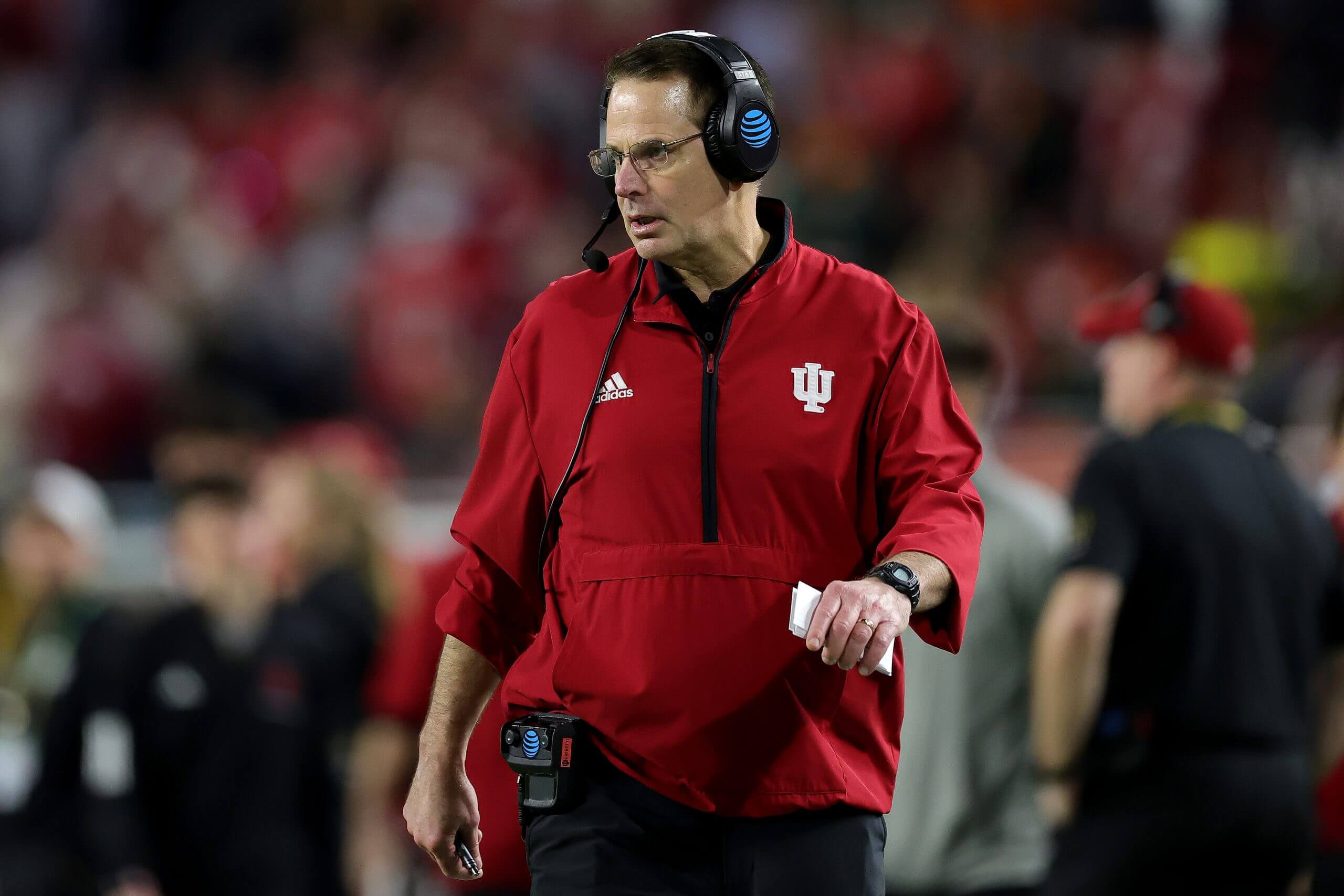
Curt Cignetti’s call to go for it on fourth down in the fourth quarter swung the game in the Hoosiers’ favor. (Alex Slitz / Getty Images)
The man who bet on himself when he left the SEC for Division II, who had the audacity to say “I win, Google me,” before he’d coached a game at Indiana, was not going to play it safe now. The staff that week had installed a red-zone play specifically designed to counter the coverage it expected from Miami.
“If this works,” Owings thought to himself, “(Cignetti) has got the biggest balls in America.”
Mendoza dropped back, then took off up the middle on a designed draw. As he neared the 5-yard line, Mendoza ran headfirst toward Canes linebacker Wesley Bissainthe. A year earlier in Miami’s game at Cal, Bissainthe drilled Mendoza on a third-down scramble with 2 minutes left, forcing a punt and leaving Mendoza writhing on the ground. Cam Ward proceeded to lead the Canes on a game-winning drive.
This time, Mendoza leveled Bissainthe. The impact turned the QB backward for a second, before he steadied himself, turned and dove sideways toward the end zone for his legacy-defining touchdown run. The broadcast immediately cut to a shot of his dad, Fernando Sr., pumping his fist and hugging an elated Elsa.
“It was just so magical,” said Smith. “Being able to take a hit like that, stay on your feet, and then go just a little bit harder is what all of our training was about.”
Miami QB Carson Beck led his team right back down the field to get within 3 points, and a false start by Smith helped stall IU’s next drive in the red zone. This time, Cignetti took the points, giving the ball back to Beck, down 27-21, with 1:42 remaining. Some 30 million television viewers hung on the edge of their seats as Beck led the Canes across midfield.
But on a first down with 51 seconds left, Beck passed up an open throw to Malachi Toney over the middle and locked in on receiver Keelan Marion streaking down the left sideline. From the sideline, Jones watched as Beck launched the ball nearly 40 yards downfield.
“I’m like, ‘(cornerback) Jamari Sharpe is gonna pick this off,’” said Jones. “The ball’s in the air and Sharpe goes up, I’m just thinking, ‘Dude, you got to catch this.’”
“I was screaming, ‘Go down!’” said Owings. “And then it was just surreal. ‘Holy sh-t, this just happened.’”
Two kneel-downs later, as the clock hit 0:00, Cignetti smiled, looked up and pointed two fingers to the sky.
Three months later, the coach stood inside John Mellencamp Pavilion, Indiana’s indoor training facility, talking to his team at the end of a spring practice. Their last practice, he told them, was the worst in his entire three years there. This one was better.
After they broke the huddle and the Hoosiers dispersed, Cignetti smiled as he left the field. Another day in the process of building his next team. The fun is in the doing.
Meanwhile, Indiana’s athletic department was inundated with requests this spring from graduating seniors at the university wanting to conduct photo shoots at the 50-yard line of Memorial Stadium. They weren’t fielding many of those over the previous 50 years.
In addition to his usual offseason duties, Cignetti was managing an unprecedented amount of requests — coaching award banquets, podcast interviews and endorsement opportunities. He’d turned down most of them, even the chance to film a commercial for his beloved Chipotle bowl.
Amidst all those demands, Cignetti found at least some time to reflect. About last season. About the championship. But also, about his 40-plus-year career, one that took him to 10 different schools, spanning three levels of college football, on a long, slow burn to the victors’ stage at Hard Rock Stadium.
“Occasionally, when I get a little time,” he said, “I think, ‘Well, what a journey.’”