
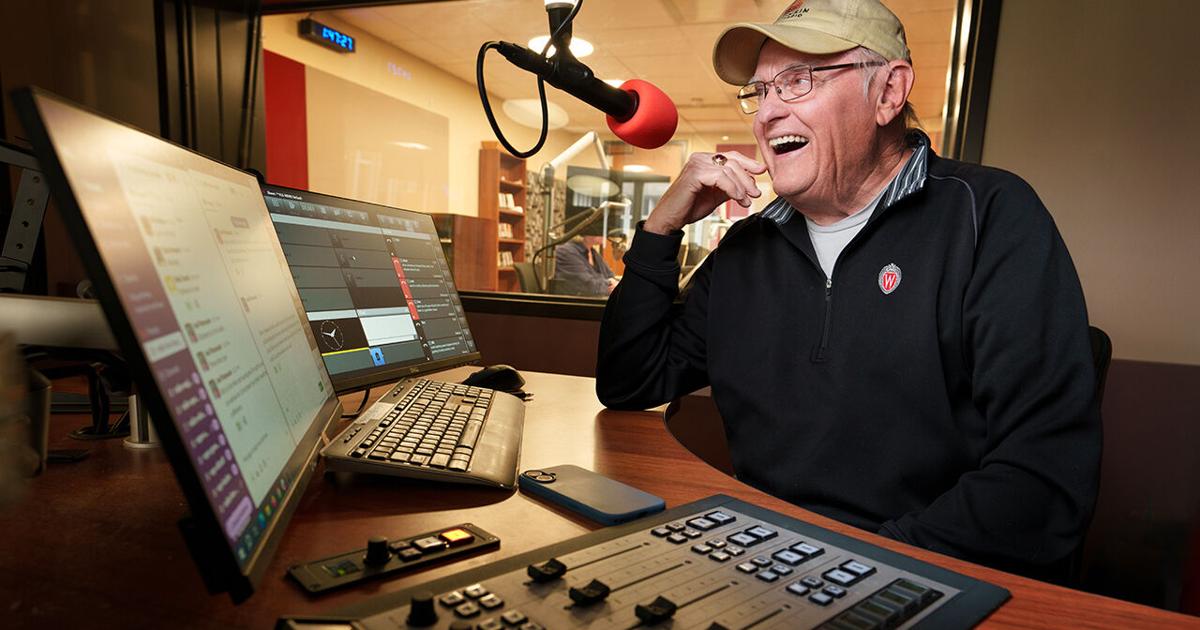
Larry Meiller once commented on the appeal of his Wisconsin Public Radio (WPR) call-in show by describing his connection with listeners: “I think they look at me as an old friend.”
That was in 1987.
Nearly 40 years on, Meiller’s relationship with his fans continues — and they’re not just old folks. This past winter, Meiller was dining with friends at Sardine in downtown Madison when a young waitress heard him speak.
“You’re Larry Meiller!” she said. “Is it OK if I get my phone?”
The waitress got her selfie, and Meiller — who turns 82 this May — banked another warm and humorous memory from his 59-year career in public radio, which will end with a final show on June 30.
It’s now called “The Larry Meiller Show,” but he’s been hosting guests and taking statewide listener calls around the noon hour on weekdays since 1978. Prior to that, Meiller did a daily half-hour farm show on WPR, which transitioned after three years to an hour-long show highlighting consumer topics. His enduring appeal is undeniable.

Larry Meiller, shown hosting a show in 1998.
Photo By Rick Dahms
“Larry is kind of like your favorite uncle,” says Jill Nadeau, the show’s executive producer. “He’s so friendly. I tell people he has a Ph.D., and they’re like, ‘What?’ He comes across like a farm boy from Cottage Grove, which he is.”
The call-in show was suggested by Jack Mitchell, a public radio legend who led WPR for two decades after a successful stint producing “All Things Considered” at National Public Radio.
“What kind of call-in show?” Meiller asked.
“Think about it and tell me tomorrow,” Mitchell said.
Meiller’s pitch was inspired by the Wisconsin Idea. He imagined sharing expert knowledge on a wide variety of topics — health, pets, gardening, the outdoors and more — and allowing listeners to tap into it with phone questions.
His first guests were University of Wisconsin veterinary science specialists. His first caller — “Grace from Stevens Point” — asked how you could tell if your cat was male or female.
UW professor Richard Bristol’s reply: “Just pick up its tail.”
Grace called so often they had to institute a limit: one call per person per week.
“The Grace rule,” Meiller says, chuckling.
It was the grace of good timing that landed Meiller in radio in the first place.
After his Cottage Grove farm upbringing, Meiller attended Madison East High School and then University of Wisconsin–Madison. He was interested in marketing and animal science.
“I thought I wanted to work in the marketing department at Oscar Mayer,” he says.
Meiller took a radio class his senior year at UW. The professor — who hosted a daily half-hour farm program for public radio in connection with the Department of Agriculture Journalism (now Life Sciences Communication) — took a leave of absence. Meiller was asked to fill in.
In hindsight, it was life-changing, but several dominoes needed to fall. The professor was promoted and left the show to Meiller. Meiller went to graduate school, completing his Ph.D. in mass communications in 1975. He joined the faculty and kept doing the farm show.
“I wasn’t any good at it at first,” Meiller says of his early radio hosting days. He sought counsel from WPR stalwarts Karl Schmidt and Ken Ohst, and that, Meiller says, “made all the difference.”
Once he started the call-in show, a public identity was established that would cover nearly half a century. But many listeners probably didn’t realize that across those decades, Meiller also taught — radio broadcasting, newswriting, communication theory — and conducted research focused on community engagement. He served on dozens of campus committees and did eight years on the UW–Madison Athletic Board.
When his audience listened, they felt a personal connection. He’d get letters: “I know you like to camp. I’ve never been camping. Would you take me?”
He got calls at home, too (he was listed in the phone book): “It’s my birthday. My friends bet me that I wouldn’t call you on my birthday.”
Regular studio guests, like Scott Craven of the UW–Madison Department of Forest and Wildlife Ecology, became more than interview subjects. “Family friends,” Meiller says.
Wisconsin authors were grateful that Meiller always read the books he had them on to discuss. Michael Perry recently wrote on Facebook about his first appearance on Meiller’s show more than two decades ago. “[He] greeted me like an old friend, then proceeded to make me feel like the wittiest person he’d interviewed that year,” wrote Perry, who is scheduled for a final show in June.
When “Calling All Pets,” a popular WPR show Meiller hosted with Patricia McConnell for almost 14 years, ended in 2008, McConnell wrote, “He makes it look easy to be on the radio. … He taught me so much, and I will forever be indebted.”
With retirement at hand, there will be numerous tributes — “Larry Meiller Day” with the Madison Mallards is June 14 — and final on-air appearances with regulars like Perry.

Photo By Rick Dahms
Meiller says he “worried a bit” about what not doing the show will be like after all this time. But he has volunteer opportunities lined up, Badgers season tickets, daughters living in three states to spend time with and renewed enthusiasm for golf after scoring his first hole-in-one last fall at Odana Hills Golf Course.
He’s angered by what he calls “the assault” on public media by the current administration in Washington, D.C. Budget concerns led WPR to end production of four shows in 2025.
“But I’m hopeful, too,” Meiller says. He points to WPR’s loyal audience, its “ramped up” social media presence and new collaborations with PBS Wisconsin that bode well for the future.
“We’ll focus on Wisconsin,” says the man who did just that, wonderfully well, for some 60 years.
Doug Moe is a Madison writer and a former editor of Madison Magazine. Find more by Moe in his web-exclusive blog at madisonmagazine.com/dougmoe.
COPYRIGHT 2026 BY MADISON MAGAZINE. ALL RIGHTS RESERVED. THIS MATERIAL MAY NOT BE PUBLISHED, BROADCAST, REWRITTEN OR REDISTRIBUTED.