
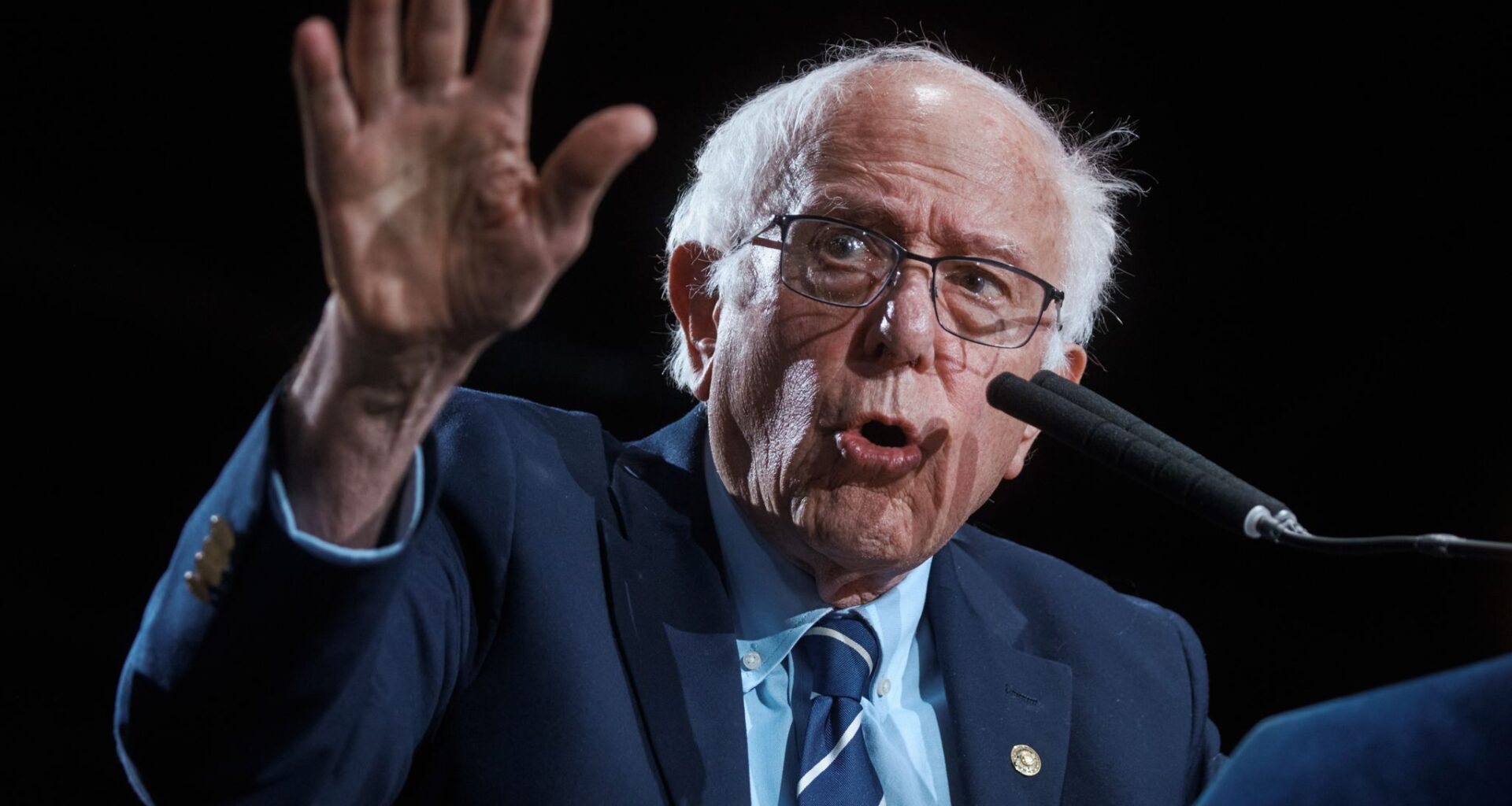
Rep. Bernie Sanders, I-Vt., speaks during an address marking New York City Mayor Zohran Mamdani first 100 days in office at the Knockdown Center, Sunday, April 12, 2026, in New York.
Andres Kudacki/AP
The claim: Democrats say Republicans have ignored voters’ concerns about affordability, including health insurance as they supported President Donald Trump’s 2025 tax and spending bill.
“As a result of the ‘Big Beautiful Bill,’ 15 million Americans have been thrown off the healthcare that they need,” Sen. Bernie Sanders, I-Vt., said during a committee hearing that included testimony by Health and Human Services Secretary Robert F. Kennedy Jr.
The senator, who frequently talks about the high cost of health insurance or lack of access to it, has cited the 15 million number several times in recent months.
Article continues below this ad
PolitiFact ruling: Mostly False. This is premature. ACA plan enrollment is down about 1 million people since 2025. The CBO projected that 10 million people would be newly uninsured by 2034 as a result of the 2025 bill. Separate from the legislation, in 2026 roughly 4 million people were expected to lose expiring tax credits that subsidized their coverage.
Although close to 15 million people are expected to lose coverage — not all of them because of the One Big Beautiful Bill — it hasn’t happened yet and we cannot know with certainty that it will.
Discussion
Millions of people are on track to lose Affordable Care Act coverage in the coming years, according to independent estimates. But only a fraction have likely occurred so far.
The One Big Beautiful Bill Act extended income tax cuts for a wide swath of individual taxpayers and businesses, added $75 billion in new funds for Immigration and Customs Enforcement, and made historic cuts to safety net programs, including Medicaid.
Article continues below this ad
The Congressional Budget Office, Congress’ nonpartisan budget-analysis arm, predicted shortly after the legislation passed that the law would increase the number of people without health insurance by 10 million through 2034. That included people who had been covered by Medicaid or the Affordable Care Act.
Although Sanders’ statement targeted the legislation, Sanders’ spokesperson Patrick Barham told us the senator was also referring to the expiration of premium tax credits for people purchasing insurance through the ACA marketplaces, expected to affect about 4 million people. Barham said these two factors “will strip coverage from more than 15 million Americans and increase out-of-pocket health care costs for millions more.” He cited an analysis by the left-leaning Center on Budget and Policy Priorities.
The Centers for Medicare & Medicaid Services reported in March that 23.1 million consumers were enrolled in ACA plans for 2026. That’s about 1 million less than in 2025.
So far, New Jersey and New York are among the states reporting decreased enrollment.
Community health centers that serve high volumes of ACA-enrolled patients have reported declines in insured patients, said Sara Rosenbaum, a George Washington University healthcare law and policy professor. Young people have disproportionately shed their insurance, leaving older, sicker people insured.
Article continues below this ad
Medicaid work requirements under the 2025 law are set to take effect in January 2027, although some states are implementing the new rules this year, including Nebraska and Montana.
KFF Health News reported that most Medicaid beneficiaries affected by these provisions are expected to lose health insurance coverage not because they don’t work but because of paperwork errors, such as failing to document their hours worked.
Joe Antos, an American Enterprise Institute emeritus health policy specialist, said it’s not easy to assign the cause or causes of declining ACA enrollment, given the changes in the law and overall inflation that is squeezing many households.