
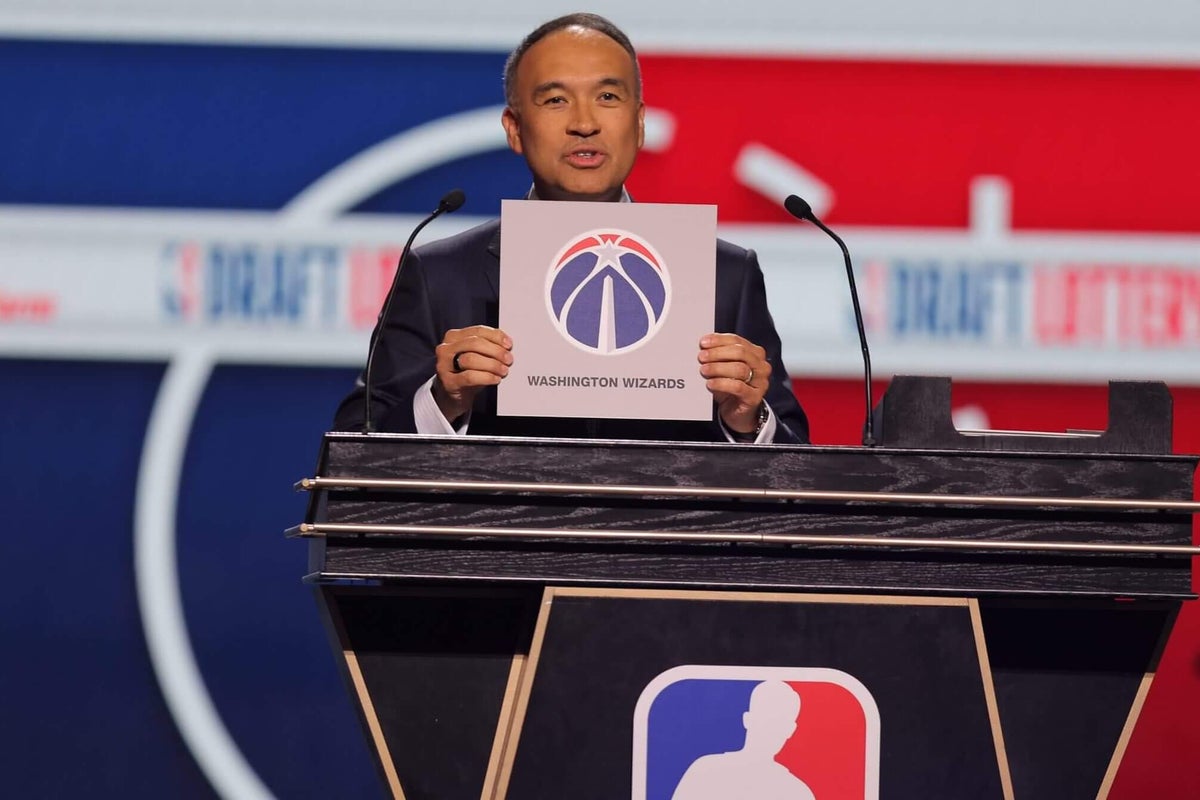
We’re back, folks, for what might be the final consequential NBA Draft Lottery for the Washington Wizards for some time. (At least, they hope so!)
We did this last year, when the Wizards were dreaming of adding a future superstar by getting to draft either Cooper Flagg out of Duke or Dylan Harper out of Rutgers — each a franchise-level player at his respective position — with one of the top two picks in the draft.
And we did it three years ago, wondering how the Wizards winning the 2023 lottery, and Victor Wembanyama’s services, had the potential to turn the fortunes of, perhaps, the NBA’s most woebegone franchise.
Absolutely none of that happened.
The Wizards came up one ping-pong ball short in the four-number combination the league uses to assign picks to teams from getting Wemby in ’23. Excruciating. And last year, Washington fell four spots, as far as a team can fall in the lottery, with the league’s second-worst record, plummeting all the way down to six. Again, Washington was one combination number away from getting the top pick, which went to Dallas, which took Flagg.
So, we’re back at square one. The 2026 draft is the draft that multiple teams, including Washington, have been eyeing for years. Individual players such as Wembanyama and Zion Williamson in 2019 generated more buzz than this year’s top prospects, but the depth at the top of this class is as strong as it’s been in at least several years.
Multiple players, all freshmen — BYU wing AJ Dybantsa, Kansas guard Darryn Peterson, Duke forward Cameron Boozer and North Carolina forward Caleb Wilson — are viewed by most NBA scouts and personnel people as potential superstars. At the very least, they’re considered players with extremely high floors who’ll become integral parts of their NBA teams quickly.
Right behind that quartet is another foursome, also all freshmen — Arkansas guard Darius Acuff Jr., Houston guard Kingston Flemings, Illinois wing Keaton Wagler and Tennessee wing/forward Nate Ament — who are also viewed as having high, high upsides. Some evaluators have the 6-foot-2 Acuff ranked as a top-four pick after his terrific season for the Razorbacks.
Still more freshmen, including Arizona guard Braydon Burries and Louisville’s Mikel Brown, round out most top 10 mock drafts.
What does this mean for the Wizards?
Washington achieved its main organizational goal this season: keeping control of its 2026 first-round pick, rather than losing it to New York. The first-round pick was protected for the Wizards for draft selections Nos. 1 through 8. Washington will now send a second-round pick this year and another next year to the Knicks to satisfy its trade obligation to New York.
But in addition to keeping their first-round pick, the Wizards accomplished something else. By finishing with the league’s worst record outright (17-65), the franchise ensured that it can fall no lower than the fifth pick.
Falling to fifth in this year’s lottery, of course, would be a disappointment. But we think that the Wizards’ knowing their lottery floor is at No. 5, instead of at Nos. 6-8, potentially is of tremendous value, even if this draft has “only” five future stars. The Wizards, internally, believe that this is a six-player draft; they believe there are six potential stars available at the top of the first round. But Washington has to be right in identifying those players.
The Wizards finished last season with the league’s second-worst record but fell to No. 6. They wound up drafting an outstanding shooter there — wing Tre Johnson out of Texas — but there was a lot of buzz throughout the league before the draft that the Wizards preferred Rutgers forward Ace Bailey, taken one pick before Washington by Utah, at No. 5, over Johnson.
Washington’s front office, led by Monumental Basketball president Michael Winger and Wizards general manager Will Dawkins, has said the 2026 draft will mark the end of the team’s deconstruction phase, which has produced a horrendous 50-196 (.203) overall record the last three seasons. During those years, Washington has tanked in order to maximize its chances at high draft picks.
It worked in 2024, when Washington got the second pick overall and took center Alex Sarr, the player the front office would have drafted at No. 1. After struggling as a rookie at both ends of the court, Sarr made significant strides in his second NBA season, putting more pressure on the basket offensively and becoming much more potent as a rim protector. He looks to be a foundational piece going forward.
The Wizards also have promising young wings in Kyshawn George and Will Riley, who have each shown potential as long, skilled playmaking forwards. In his second season, George also flashed signs of becoming a plus defender. They also still believe that third-year forward Bilal Coulibaly, with his strong perimeter defensive skills, is a big part of their future.
And, of course, the Wizards took two huge swings before this year’s trade deadline, hoping that Anthony Davis and Trae Young can return to their best forms next season and lead the team to more consistently competitive play on the court.
But Washington still lacks the young, foundational superstar around whom most true contenders coalesce.
Multiple teams playing in this year’s postseason, including the Celtics, Pistons, Timberwolves, Magic, Rockets and Cavaliers, rebuilt their rosters in large part over the last decade by taking impactful players at the top of a draft, or multiple drafts, who provide years of runway to construct a contending team. Since taking John Wall first in the 2010 draft, Bradley Beal third in 2012 and Otto Porter Jr. third in 2013, Washington has not.
Thus, the potential depth of the 2026 draft, combined with the belief by many around the league that the 2027 and 2028 drafts aren’t going to have nearly as many top-level prospects at the top — and near-certain lottery reforms that will make tanking far less palatable as the primary team-building strategy going forward — make this year’s lottery crucial to the long-term forecast of the Wizards’ franchise.
Let’s look at all five possible scenarios, and what they could mean for Washington.
Scenario No. 1: Blackjack!
Pick: First (odds: 14.0 percent)
Candidates: AJ Dybantsa, Darryn Peterson
David Aldridge: As much as Washington coveted both Flagg and Harper last year, the feeling inside the organization, consistently, for several years, has been that the top of the ’26 draft would be just as good, and maybe better. Dybantsa in particular has intrigued Wizards people as a do-everything offensive talent. The 19-year-old would be the dynamic kind of wing Washington hasn’t had since … well … ever? Look, I loved Caron Butler, but Tuff Juice wasn’t 6 foot 9. Dybantsa would be a whole new kind of player in D.C.
Peterson’s up-and-down season in Lawrence (20.2 points, 4.2 rebounds per game) produced multiple questions that he’ll need to answer in pre-draft interviews. But the 6-6 teenager still showed more than enough to be No. 1 worthy, as a potential Anthony Edwards-level two guard offensively — while also projecting as a strong perimeter defender at the pro level.
Josh Robbins: Dybantsa appears to be the current projected No. 1 pick among NBA scouts and executives. The momentum has swung back to him over Peterson. I cannot claim any knowledge about who the Wizards would favor at this moment, but who they would favor at this moment is irrelevant, anyway.
If this scenario comes to pass for Washington, I would think the front office would not merely invite Dybantsa and Peterson to town for thorough interviews and workouts, but would be interested in sitting down with Cameron Boozer, Caleb Wilson and Darius Acuff Jr., too, if those players would be willing to do so — given how the Wizards almost certainly would pick between Dybantsa and Peterson.
Why bother speaking with Boozer, Wilson and Acuff, you might ask? Because that’s what smart, thorough front offices do. They collect as much information on players not just for this draft but for potential trades and free-agent signings down the line. Remember: The pre-draft process will be the last opportunity for Wizards officials to sit down with members of this draft class before the prospects go to other teams. Intel matters.
The medicals collected at next week’s NBA Draft Combine are probably the least talked-about portion of the combine, but they are a critically important part of the process. And they’ll be key with Peterson, whose one-and-done year at Kansas was strange from a minutes-allocation perspective.
Scenario No. 2: Wizards standing on 20; House showing 8
Pick: Second (odds: 13.4 percent)
Candidates: Dybantsa, Peterson, Cameron Boozer
Robbins: Drafting here also would be a fantastic scenario for Washington, especially if Dybantsa and Peterson are indeed in a tier on their own above everyone else in this draft. Allow me, also, to rant against one of my pet peeves: When you’re picking this high in an NBA Draft, you draft for talent, not for positional need. As impressed as the Wizards are by George’s two-way skills and feel on the wing, you don’t let that stop you from taking either Dybantsa or Peterson.
Aldridge: Indeed, if Washington’s picking second, being able to take one of Dybantsa or Peterson would be an organizational triumph. Boozer will have to get a look here as well after his strong season for the Blue Devils, where he continued to produce at a prodigious rate, leading the country in Defensive Win Shares, per basketball-reference.com, and finishing fourth in defensive rebounds, while averaging 22.5 points per game. He’s physical and smart, and wins everywhere he plays. But I’d bet the house on either Dybantsa or Peterson here.
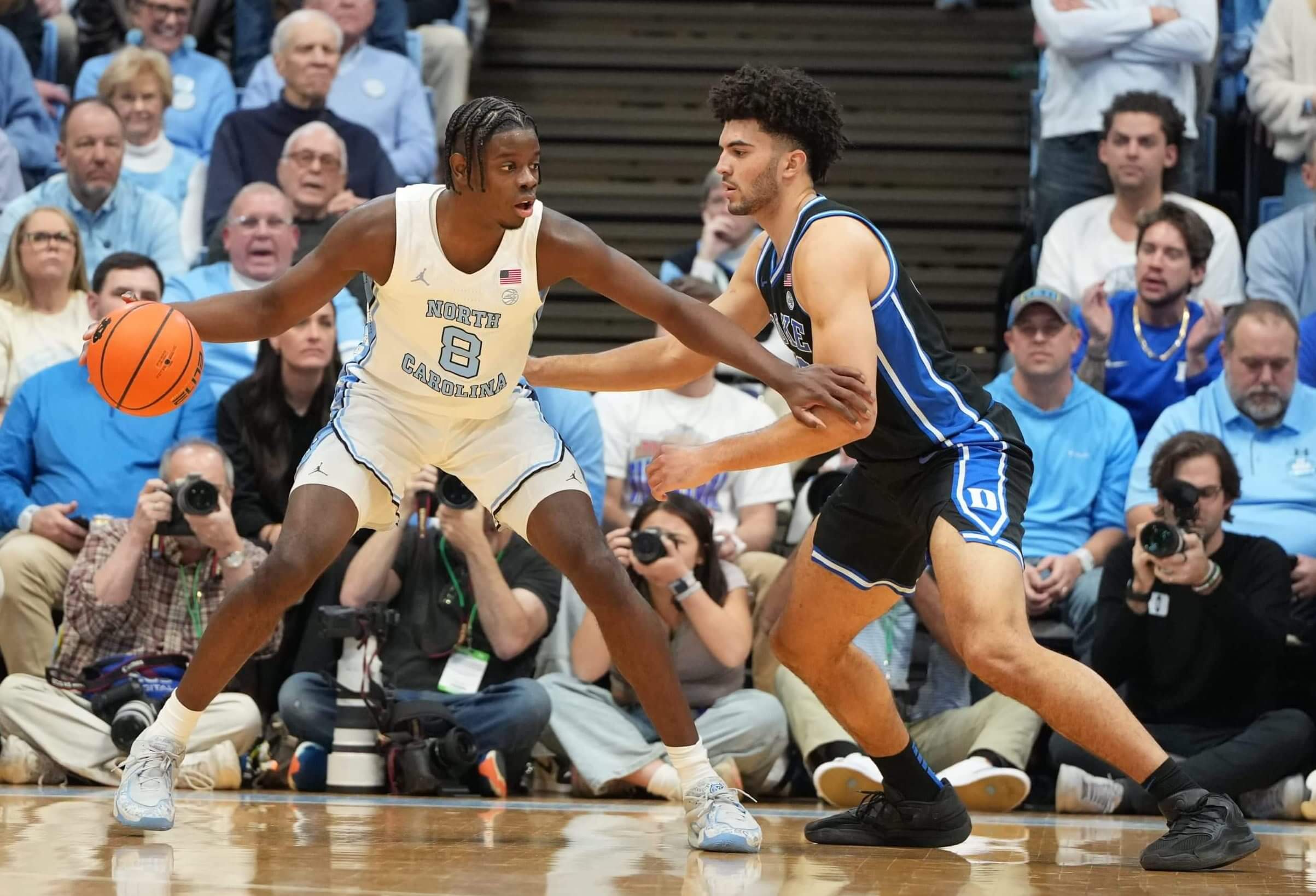
If the Wizards get the No. 3 pick in the 2026 NBA Draft, it could be a tough choice between North Carolina’s Caleb Wilson and Duke’s Cameron Boozer. Bob Donnan/ Imagn Images
Scenario No. 3: House standing on 18; Wizards showing 10
Pick: Third (odds: 12.7 percent)
Candidates: Boozer, Caleb Wilson
Aldridge: Having Davis on the roster should not dissuade Washington from taking either Boozer or Wilson as potential long-term solutions at the four. Wilson’s explosiveness and length has had his most ardent supporters comparing him to Kevin Garnett. I’d take the KG talk down a notch, but Wilson does put me in mind of a young and healthy Antonio McDyess, the second pick in the 1995 draft, who played 15 NBA seasons. Before knee injuries robbed him of much of his explosiveness, Dice was trying to dunk everything.
Wilson’s shot needs work, and we’ll find out if he’s really 6-10 when he’s measured in Chicago, but his hops and long arms allow him to play bigger. He and Young would be a stupid-fun alley-oop tandem.
Robbins: I agree with David about not letting Davis’ presence prevent Washington from selecting a power forward. Having said that, choosing between Boozer or Wilson would be a fascinating choice for the Wizards.
David alluded to the differences between the two prospects as shooters. Boozer went 54 of 138 (39.1 percent) from deep, while Wilson went 7 of 27 (25.9 percent), so Boozer is clearly far, far, far ahead of Wilson in that important aspect of the game. But here is where the rest of Washington’s roster comes into play. The Wizards do have highly capable 3-point shooters already on the team: Trae Young, Tre Johnson, George and Bub Carrington. With that 3-point shooting already in house, the Wizards could withstand adding someone who is a non-shooter and attempt to develop that aspect of his game. If the Wizards had little to no 3-point shooting on their roster already, then Boozer’s 3-point shooting would be even more important.
Also, would the Wizards consider Darius Acuff Jr. here? Maybe.
Scenario No. 4: House standing on 20; Wizards showing 12
Pick: Fourth (odds: 12.0 percent)
Candidates: Wilson, Darius Acuff Jr.
Robbins: As tantalizing as Wilson would be here, I think the Wizards would have to consider Acuff in this scenario, especially if he projects to be on par with the Philadelphia 76ers’ Tyrese Maxey, an All-Star whom he has drawn comparisons to because of his scoring ability and height.
Aldridge: I agree. Wilson is enticing. But Acuff is a certifiable, three-level bucket. He shot 44 percent(!) on 3s at Arkansas last season, and 81 percent from the line. Plus, I trust pedigrees. John Calipari has consistently produced elite NBA-level guards at his college stops: Shai Gilgeous-Alexander, Maxey, Devin Booker, Jamal Murray, Derrick Rose, De’Aaron Fox and Wall, among others. And Calipari says Acuff is as good as any of them. As with Davis and the potential power forwards at the top of this draft, having a veteran — in this case, Young — playing in front of Acuff for a year or two would not matter at all, to me. Take the talent!
Scenario No. 5: House showing Ace; Insurance?
Pick: Fifth (odds: 47.9 percent)
Candidates: Acuff, Kingston Flemings, Keaton Wagler
Aldridge: Flemings was very, very good for Kelvin Sampson at Houston, and Sampson’s program has produced very solid NBA players for years. The 6-6 Wagler came out of nowhere on college ranking boards before this season to lead the Illini to the Final Four, as a First Team All-Big 10 selection. And the Wizards look like they’ve just hit on a Brad Underwood freshman from Champaign in Riley.
Still, if I were Washington, and picking fifth, I’d at least think about moving the pick, as the Wizards did in 2004, when they traded the fifth pick to the Mavericks in a multi-player deal that brought Antawn Jamison to Washington. Teams that want/need point guards would likely try to get in here to take either Acuff or Flemings, if they’re still on the board.
One team that comes to mind is the Pelicans, who don’t have a 2026 first after trading it last year in a deal with the Hawks to move up 10 spots in order to take Maryland’s Derik Queen. The Pels don’t need a point guard after taking Jeremiah Fears earlier in the ‘25 draft, but they need help at other spots, whether or not they hold onto Williamson.
So, why not inquire about Troy Murphy III, who’ll be 26 on opening night, is coming off a terrific season (21.5 points, 5.7 rebounds, 3.8 assists, 38 percent on 3s) and is on a wildly good contract (three years left at an average $29 million/year through 2028-29)? It would likely cost Washington one of George, Riley or Coulibaly, along with the pick, but a starting five with a Murphy-Davis-Sarr frontcourt, with Young and Johnson in the backcourt, would be pretty intriguing.
Standing pat, though, would make sense, too. This is where finishing with the worst record this year really helps the Wizards. In this draft, at five, you can still potentially hit on a real impact player.
Robbins: I believe the Wizards, at this moment, have Acuff ranked as a top-five prospect in this draft. Assuming that Dybantsa, Peterson, Boozer and Wilson are all off the board here, I think the Wizards would take him given what the front office knows at this moment, before medicals and interviews.
Having said that, I think the Wizards would invite as many other prospects to Washington as possible to see, first, if anyone knocks their socks off and, two, to gather intel for future drafts.
As for David’s idea about considering trading the pick, I would say, yes, you at least listen to offers.
But I think whoever the team picks at No. 5 has a strong chance to be the most talented player on the roster other than Davis or Young. You don’t pass up that opportunity. The Wizards tore down their roster and tanked for a reason, and I think that reason is they believe their draft pick here — even at No. 5 — would be the most talented young player on their team.