
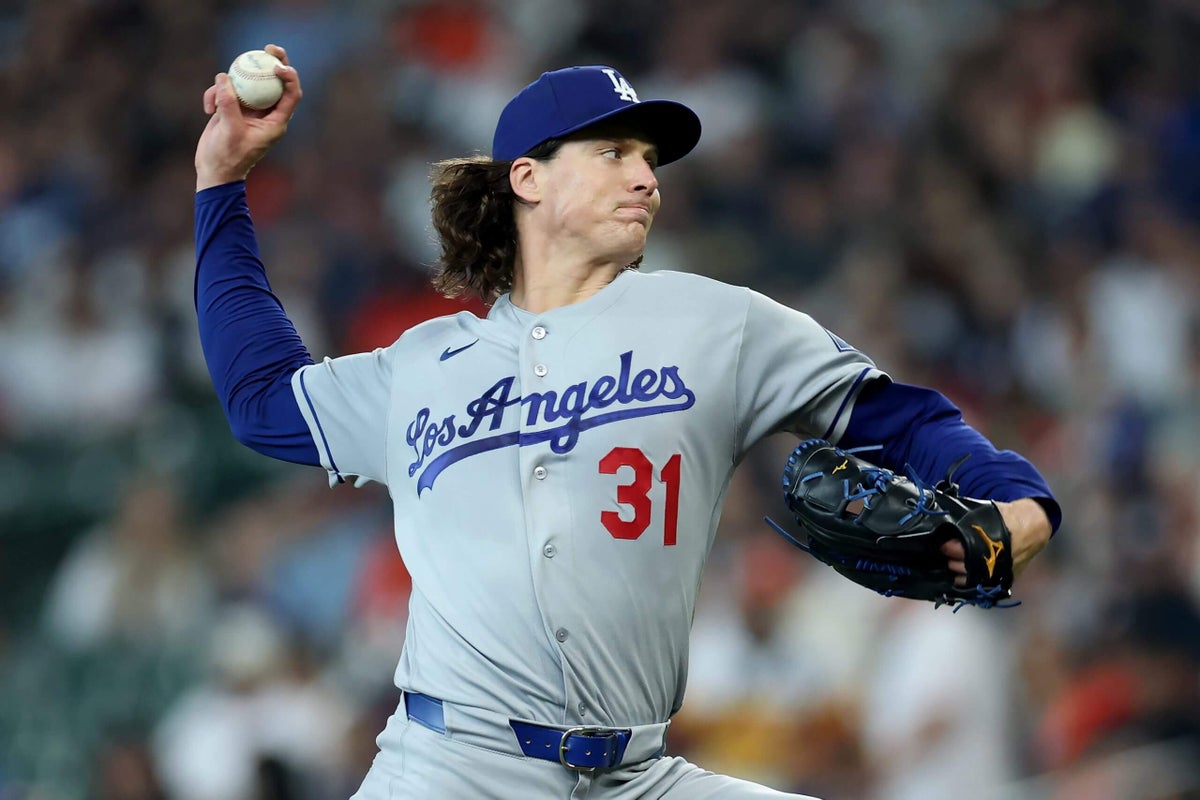
HOUSTON — Tyler Glasnow echoed the thoughts of the Los Angeles Dodgers when he bent over on the Daikin Park mound and yelled out an expletive, an ominous sign for an outing that wound up lasting just 19 pitches.
As it turns out, both he and the Dodgers avoided the worst.
Glasnow, who suffers from near-annual back spasms, felt his back “gave out” during a warmup toss before the second inning of the Dodgers’ 12-2 blowout win over the Houston Astros on Wednesday. But he is not expected to go on the injured list, despite manager Dave Roberts saying that he will have a precautionary MRI once the club returns to Los Angeles.
“Being tall, I guess,” the 6-foot-8 Glasnow said. “I get it a couple times a year. … But it’s not too serious.”
Glasnow did not make much of a case to stay in the game once his back flared up, walking off with head athletic trainer Thomas Albert after a quick conference.
This is not new. Glasnow skipped a start in Baltimore last September with what he called “tall guy back,” but returned on eight days’ rest to throw seven no-hit innings against the Colorado Rockies. He also missed the minimum 15 days on the IL in 2024 when his back flared up while playing catch. Each recurrence has prompted an MRI, which has revealed no structural damage to his back.
So the Dodgers exhaled. They got eight innings of one-run ball out of their bullpen ahead of an off day. Their dormant offense erupted for its highest run total in 11 days, backed by Andy Pages’ three home runs. The Dodgers salvaged a .500 road trip despite getting little from their lineup and having much of their roster deal with a lingering illness.
Glasnow, despite the scare, appears fine.
“I think today, given the situation with Tyler, it couldn’t have been a better outcome,” Roberts said.
Since spring training, Roberts and the organization have been bullish in their praise of Glasnow, confident not just that he was past his extensive list of physical maladies but that he would take a step forward mentally after a formative and successful experience last postseason. Glasnow looked as good as he ever has through his first six starts of the season, tinkering with some of his pitch usage while sounding unencumbered by his body and his mechanics.
The organization wants to keep that momentum going. Despite an upcoming roster crunch with the rotation with Blake Snell due back as soon as next week, the Dodgers don’t want to put Glasnow on ice.
So far, their rotation has thrived, even at less than full strength. Entering Wednesday, the club’s 2.96 ERA was the second-best in the sport, with Shohei Ohtani (0.97) and Justin Wrobleski (1.25) pacing all qualified starters and Glasnow (2.72) and Yoshinobu Yamamoto (3.09) off to strong starts. They have accomplished this without Snell, who missed the start of the year with lingering shoulder discomfort.
Snell will make what is expected to be his final rehab start Saturday.
Pending health, the Dodgers could be back at full strength in their rotation just like they were when Snell, Yamamoto, Ohtani and Glasnow combined to shoulder 113 of the 165 innings the Dodgers needed to repeat as World Series champions last fall.
Of course, having them all simultaneously healthy matters less in May than it does in October.
The Dodgers’ rotation this weekend against Atlanta fittingly features the three pitchers who could be bumped out of the mix in Snell’s place. A clean MRI for Glasnow would mean that this weekend is one final audition for Wrobleski, Emmet Sheehan and Roki Sasaki to stick around.
Wrobleski has pitched the best by far, but has experience in the bullpen that would make shifting roles a simple move. Sheehan has flashed extreme upside in the majors, but has not looked right at all in 2026; he has insisted that his in-game dips in velocity are due to mechanics, not an injury. Either way, his ERA is 5.23.
Then there’s Sasaki, who has a 5.97 ERA that is the worst of the three but has shown tangible growth over his last two starts. It has taken more than a year since arriving from Japan for the Dodgers to build enough trust and a foundation to implement changes, including adding a new variation of a harder splitter to go with his signature forkball. Sending him to the minors risks halting that progress.
“There’s a lot of different ways we can go,” Roberts said Wednesday morning of the organization’s looming decision.