
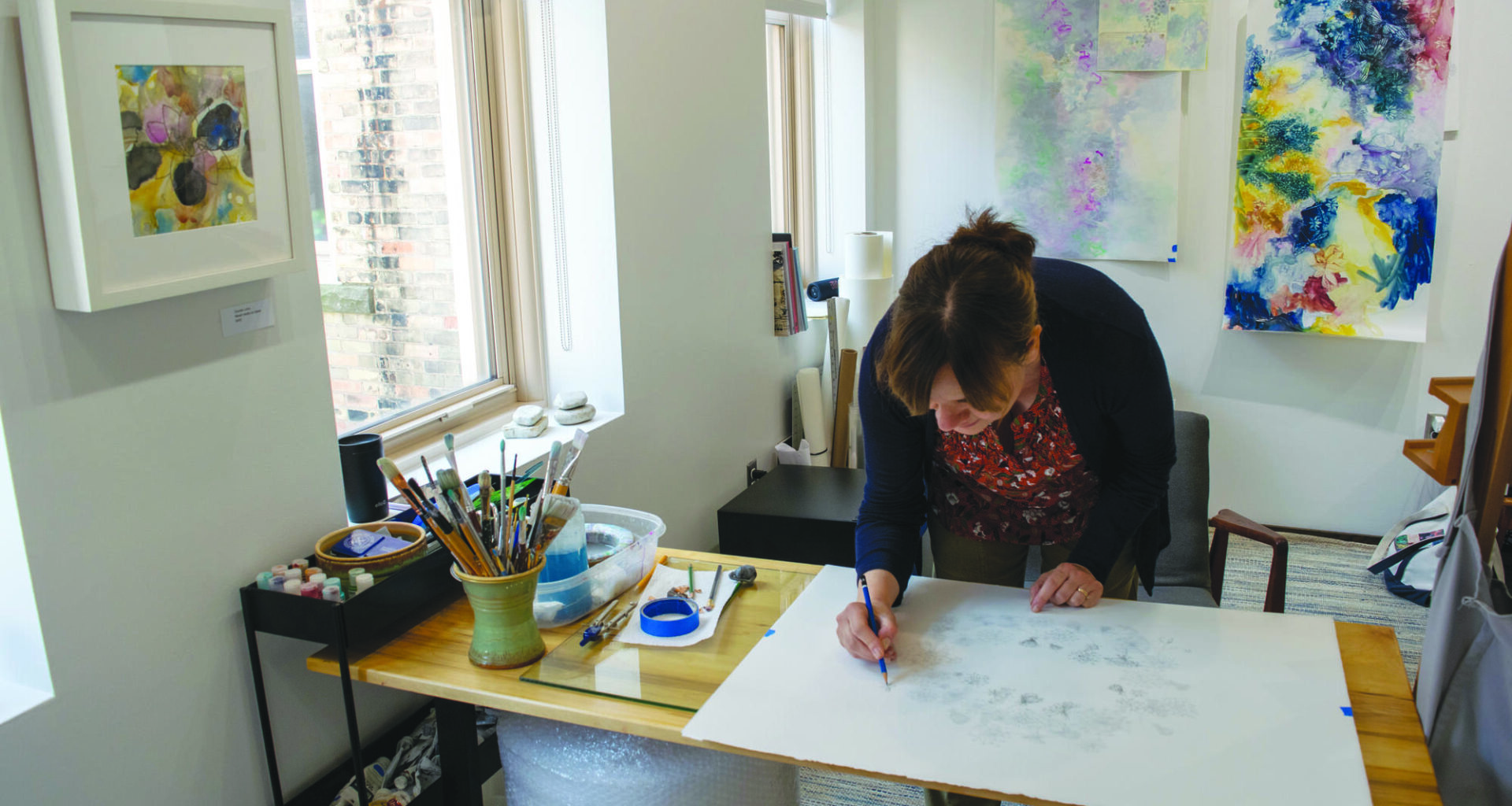
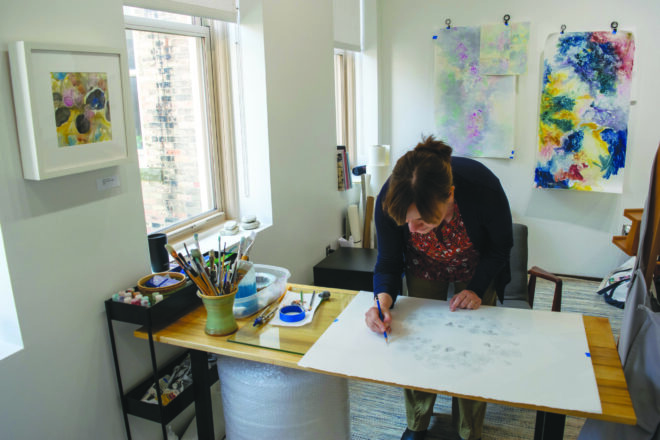
Shan Bryan-Hanson in her gallery. File photo by Remy Carmichael.
A tour of local artists’ workspaces
“I’ve worked in all kinds of spaces – small, large, home, garage, corner of kitchen and university studios,” read an email from Shan Bryan-Hanson, who worked as a gallery curator and art instructor at St. Norbert College in DePere for nearly 20 years until the school cut back its art program.
Bryan-Hanson used this opportunity to open an art gallery and studio in the Fairfield Building in downtown Sturgeon Bay in May 2024, before closing it in October 2025 and moving her studio to a smaller space in her Sturgeon Bay home. Trying to paint while running a business and responding to customers didn’t work for her, so she welcomed the venue change.
“This is not my first time in a small studio, and returning to one has reminded me that organization really makes a difference,” she wrote in her illuminating Substack column, Artist Sanctuary, which combines art insights with practical tips, such as organizing a small studio space.
For example, Bryan-Hanson says magnetic hooks are a game-changer for organizing tubes of paint. She keeps them on her paint cart, which is on wheels, like most of the furniture in studios this writer visited.
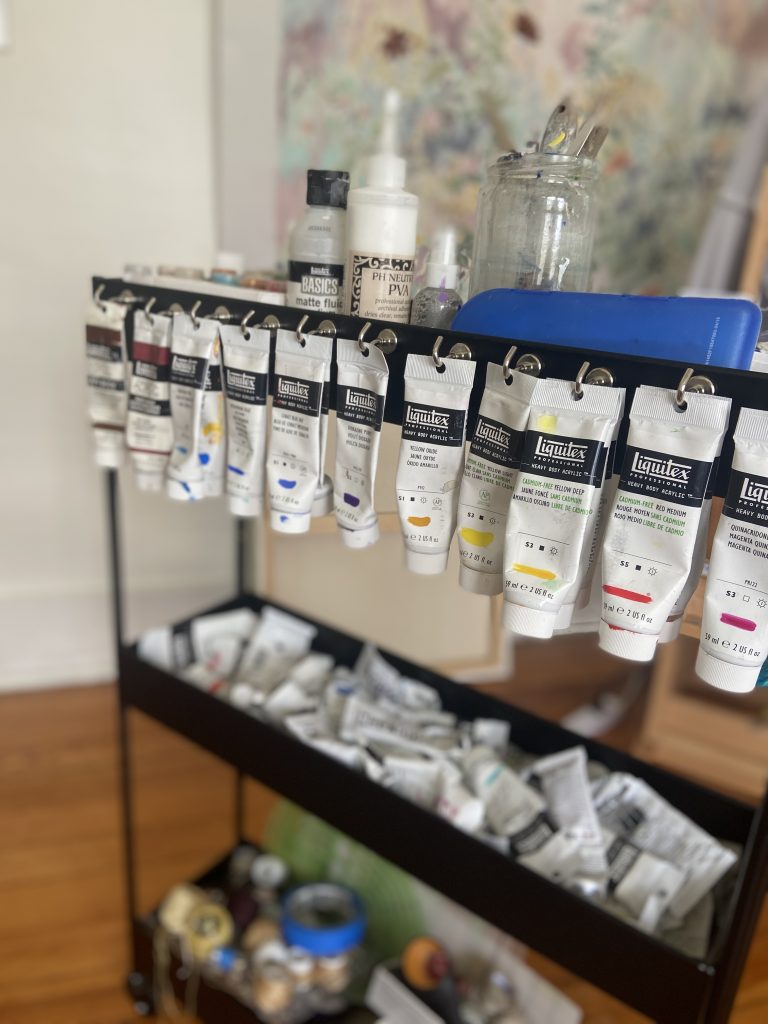 Painter Shan Bryan-Hanson hangs her supplies on magnetic hooks. Photo by Tom Groenfeldt.
She also encourages students to find a space to work on their art, even if it’s just a corner of a table or desk.
“Get rid of roadblocks,” she said. “Remove any obstacles. The biggest obstruction for most artists is the time it takes to set things up and put them away. Do what you can to make it work.”
A year working in a gallery-studio space open to the public made Bryan-Hanson realize she’d rather work privately.
“I really prefer to be able to close myself off,” she said. “Some people thrive in one environment, some can handle both. Learn what works for you.”
Her studio in the Fairfield Building had huge north-facing windows, providing the muted light prized by painters through the ages. Marc Anderson, a landscape painter whose space is around the corner across Michigan Street on 2nd Avenue, occupies a former chiropractic and wellness center where he has constructed a studio with track lighting.
“These are all on a dimmer switch, so I can pop it up or down, and they’re all high-CRI [color rendering index, a measure of how accurately artificial light mimics daylight],” Anderson said. “They’ve got a switch on them so you can [change] the temperature. It’s taken some experimentation.”
He does like natural light. When he had a three-bedroom apartment above a bar in western Wisconsin to himself, any bedroom could have been a studio. But the living room had north-facing windows and overlooked downtown.
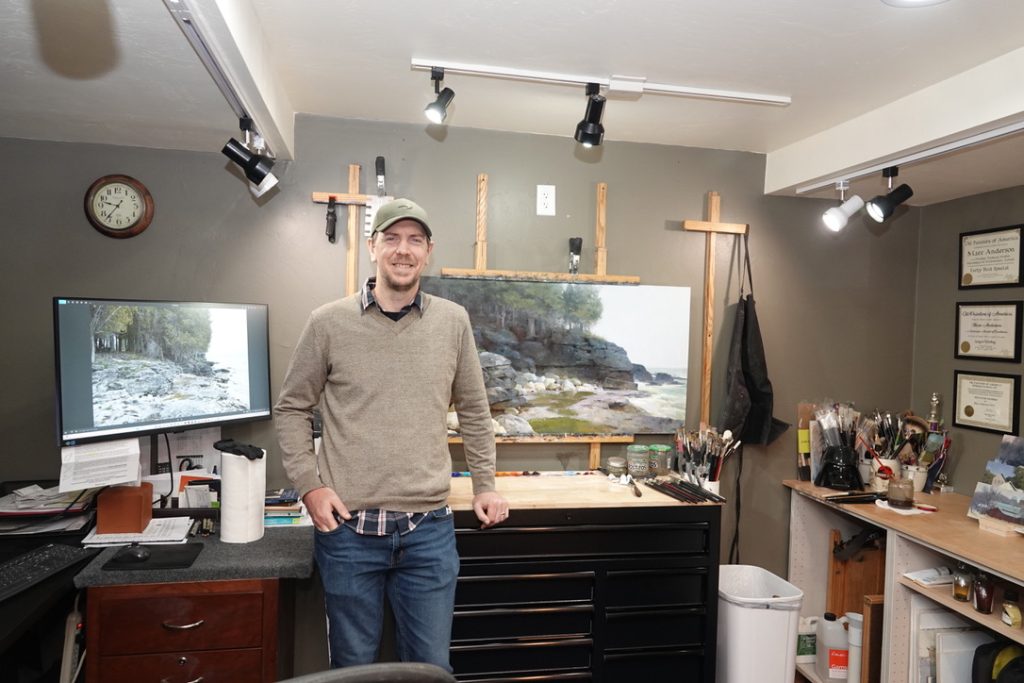 Marc Anderson in the studio. Photo by Tom Groenfeldt.
“A bachelor in my 20s? Yeah, of course, I am going to make the living room this giant studio,” Anderson said. “That was pretty awesome.”
Now, his plein air painting practice gives him plenty of natural light. Back in the studio, a large computer monitor sits next to his easel, displaying a photo of the Cave Point scene he was painting. Canisters of brushes occupied the edge of his palette. Most are half-inch or smaller, including a “calmer” with different length bristles to create texture, “like an old chewed up brush,” Anderson said. “It’s important to have a wide variety of synthetic brushes of all different shapes and sizes.” He keeps the chewed-up brushes, too.
He is still adjusting to a new palette he built to replace a little end table.
“I wanted something a little bigger and something with drawers,” he said. “The problem is this palette is a little bit lighter than the one I had before, so it’s harder to see the color that I’m mixing.”
Anderson’s easel is mounted on the wall, a trick he learned from another artist.
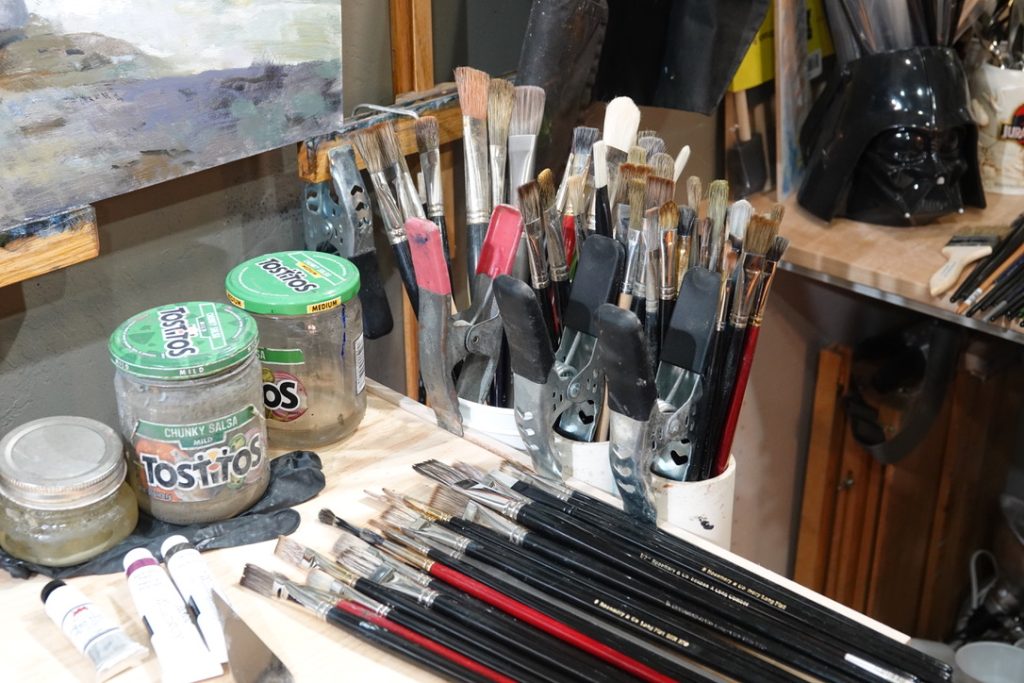 A collection of brushes in Marc Anderson’s studio. Photo by Tom Groenfeldt.
“I went home and built this because my last studio was a smaller room; floor space was at a premium,” he said. “I’ve just grown accustomed to having that on the wall, and it’s pretty flexible for whatever size you want to work.”
While Anderson keeps his space neat and orderly for his creative work, glass artist Laurel Grey believes in clutter – most of it highly organized so she can see her inventory. It includes driftwood pieces, treasures from area second-hand shops, paints, glass and colored ground glass beads.
“The studio doesn’t look particularly pretty because it’s a real hodgepodge, but it’s a working studio,” Grey said.
Her studio workshop is in the former Door County Economic Development Corporation business center next to Wulf Brothers on State Highway 42/57, just south of the Bayview Bridge. The center was sold to Lawe Street Sanctuary, LLC of Appleton, which has said it will continue to operate it as a multi-tenant building.
Inside Grey’s workshop are tables as large as 4 by 8 feet that she built herself, with wheels or glides so they can be moved around easily. Each has at least one fully stocked paper towel holder, and most have $10 magnetic bars from Harbor Freight screwed in place to hold tools. Wastebaskets are conveniently abundant.
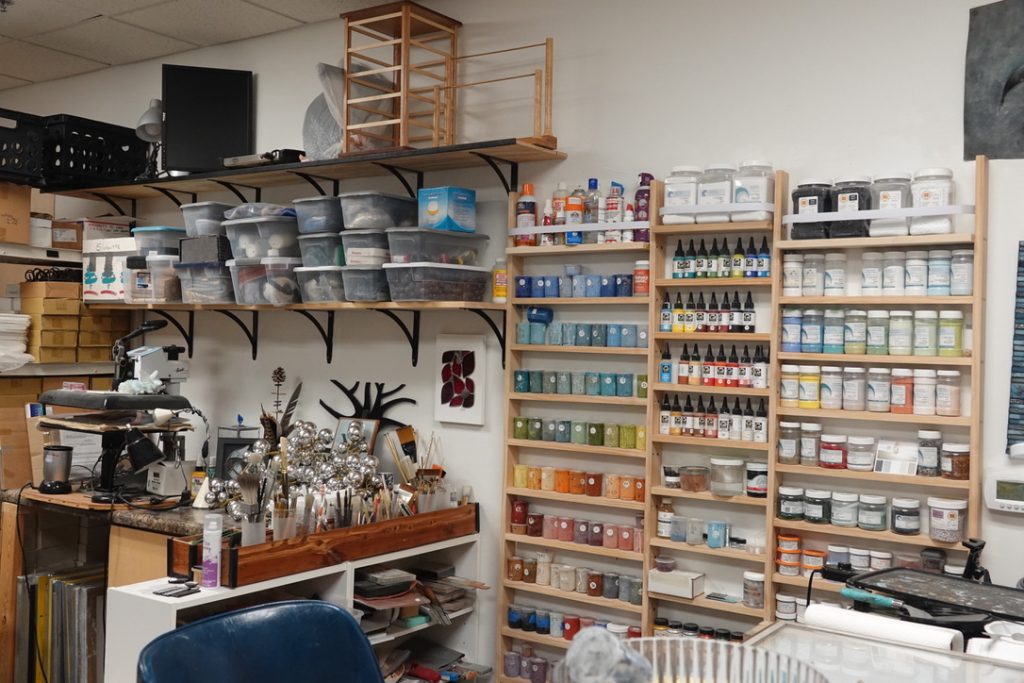 Inside Laurel Grey’s studio. Photo by Tom Groenfeldt.
“I believe in not having to search and walk too far for everything when you’re working,” Grey said. “I have scissors and paper towel holders at every station, and garbage cans everywhere.”
Two of Grey’s work tables have storm-door tops with fluorescent lights and diffusion, turning them into oversized light tables. A solid old dresser from the ReStore provides storage for her molds, and a cement-board top makes it a handy sideboard for her kiln.
Her computer-programmable glass cutter turns out the intricate leaves she makes into dangling strings that scatter rays of light and respond to the slightest breeze. A pancake griddle provides fast, high heat when she wants to dry paint on glass and see if it needs to be painted and kiln-fired again.
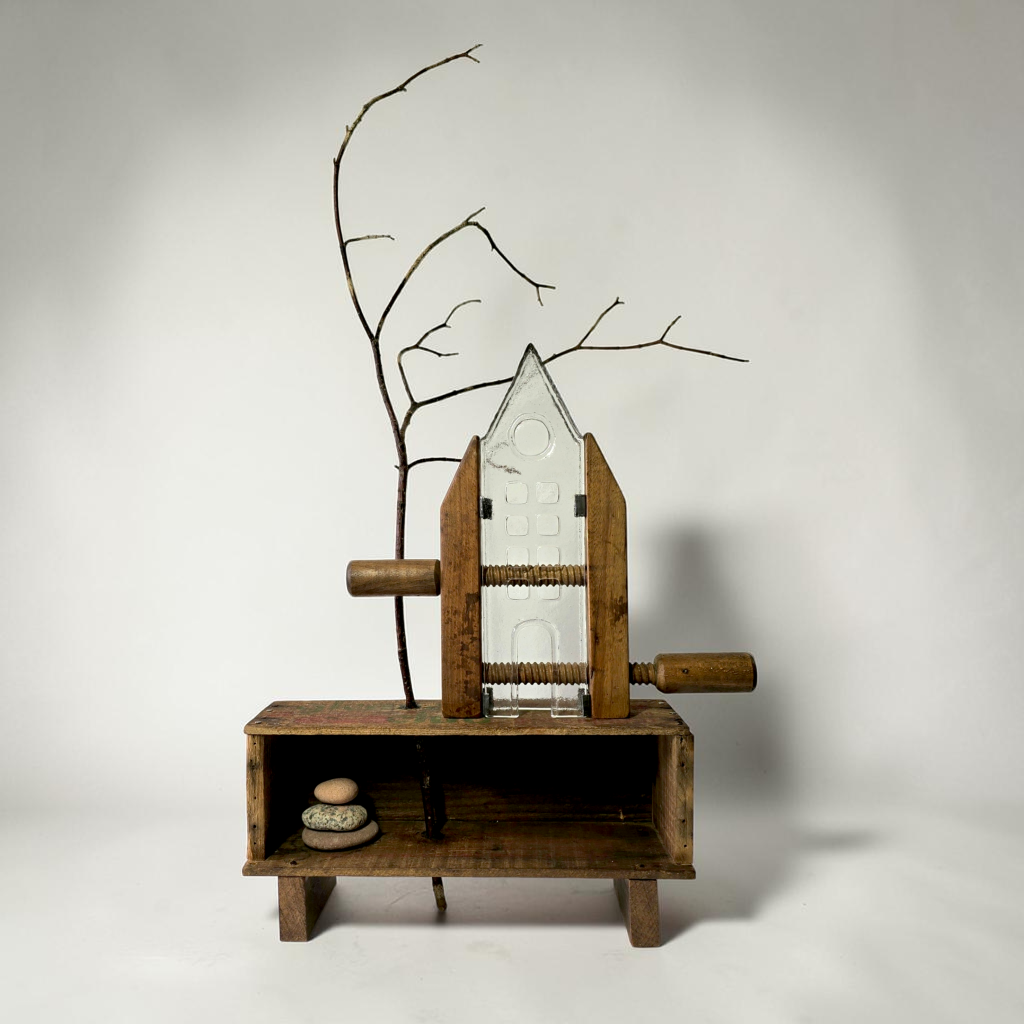 “Clamp House,” multimedia art by Laurel Grey, made with wood clamps and glass. Submitted.
Under the tables, large plastic bins hold some substantial driftwood pieces waiting to be used.
“I created space under the tables because I don’t like too much being over my head,” Grey said. “I have had things fall on me.”
Plastic shoe hangers provide more storage.
“It’s a great way to organize, and you can see everything,” Grey said.
Shallow four-inch shelves holding paint and ground glass provide the same advantage – she can see what she has at a glance.
With her supplies organized, Grey can come up with a concept and usually find the materials to make it happen – “and, conversely, I’m often able to generate ideas from stuff I have,” she said.
Graphic artist and printmaker Dale Vanden Houten would understand. In Two Bridges Gallery on 3rd Avenue, he has been puzzling over some 14-inch beams left over from a construction project at his Carlsville home. He’s planning to affix some abstract design composed of several large letters he printed on his etching press, then cut out in little squares or rectangles.
“It becomes abstract because you lose the meaning of the letters, which is exactly the point,” Vanden Houten said.
He’s been looking at pieces of his design for several days, trying to make it work. Like Grey, he has his work tables on wheels.
“That way, no matter what I’m doing – if I’m working with large sheets of paper or large plates – I can move whatever tables I need around,” he said. “So it’s really like quadrupling your space.”
Meanwhile, in her studio behind the former SŌMI Gallery on 3rd Avenue, multidisciplinary Melissa Resch is creating items to sell at The Hardy Gallery. One popular item is a print of summer corn.
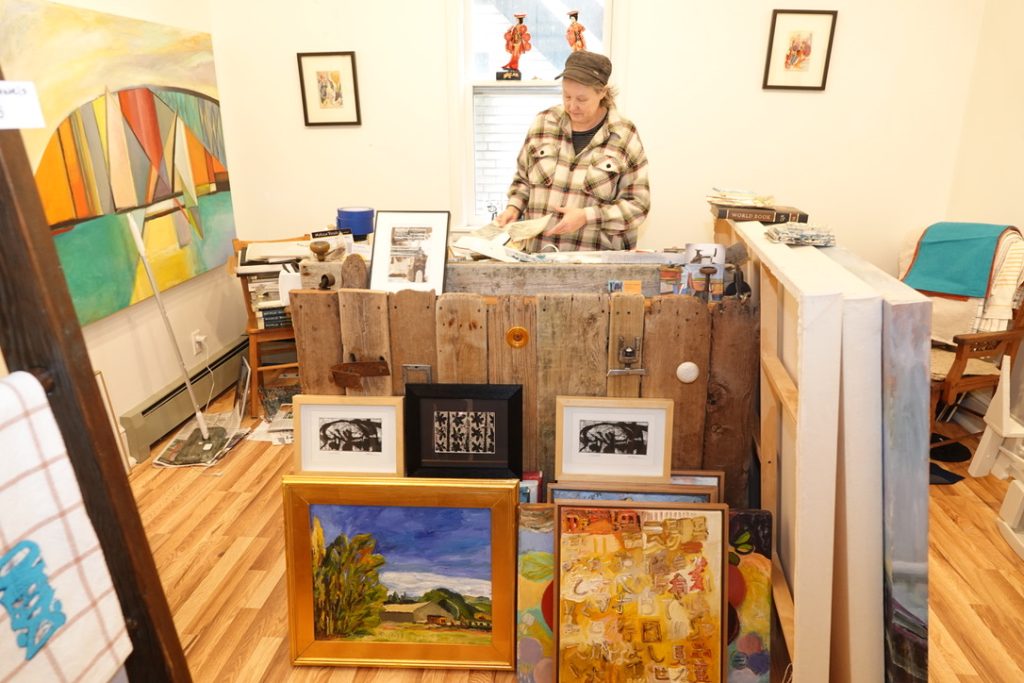 Melissa Resch in the studio. Photo by Tom Groenfeldt.
“It took a long time to do the original because I did five layers of color on every single kernel,” she said.
For the Hardy shop, Resch will be selling reproduction prints. The often-overlooked shop will also feature original merchandise from Liz Butler and Mary Blichmann, along with a rack of prints and works on paper from a variety of Door County artists.
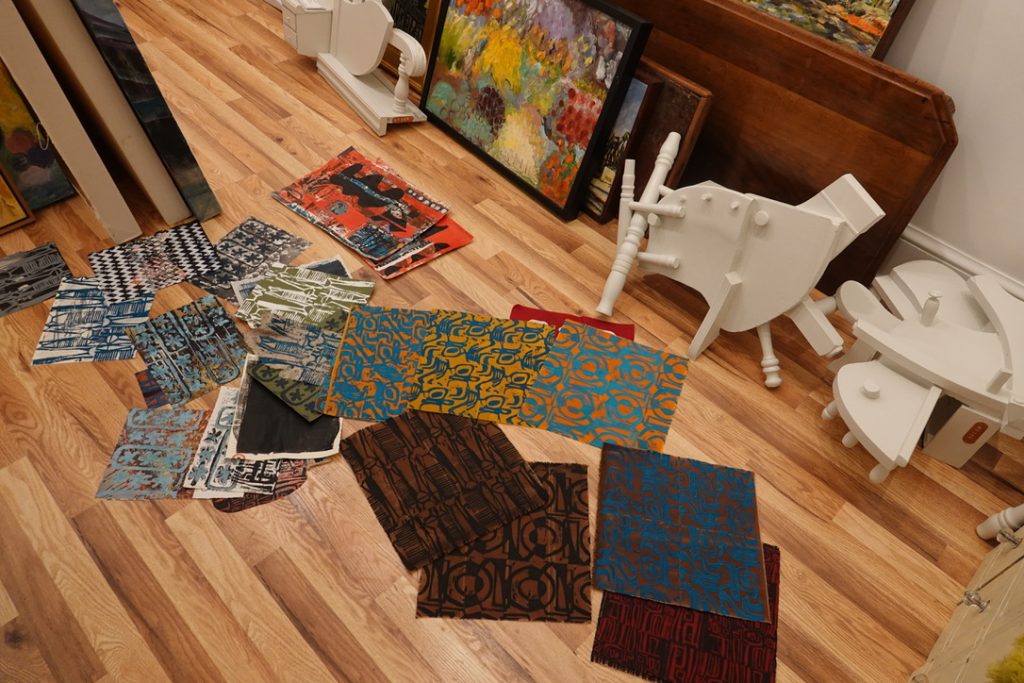 Collage elements scattered across Melissa Resch’s studio. Photo by Tom Groenfeldt.
Resch’s studio holds materials for making collages, two sets of World Book Encyclopedias for additional imagery and a sewing machine to put the pieces together, plus multiple lamps awaiting creative new shades. Resch paints in the kitchen of her apartment, the only room without carpet.
“In my front porch, I’ve got my tools and all the wood that I’ve collected,” Resch said. “As soon as it’s warm enough during the day, I’ll go out and start working.”