
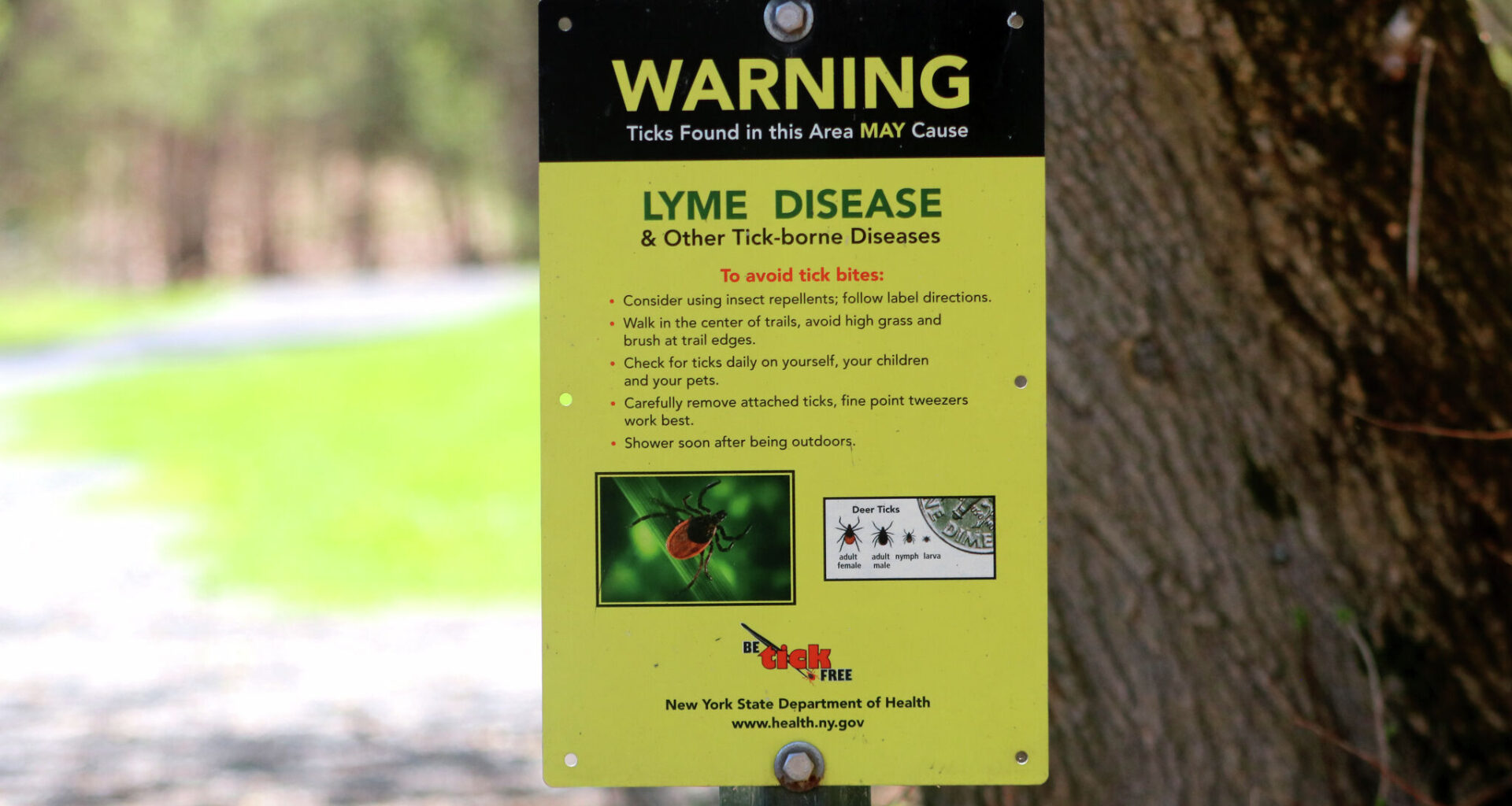
A Lyme disease warning sign is posted in Peebles Island State Park in Waterford in April.
Tyler A. McNeil/Times Union
The rate of emergency room visits for tick bites in the northeastern United States has surged to its highest level in the last decade, according to the Centers for Disease Control and Prevention.

Hospitals in the tick-heavy region from Maine to Virginia reported more emergency room visits for tick bites this April than in any April since 2017, when the agency began keeping track. The spike was especially pronounced in mid-April, when the number of people seeking emergency care for tick bites was about double that of previous years.
Article continues below this ad
The data, collected from a federal disease surveillance program, underscore what scientists have long feared: tick seasons may be starting earlier and becoming more intense, exposing more people to Lyme disease and other dangerous pathogens. While tick activity doesn’t typically peak until May, the data indicate that “ticks are out and people are getting bitten,” said Alison Hinckley, a CDC Lyme disease expert.
Early indicators suggest this year will be particularly severe. Researchers at Upstate Medical University’s Tick Testing Laboratory in Syracuse are predicting a heavy tick season based on the volume of tick submissions they have already received from across New York.
Most ticks that attach to human skin can be removed with a standard pair of tweezers. Doctors advise anyone who develops a rash or fever within several days of removing a tick to seek medical care. Because the CDC data broadly categorizes emergency care for tick bites, it is impossible to say exactly what type of care is being sought.
Make the Times Union a Preferred Source on Google to see more of our journalism when you search.
Add Preferred Source
More: How to protect yourself from ticks
Article continues below this ad
There is “probably no typical” ER visit for a tick bite, said Dr. Arthur Gran of Troy Infectious Disease, a practice of St. Peter’s Health Partners Medical Associates. “If someone is going to an ER because there’s a tick stuck to their arm, that’s kind of silly.”
Because not every bite results in an infection, it will take time for medical experts to know whether there’s an actual surge in Lyme disease or other illnesses that can be linked to the rise in ER visits. But Dr. Danielle Wales, a primary care physician in Albany Medical Center’s Latham office, said the increase in ER visits related to ticks could be tied in part to anaplasmosis and babesiosis, a disease sometimes referred to as “American malaria.”
“Certain people can get pretty sick from those two illnesses,” Wales said. “It makes sense that they might show up at the ER.”
Wales added that some people may be going to the ER for help determining whether the skin redness that can develop after removing a tick is Lyme or just an allergy. While the bullseye rash is a hallmark of Lyme disease, it can sometimes be mistaken for irritation caused by an allergy to tick saliva.
Article continues below this ad
Doctors said emergency care should generally be reserved for patients exhibiting the most severe symptoms of tick-borne illnesses, such as shaking chills or a fever above 102 degrees. Gran recommended visiting an urgent care clinic or primary care provider within 48 hours of removing an engorged tick, which can be treated with a dose of antibiotics, or if flu-like symptoms develop within about a week of a bite.
“If you remove a tick that is crawling around on your skin, dispose of it, check yourself and move on with your life,” he said. “If it’s not biting you, don’t worry about it. It will not make you sick.”
Within the Albany Med Health System, emergency departments have seen only a slight increase in tick-related visits, but overall, they are not seeing a large number of tick cases, according to spokesperson Melissa Mansfield. However, the system’s nine urgent care centers and primary care providers have handled significantly more cases, with nearly 300 tick-related visits already recorded as the peak season approaches.
Tick populations fluctuate throughout the year and are influenced by several factors. Climate change is widely believed to play a role, as ticks like warmer weather and milder winters. The availability of hosts such as deer and mice may also be a factor.
Article continues below this ad
Health experts urge people spending time outdoors to take precautions, including wearing protective clothing, using insect repellent and checking for ticks — even using a lint roller when possible. Unlike mosquitoes, ticks cannot bite through clothing. Parents should check children who have been playing outdoors.
So far this year, most ticks seen in the Northeast have been large adult ticks. But in the weeks and months ahead, smaller juvenile ticks known as nymphs will become more prevalent. Because they are harder to spot and can remain attached longer, nymphs pose a greater risk of infection. Wales said nymphs can be “as small as a period at the end of a sentence.”
Gran, who has been treating people with a range of severe tick-borne illnesses for more than a decade, said he has grown more careful about protecting against tick bites. After treating so many cases of tick-borne illnesses among “homebodies” and isolated people like those living in nursing homes, he has started preaching constant vigilance, regardless of how frequently a person exposes themselves to nature.
Article continues below this ad
“If you live in this part of the country, you are at risk,” he said.