
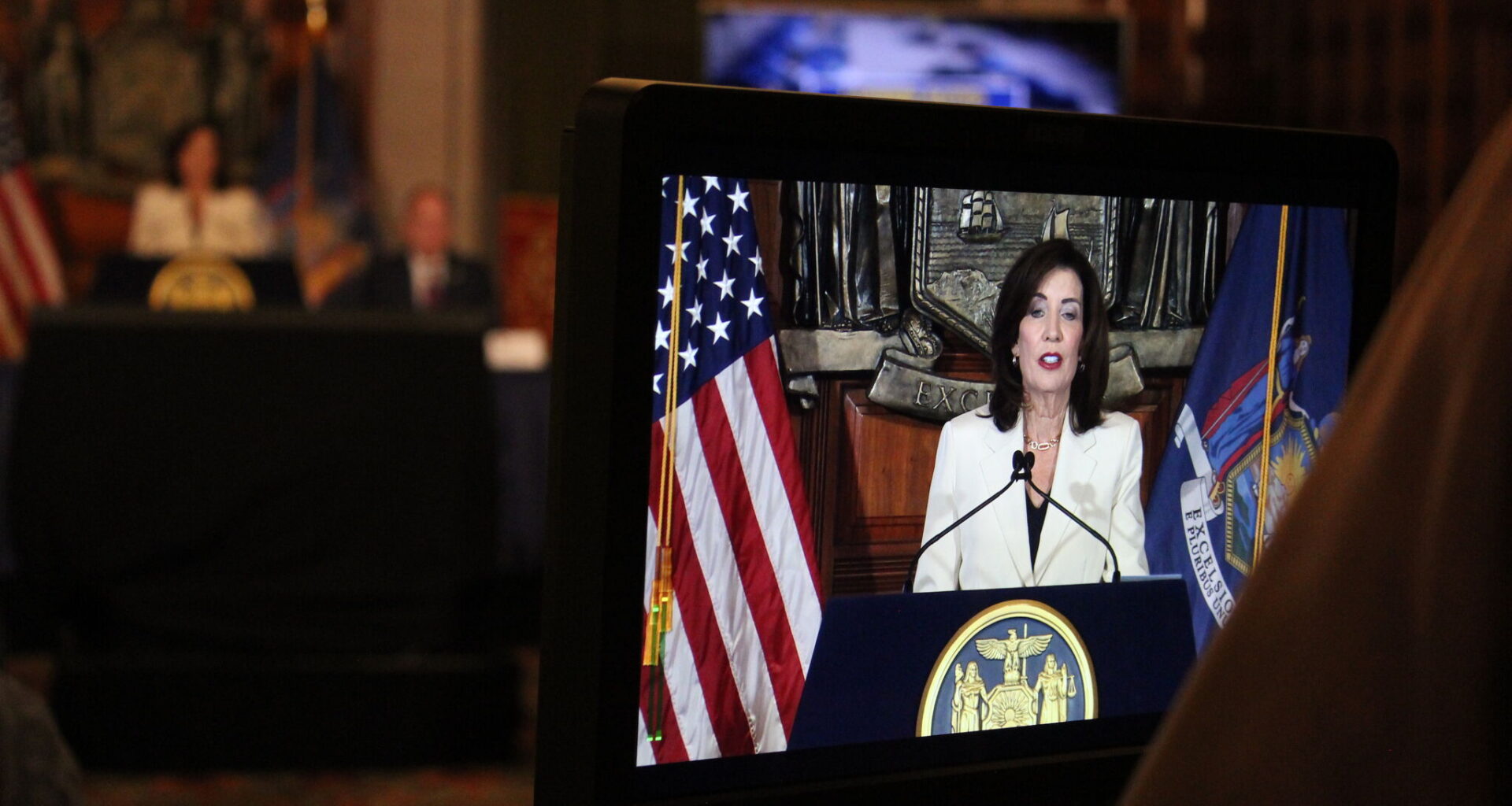
Gov. Kathy Hochul said Thursday that she had struck a deal on the state budget with Democrats in the state Legislature.
Timothy Fanning / Times Union
The budget deal announced by Hochul includes changes to the state law related to immigration policy, car insurance and energy mandates.
Timothy Fanning / Times Union
Democrats in the state Legislature, including Assembly Speaker Carl E. Heastie, disputed that there was a deal on the state budget Thursday.
Timothy Fanning / Times Union
State Senate Deputy Leader Michael Gianaris said several areas of the spending plan remain unresolved.
Will Waldron/Times Union
Senate Majority Leader Andrea Stewart-Cousins, left, Speaker Carl Heastie, center, and Gov. Kathy Hochul have been meeting several times a week to hammer out the state budget. (File photo)
Will Waldron/Times Union
Edward P. Ra, the Assembly minority leader, said the disagreement over a deal was evidence of dysfunction at the state Capitol.
Timothy Fanning / Times Union
ALBANY — Gov. Kathy Hochul said Thursday morning that she had reached a deal on a $268 billion state budget with Democrats in the state Legislature, who called that announcement “premature,” and claimed no such agreement had been struck.

“There’s no deal,” said Assembly Speaker Carl E. Heastie, a Democrat from the Bronx. “I just think it was very premature for the governor to make this announcement.”
Article continues below this ad
There are several areas of spending and policy that remain unresolved, Heastie said. That contradicted Hochul’s announcement that she and lawmakers had reached an agreement on the state’s spending plan.
“I’m very proud to announce that we’ve reached a general agreement for the fiscal year 2027 state budget,” Hochul said at the state Capitol, noting that the final details of the spending plan are still under discussion.
Hochul had outlined a broad agreement around several of her top policy priorities, including the cost of car insurance, regulatory roadblocks to housing development, immigration policy and a delay of the mandates governing the state’s strategy to combat climate change.
Make the Times Union a Preferred Source on Google to see more of our journalism when you search.
Add Preferred Source
Those four issues, according to Hochul and lawmakers, are what have held up a deal on the spending plan, which was due April 1.
Article continues below this ad
“I’m not going to mince the words, the negotiations were not easy,” Hochul said. “There were very substantive disagreements, tough choices and powerful special interests trying to influence the outcome.”
The budget as Hochul described it includes $14 billion more in spending than what the governor and lawmakers approved last year. That increase will not impact state income tax rates, which will remain flat under the new plan.
The purported deal instead seeks to lower current and future costs in a handful of other areas, including the price of car insurance and a spike in utility bills anticipated by the state as a result of its policies related to climate change.
Car insurance companies will no longer be able to use certain criteria to determine the cost of each driver’s individual policy. That includes the driver’s ZIP code, homeownership status, education level and occupation.
Article continues below this ad
Hochul and lawmakers have also decided to do away with the current framework for what’s called “flex rating,” in which car insurance companies can increase their rates by up to 5% without first seeking approval from state regulators.
New York’s definition of what’s considered a “serious injury” for victims of car crashes to seek damages for pain and suffering will also be narrowed by the deal.
That includes injuries that result in a fracture, permanent loss or limitations of parts of the body, dismemberment, loss of a fetus and disfigurement. It also includes any injury that prevents someone from their usual daily activities for at least 90 days.
The deal struck between Hochul and lawmakers will eliminate the last category. Victims would still be able to recoup other damages, like medical costs and lost wages.
Article continues below this ad
“We’re also putting a cap on the excess profits insurance companies bring in, and making sure that New Yorkers benefit from the savings our reforms create and not the insurance companies,” Hochul said. “It’s only fair.”
Hochul had faced fierce opposition from the New York State Trial Lawyers Association in changing the state’s definition of what’s considered a “serious injury” and other legal reforms she had proposed to limit high-value payouts to crash victims.
But Andrew Finkelstein, the group’s president, said they supported the changes included in the deal on how insurance companies set rates for different consumers.
“At the end of the day, Gov. Kathy Hochul recognized that predatory practices like redlining must end and that insurers must be held accountable,” Finkelstein said. “NYSTLA remains ready to work with the governor to advance reforms that protect consumers and hold insurers accountable.”
Article continues below this ad
Democrats in the state Legislature also struck a compromise with Hochul, she said, on changes to the state’s mandates to reduce carbon emissions first set by the Climate Leadership and Community Protection Act of 2019.
The law required the state to develop regulations by 2024 to rapidly reduce carbon emissions across the state. But that never happened.
Environmental advocates then took the state to court, where a judge ordered the Hochul administration to produce those regulations this year. That decision is on pause pending an appeal.
But Hochul has argued, in what environmental advocates have framed as a worst-case, unrealistic scenario, that forcing the state to enact those regulations would raise annual energy costs for households by thousands of dollars as soon as 2031.
Article continues below this ad
“Reality has been harsh,” Hochul said. “We can not meet the current timelines without driving energy costs higher. The facts bear that out and we can not let that happen.”
She had originally pushed to delay the regulations until then but, in the deal Hochul said she struck with lawmakers, they will now be due by 2028. The cost and environmental impact of that decision is unclear.
Those regulations will be required to plot a path for the state to reduce carbon emissions by at least 60% below 1990 levels by 2040.
“It’s a target that’s going to be set out in statute that we will have to promulgate regulations to achieve in 2028,” said Brian Mahanna, counsel to the governor.
Article continues below this ad
The deal also includes $1 billion in direct assistance to New Yorkers to help offset the cost of energy, Hochul said, but she did not have details on the amounts of those payments or who would be eligible.
The agreement also includes a new package of legal protections for noncitizens from federal immigration enforcement and measures aimed at U.S. Immigration and Customers Enforcement officers.
“States like New York can and must be a guardrail from ICE overreach,” Hochul said.
Part of that package will ban what are called 287(g) agreements, where local law enforcement agencies can agree to assist ICE with detaining noncitizens and holding them in local correctional facilities.
Article continues below this ad
Federal immigration officers will also be prohibited from entering schools, libraries, community centers, polling sites and other unspecified “sensitive locations” without a judicial warrant, Hochul said.
The package also includes a measure that will allow lawsuits against ICE officers accused of violating someone’s constitutional rights, though Hochul did not say what that would entail.
Her announcement frustrated Democrats in the state Legislature, who said several policy issues and spending priorities are still up in the air.
“We’re still trying to figure out where some of these spending levels are going to go for a whole host of programs,” said state Senate Deputy Majority Leader Michael Gianaris.
Article continues below this ad
That means that, while Hochul said the final budget will include $268 billion in spending, that could change as discussions around the final details continue.
Hochul unveiled an executive budget proposal in January that included $6 billion more in spending than what she and lawmakers approved last year.
That was despite what her administration said was an expected $10 billion decrease in funding from the federal government. The Hochul administration has projected that strong income tax receipts will help bridge that gap.
But her plan became complicated weeks later when New York City Mayor Zohran Mamdani said the city’s budget, due at the end of June, faced a deficit of about $7 billion.
Article continues below this ad
Mamdani had pushed Hochul and Democrats in the state Legislature to authorize the city to raise its local tax rates on high-income earners and large corporations as a solution. Hochul opposed that plan.
She instead committed to including an additional $1.5 billion in aid for New York City in the final state budget. Mamdani continued to push for tax hikes.
That led to an agreement between Hochul and Mamdani to levy a new tax on second homes in New York City valued at more than $5 million. The Hochul administration has projected that it will generate about $500 million in new revenue for the city each year.
Mamdani and New York City Council Speaker Julie Menin are expected to resolve the rest of the city’s financial problems as part of discussions through the end of June.
Article continues below this ad
Details on how much aid will be distributed to other financially distressed cities across New York, including Albany, have not been revealed.
“We want to be very helpful to cities across New York like Buffalo,” Hochul said. “That’s why we’ve added additional money beyond what they’ve received in the past. I’m proud of that, and the numbers are still being finalized, but we’re going to do what we can to help out the city of Buffalo, as well as well as our other upstate (cities).”
Other areas of the state budget also remain unresolved.
That includes proposed pension reforms for certain state workers, potential changes around the formula used to calculate state aid for schools and assistance for municipalities statewide struggling with their own finances.
Article continues below this ad
Republicans were critical of the disconnect on a deal between Hochul and Democrats in the state Legislature, saying their disagreement over where the state budget stands demonstrated dysfunction at the state Capitol with their party in control of all three branches of state government.
“I just think we’ve gotten so far away from having responsible leadership of this state and caring about what it means to pass a budget on time,” said Assembly Minority Leader Edward P. Ra.
Deal or not, the state budget is on track to be the latest approved by lawmakers since 2010, when discussions stretched into the summer.
Article continues below this ad