
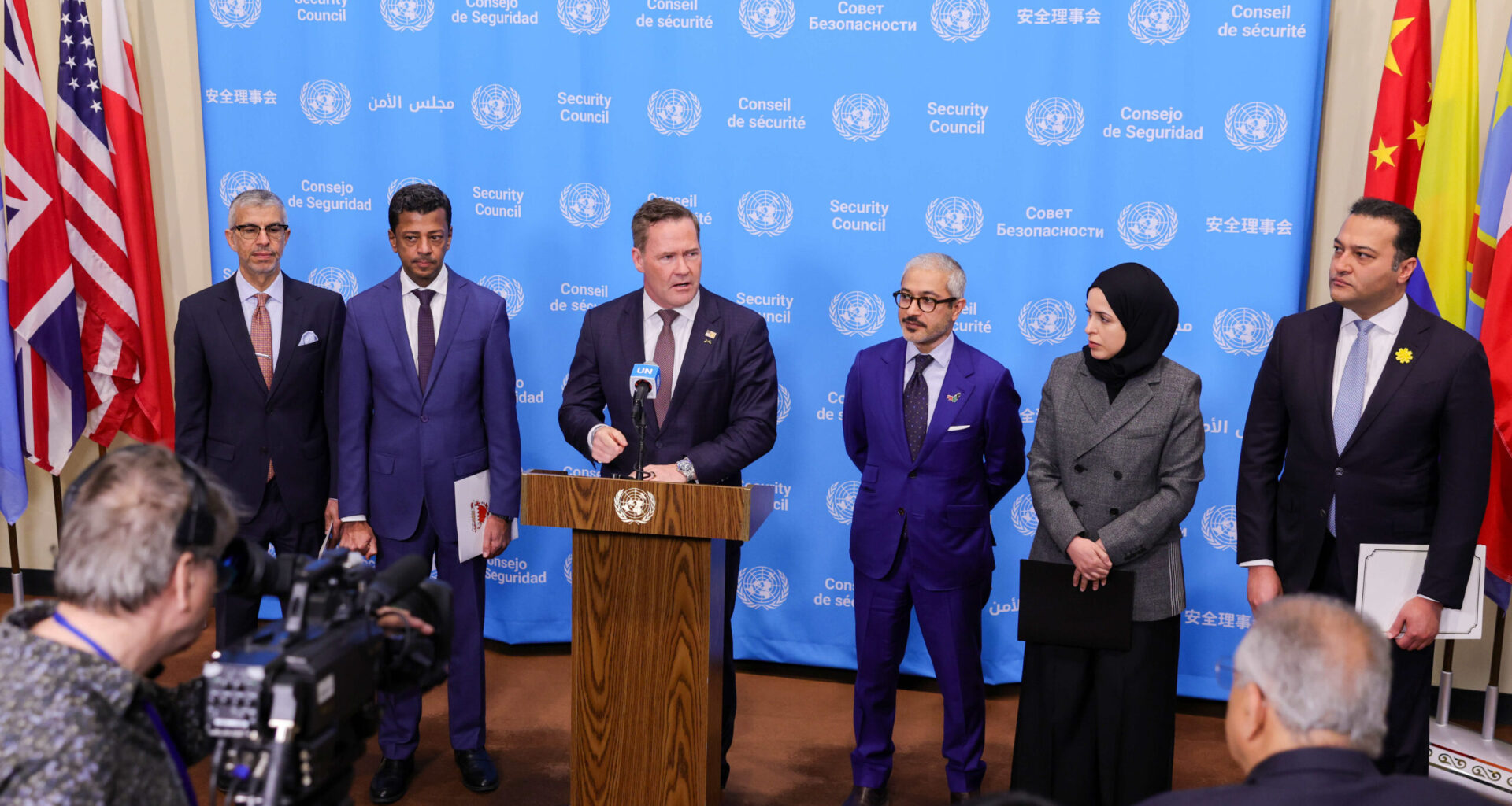
Ambassador Mike Waltz
U.S. Representative
New York, New York
AS DELIVERED
Thank you. It is my honor to stand with my fellow Ambassadors here, and our partners from the Gulf.
We drafted this resolution —together with Bahrain—and we have worked closely with the rest of our friends in the Gulf and throughout the UN, because we believe in some basic, fundamental principles: Namely, the freedom of navigation for the entire world’s economies.
That is what’s at stake here: nothing less than a cornerstone of worldwide stability and commerce.
And those who abuse it or seek to throw it out, are setting a very, very dangerous precedent and are frankly setting the stage to doom global trade.
We like to talk a lot about international law here at the UN.
Well, Iran’s indiscriminate mining and tolling efforts in the Strait of Hormuz are textbook violations of international law.
They violate the most basic law of the sea rules on navigational rights and freedoms, international law, their defiance of this Council’s very resolutions. I’ll list a few of the places: the United Nations Convention on the Law of the Sea, the Hague Convention 8, the Hague Convention 13, the ICJ international criminal court’s Corfu Channel judgment, the San Remo Manual. And of course Security Council Resolution 2817, adopted with an overwhelming number of co-sponsors, in fact 136 co-sponsors that Iran’s activities are now in violation of.
So what are we asking? What is this next evolution of 2817 asking of the international community? Well, it requires Iran to do some very simple, straightforward things:
Cease its attacks on commercial shipping;
Cease mining and remove its mines from an international waterway;
Cease tolling—charging illegal tolls in the Strait of Hormuz;
And allow the UN to move forward with humanitarian aid—lifesaving aid—through that international corridor.
It is really just that simple.
The problem is, just this week, Iran’s own state media announced that the regime has launched what it calls the “Persian Gulf Straits Authority” where it seeks to demand that all ship captains from international, commercial, civilian shipping, basically have to check in and pay a bribe, pay a toll in order to use these international waterways.
So that doesn’t just affect this region, it affects the entire world. Imagine if we had countries—regardless of the conflict, regardless of what you think about the conflict, or who started what—imagine if you had two countries, hypothetically, like Spain and Morocco, have some type of dispute, and then throw sea mines into the Straights of Gibraltar, and then start trying to charge shipping to pass through the Straights of Gibraltar in a cynical bid for leverage with the other side. Collective punishment of the entire world to try to resolve some type of dispute. It’s unacceptable, it’s immoral, and it’s illegal in international law.
So, this should be a simple demand: The removal of mines from an international waterway. Cannot exact illegal tolls. We have to address these violations here in the Council. And we have to ask ourselves, if a country chooses to oppose such a simple proposition, do they really want peace?
As energy and food costs rise for the world’s peoples—and if aid fails to reach the very people that the countries in the Council claim to care about, what does that really say for the UN, what does that say for these countries abiding by international law? And also, what does it say, in the choices they’re making?
Now is the time for choosing. Are the countries of the Council choosing to stand with a regime that slaughters its own people, that brutalizes its neighbors, that strangles the world’s economy.
Or are they standing with the shining cities of Manama, Kuwait City, Dubai, Riyadh, and Doha—with the people that seek a better future, for not only their people, but for the region, and for the world. I know what decision the United States is making. And we’re choosing to stand for freedom of navigation. We’re choosing to stand for international law. We’re choosing to stand with our partners and we move forward.
So, we are giving the UN and the Security Council another chance to get back to basics to uphold these basic principles, to build on Resolution 2817, passed without opposition in this Council with 136 co-sponsors, and we’ll see what the Council decides to do in the days to come. Thank you.
###