

Listen to this article
Estimated 4 minutes
The audio version of this article is generated by AI-based technology. Mispronunciations can occur. We are working with our partners to continually review and improve the results.
When Saint John Energy announced plans for a 10-megawatt solar farm last summer, the project was billed as the biggest solar project in New Brunswick.
But a new project announced last week plans to top that, by a factor of 15.
The Cookville Solar Project promises to supply up to 150 megawatts of electricity to the provincial grid, whenever the sun shines.
According to project proponents, it could produce enough electricity in a year to supply 12,500 homes, all without generating any greenhouse gases.
The company proposing the project is a partnership between the North Shore Mi’kmaq Tribal Council and Ireland-based renewable energy developer, BNRG Renewables.
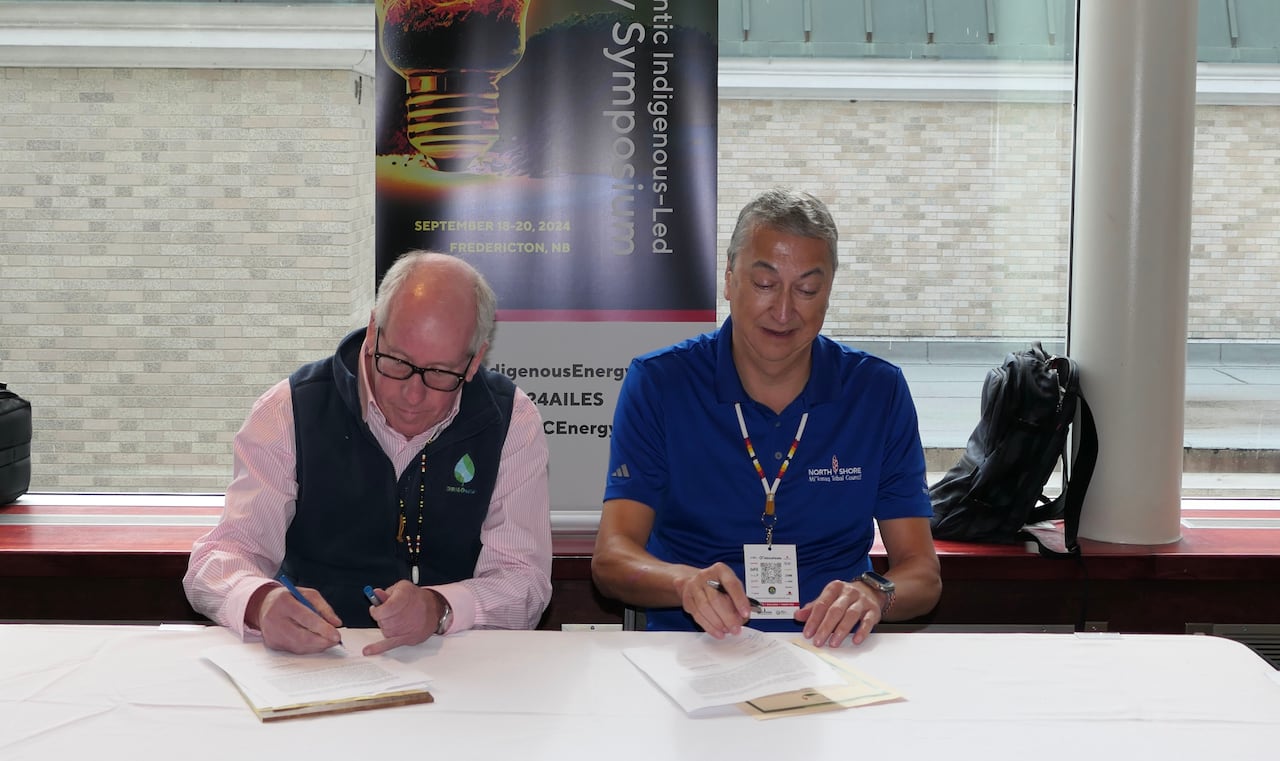 The North Shore Mi’kmaq Tribal Council and BNRG Renewables started their partnership with an agreement signed at the Atlantic Indigenous-Led Energy Symposium in Fredericton in September 2024. (Nelson Cloud/North Shore Mi’kmaq Tribal Council)
The proposed solar farm is big and not just by New Brunswick standards.
If it was built today, said Canadian Renewable Energy Association senior director Phil McKay, the Cookville solar project would be the second largest of its kind in Canada, behind the record-breaking Travers, Alta., solar farm, which has the capacity to produce 465 megawatts.
Ontario is currently home to several 100-megawatt solar farms and just announced a list of new projects, including five solar farms larger than 150 megawatts.
“It’s big,” said McKay, of the Cookville project. “Certainly not the biggest to come, but it is a proper utility-scale power plant.”
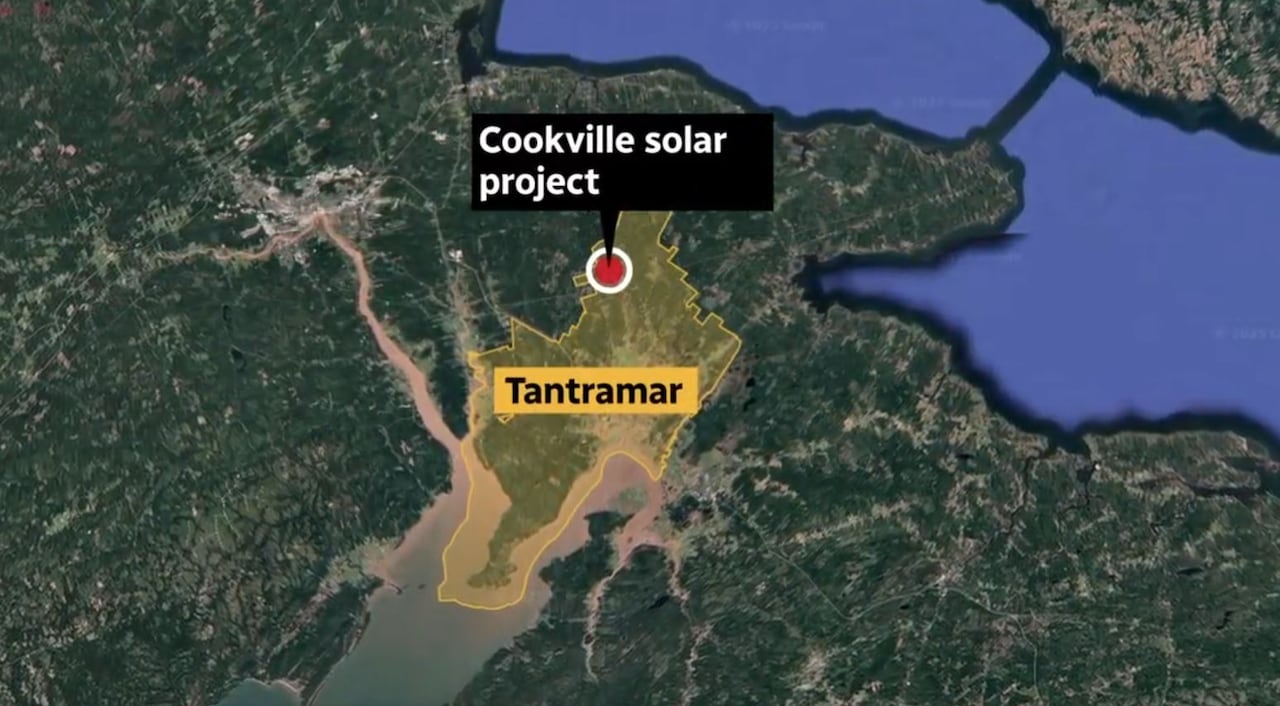 The 150-megawatt project is planned for Cookville, about 15 kilometres north of Sackville, in the municipality of Tantramar. (CBC)
The project is being proposed on a 400-hectare site in rural Cookville, about 15 kilometre north of Sackville and seven kilometres east of another major proposed energy project, the controversial Tantramar gas and diesel power plant, contracted by N.B. Power.
The project site spans roughly three kilometres north to south and two kilometres east to west, through what the company describes as “partially developed and farmed” properties that are “mostly cleared with a few wooded areas.”
WATCH | ‘It’s big for New Brunswick’:
Proposed solar farm in rural Tantramar would be one of Canada’s biggest
A partnership between a global energy company and the North Shore Mi’kmaq Tribal Council is planning a 150-megawatt solar farm on 400 hectares of land in southeastern New Brunswick.
At the southern end and western edge of the site, recent logging and clearing operations were visible this week.
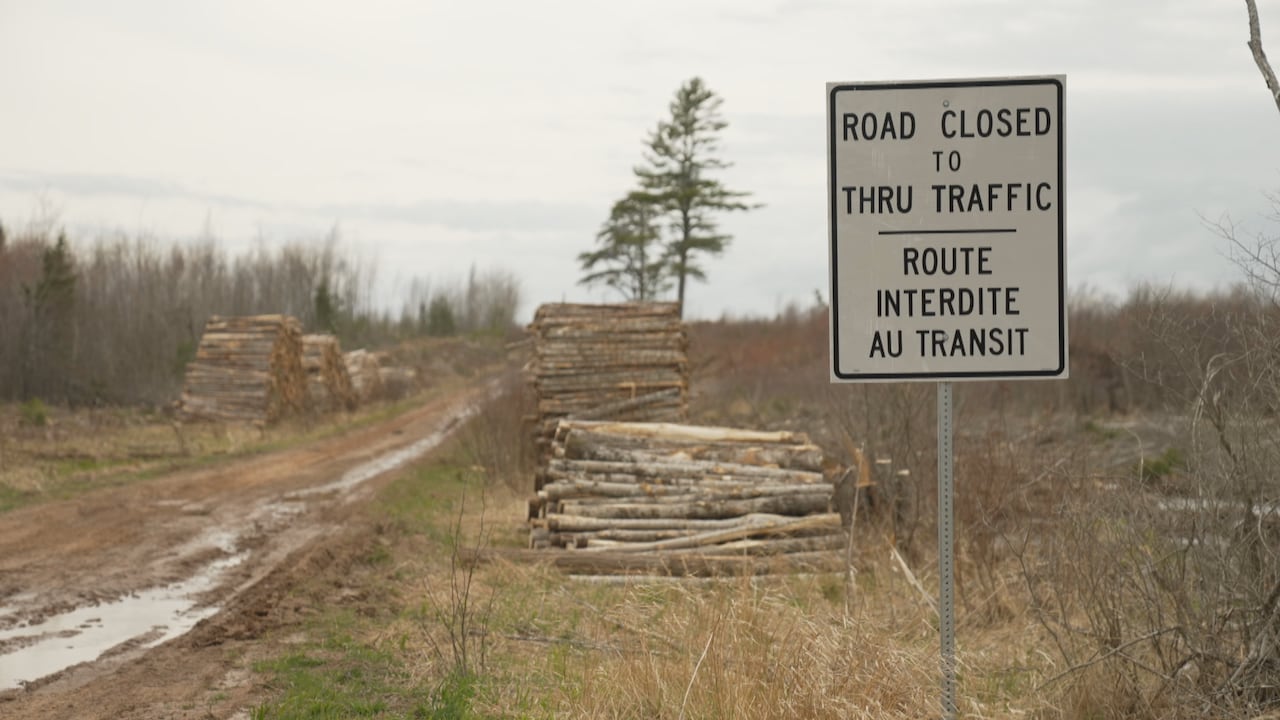 Land in the southern end of the proposed site has been recently logged and cleared. (Pierre Fournier/CBC)
About 340,000 solar panels would be installed on the farm, covering about three quarters of the site, or about 740 acres.
Most of the properties involved are owned by the Acton family, who have been farming in the area for generations.
According to the project website, the Actons will continue to use the land after the solar panels are installed for activities like sheep grazing, blueberry cultivation and honey production.
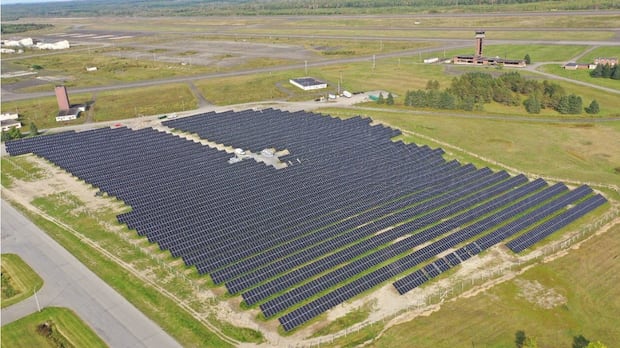
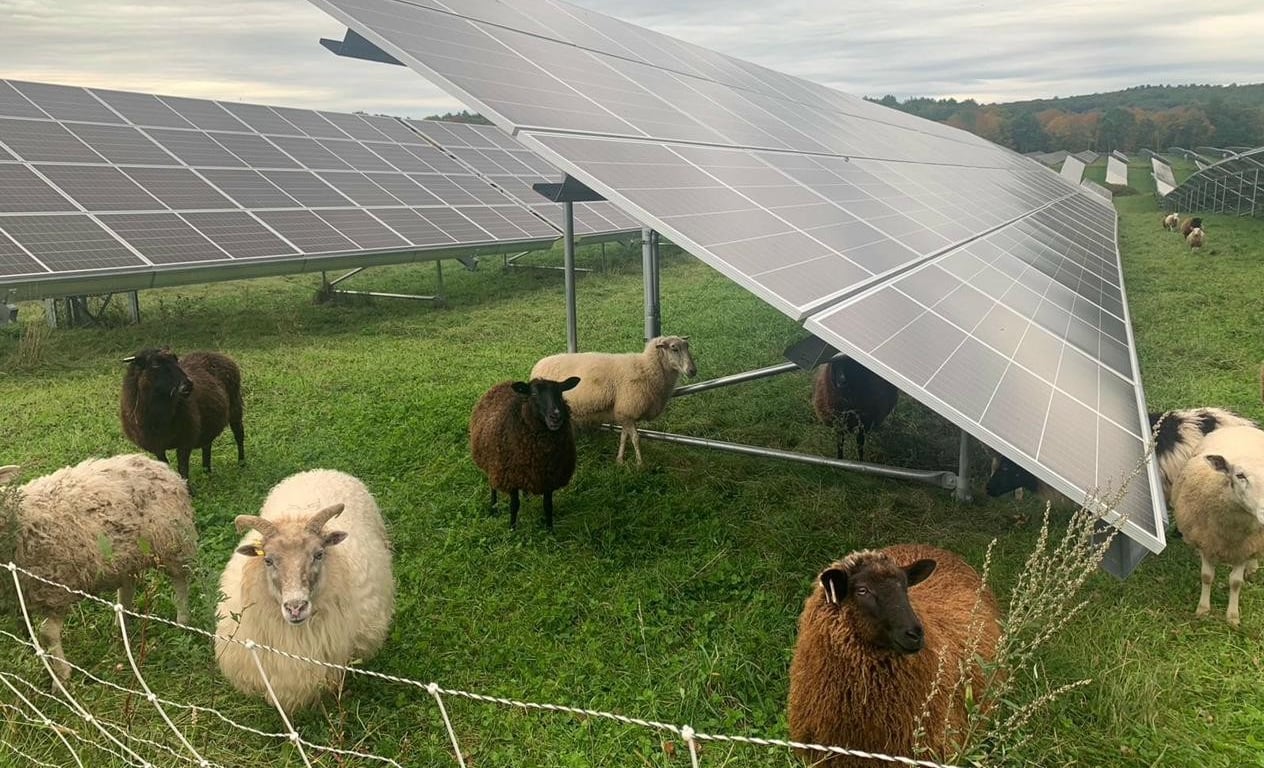 A BNRG Renewable solar facility in Augusta, Maine, in 2021. (BNRG Renewables)
Environmental impact assessment documents submitted to the province outline a construction timeline of 18 to 24 months, with completion planned for mid-2029. The project is expected to operate for about 40 years before decommissioning.
The project also includes the construction of a communications tower and an electrical substation at the southern end of the site, where an N.B. Power transmission line crosses the property.
NB Power said it has not yet signed an agreement to buy the power from the project.
The utility put out a call for 400 megawatts of renewable energy projects last May and, in December, awarded a 200-megawatt deal to Brighton Mountain Wind, a subsidiary of J.D. Irving Ltd.
The utility said at that time it was still considering 14 other proposals for large-scale renewable projects.
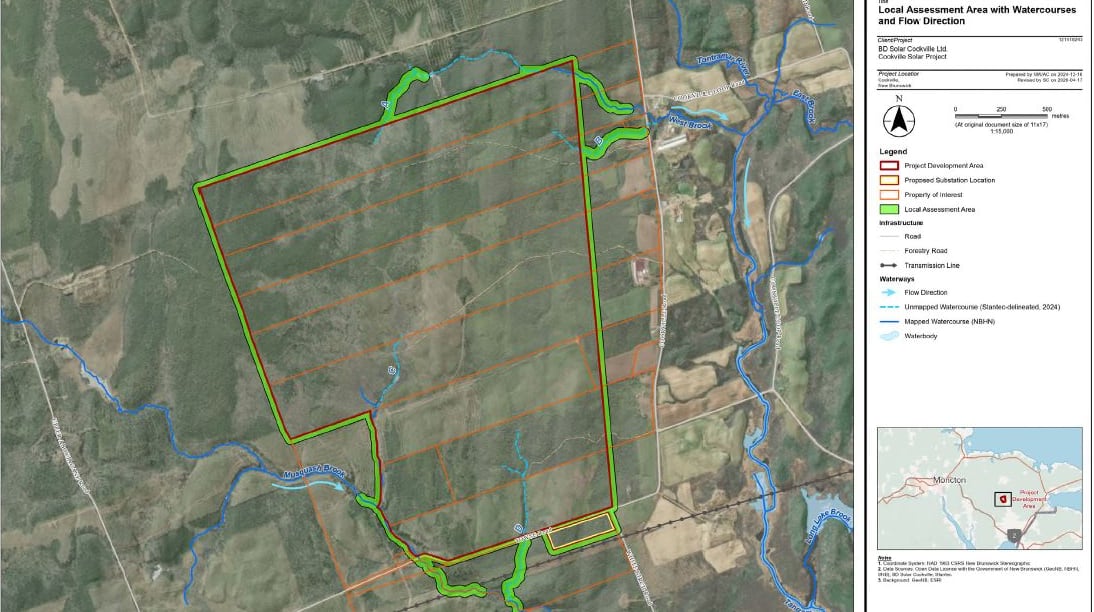 An overhead sketch of the project development area, outlined in red, as part of the environmental impact assessment for the Cookville Solar Project. (Stantec/BD Solar Cookville)
Representatives from the Acton family, the North Shore Mi’kmaq Tribal Council and BNRG Renewables declined interview requests.
The company said it is planning an open house on May 27 to answer questions about the project.
Public reaction to large-scale solar projects has varied across the country, said McKay, with some pushback around the sheer size and visibility of solar farms.
“But it is understood as essentially a crop,” he said. “People have known for many generations how to harvest a crop from the land. And so this is energy that is coming in daily, and it is a land use that is seen as beneficial.”