
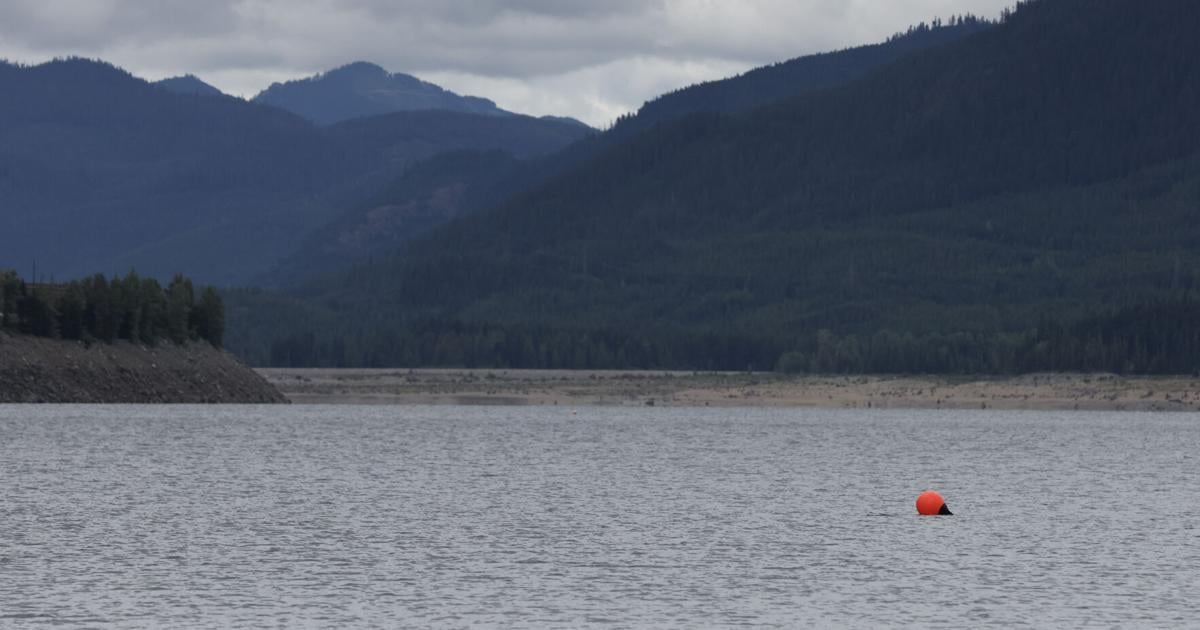
“Better than last year” was the message at the latest U.S. Bureau of Reclamation water supply update meeting Thursday.
Non-senior water rights holders in the Yakima basin are expected to receive 52% of their estimated allotment this year, an estimate that has held since April’s update. Senior water rights holders are expected to receive their full allotment.
Storage in the reservoirs on May 1 was 96% full with 1.02 million acre-feet of water, or 129% of average. Precipitation in April was 61% of average. Storage is at the second highest level on record for this time of year, said Teresa Hauser, supervisory hydrologist for Reclamation. Prorationing is likely to begin in the next 10 days.
That puts the irrigation year in a better position than last year, but dismal snowpack has pushed drought conditions in the Yakima Basin into a fourth year.
Snow water equivalent for the basin is at about 32% of normal, and the snowpack will likely completely melt off by June 1, Hauser said.
Doug Call, Yakima River operator for the U.S. Bureau of Reclamation, cautioned that snow is probably less than what the survey sites are showing.
Hotter than average weather and lower precipitation is predicted for the summer.
Sage Park, policy director for the Roza Irrigation District, said that the district could shut down for up to 15 days in May to help save water for hotter days and to extend the season.
“Fifty-two percent is better than last year,” Park said. “We hope it stays at 52%.”

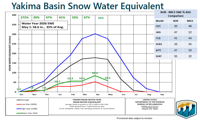
Snowpack on May 1, 2026 in the Yakima Basin was the fourth lowest on record, beat only by the drought years of 1977, 2005 and 2015.
Bureau of Reclamation
New initiative from Ecology inspired by Yakima Basin collaboration
Gov. Bob Ferguson and the Department of Ecology announced a statewide initiative Wednesday aimed at bringing together communities, farmers, businesses, tribes and other leaders to address water supply challenges.
Ecology will host a series of “Water Future Initiative” roundtables across the state, beginning this summer to discuss challenges and share solutions. University of Washington climate projections show both drought and flooding becoming more common as winter snow falls instead as rain.
Ecology Director Casey Sixkiller told the Yakima Herald-Republic that the program is inspired in part by the collaborative nature of how water in the Yakima Basin is managed, through the workgroup that manages the Yakima Basin Integrated Plan.
“We’re really seeing a sobering future of water supply,” Sixkiller said. “The work done in Yakima, beginning in the ’70s, really serves as the example we should try to emulate.”
Discussions from the roundtable will influence the water policies that Ecology brings to the Legislature next year. Dates have not been set yet.
Jon DeVaney, president of the Washington State Tree Fruit Association, said that the Yakima Basin plan has yielded wins in investment and conservation over its 18 years, and other communities ought to get started fast.
“The climate change we are seeing is shortening that runway,” DeVaney said. “We’re not only seeing a shortened window for addressing water management challenges, but we’re also seeing the change stressing the system even worse.”
Questen Inghram is a reporter at the Yakima Herald-Republic whose beat focuses on water, the environment, and Lower Valley communities. Email qinghram@yakimaherald.com or call 509-577-7674.