
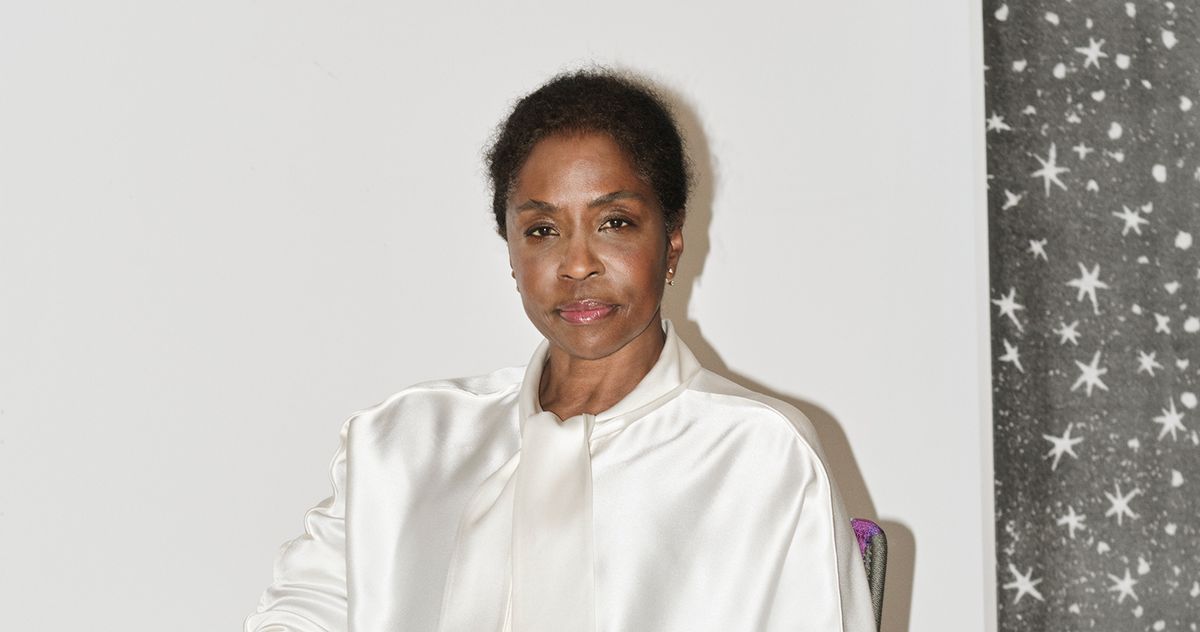
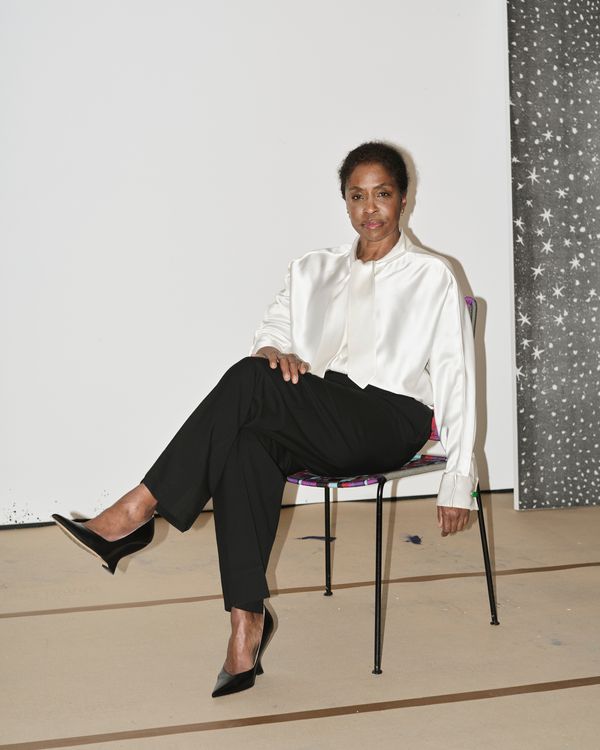
Lorna Simpson wearing Bottega Veneta.
Photo: Courtesy of Bottega Veneta
The artist Lorna Simpson sees women as entire universes. The constellations she collages within female forms glitter with boundless expansion and wink with Surrealist impossibility, a hallmark of her poetic, conceptual style that has guided a career spanning photography, painting, and sculpture for some four decades. Simpson’s solo exhibition “Third Person,” at this year’s Venice Biennale, is a sweeping view of her dynamic oeuvre set against the backdrop of a rapidly sinking city. The canals hold cultural history, much like Simpson’s works that gesture toward Black female identity, American politics, and the natural world that preceded us and will outlive us all.
“‘Third Person’ is a play on the literary point of view in terms of how one speaks about oneself or addresses someone else,” Simpson says. “But it does also make you think outside of the binary: Who is the third person?”
In 1990, Simpson became one of the first African American women to exhibit at the Venice Biennale, making Bottega Veneta’s exclusive sponsorship of her 2026 exhibition at Punta della Dogana (curated by Emma Lavigne, general director and curator of the Pinault Collection) particularly poignant. Organized in partnership with the Metropolitan Museum of Art — where the initial version of the show, “Source Notes,” was curated by Lauren Rosati — this iteration of approximately 50 works (in painting, collage, sculpture, installation, and film) spans 20 years of Simpson’s practice and includes a number of paintings created for the 2015 Venice Biennale, curated by the late Okwui Enwezor.
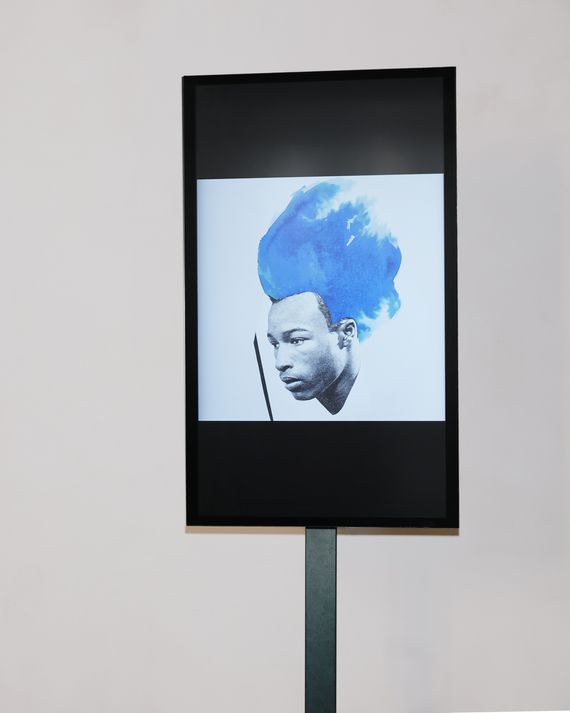
Photo: Courtesy of Bottega Veneta
Evan Nicole Brown: Regionalism is so interesting. I’m fascinated by how different settings can inform work. How are you thinking about these artworks taking shape in Venice differently than they did in New York? How have you adapted the “Source Notes” show that was at the Met last spring for the Venetian environment?
Lorna Simpson: There’s a huge difference from the show at the Met in terms of the space architecturally. But Venice, funnily enough, in terms of this body of work, the initial works that I made were included in an exhibition at the 2015 Venice Biennale by Okwui Enwezor, called “All the World’s Futures.” So the unexpected part of this coming full circle is actually a lot of the first works I made were shown in Venice. In set and setting, so much of the work has these amazing blues, has water as part of its elements as well as sky and constructed landscapes that are glaciers and ice formations, which actually complement the environment of Venice in color, scale, and being in this city that is slowly submerging and surrounded by water. So it’s a lovely return, actually.
ENB: That just conjured a beautiful memory for me: The one time I’ve been to Venice was when I was much younger with my grandmother and mother. My grandmother has passed on now, but just being with her on the canals, I remember that deep blue of the water under the moon that looks like the blue you use in your work. It’s so rich, and it makes me reflect on the power of matrilineal heritage, girlhood, and womanhood.
LS: There are many beautiful places to travel on this planet besides Europe, but Venice holds a very special place because of its relationship to water and its ancient status as a city built in water.
ENB: Yes. A lot of the works in your show are preexisting, but can you share a bit more about the new works you’ve created specifically for it?
LS: The work spans from 2014 to now, and the new ones are presented in this room we call “the Cube,” Tadao Ando’s renovation and reclamation of the architectural space that houses the Pinault Collection. There’s a cement cube, and in that cube are all these figures. It was interesting to me in that I thought about living in America right now and the overtly white-supremacist actions taken by this government in a multitude of forms, particularly with the suppression of books, information, narratives. And in that I thought, How interesting would it be in this moment that there are these larger-than-life-scale images with individuals who are sitting in the landscape, either about to write or read something? Small acts of preservation in this hellish moment we’re living in.
ENB: Something I love about your work is how you untangle politics and identity across time, because it makes me wonder how history repeats itself, and how even though you’re engaging with different eras of identity and political contexts, I’m sure you’ve noticed common threads throughout that study.
LS: Absolutely. All of those moments in history — particularly in the ’60s, of changing laws to combat voter suppression and these attacks on democracy and segregation and not allowing Black people to vote — were being overturned.
ENB: Speaking of the ’60s, I want to ask about your relationship to Ebony and Jet magazines. Your collage work uses them, especially images of Black women in the editorial looks from these publications in that era. How have these images informed your understanding of fashion as expression, particularly the way Black women have expressed themselves in print media and through style?
LS: It’s a fascinating dive in terms of fashion and looks and what’s current. But particularly in Ebony magazine, there are all these ad campaigns for makeup that had this “before” and “after.” What was striking to me is how they were transformative in that you didn’t recognize the person, or they favored particular features or a way of looking. It was about attitude, which was hilarious. The differences in expression were so intense. I love poring over those things because Ebony was one of the first major magazines that could get advertisers to fashion their ads for a Black audience. And not only national ads but also Black products — they had this space to present their products for a targeted audience. The imagery around all of that is really interesting.
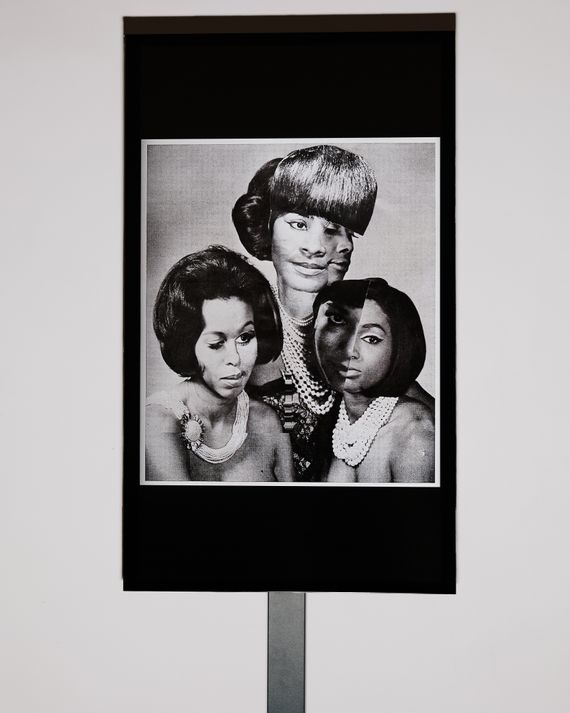
Photo: Courtesy of Bottega Veneta
ENB: I can imagine your pull toward it given that your photography practice is an origin for you. Is there a particular style of photography or advertisements that inspires you?
LS: Ad campaigns from the 1960s and ’70s were very austere, and there was always a play on words or visual opposition. I also collect defunct news photos that were made for publishing and newspapers when everything was more analog than digital. I look for imagery that has a very surreal quality to it, work that is incredibly surprising.
ENB: I’m sensing a theme in your work — from celestial skyscapes to rock formations, these natural materials with a fabricated angle as well.
LS: They’re mascots. There are several pieces where, like, there’s a woman walking down the beach in a bikini, and I cut out her body and a celestial map becomes her skin with the mascot head of a tiger on the beach. Those are the sorts of things that capture my attention.
ENB: I think we need Surrealism and whimsy. There’s this register of “Art” that can be very self-serious and elitist, so I find this renaissance of more play refreshing. What has your relationship been like with Bottega Veneta? How do art and fashion fuse together for you through this collaboration?
LS: Their support has been of the exhibition and the performances that are taking place [including one by Esperanza Spalding] and for audiences to be able to see it. Curatorially, the exhibition is coming from the Met, though.
ENB: Your practice and process have obviously transformed across the years. How might this translate to the changing phases of womanhood? Does what you’re creating now somehow run parallel to where you are in your personal journey? How do you trace milestones and eras in your career, and how do they align with the ones in your life?
LS: There are many sides: There’s making work, there’s participating in exhibitions, engaging with my studio in working on an archive and books, and trying to keep in mind, with all the work and different things happening at the same time, to enjoy it. So the presence of my family; my daughter, Zora Casebere; and her friends is really important to me. I do find myself pulling back, not from working but, for instance, going to Venice, to really take the time to celebrate and to honor other artists.
Going to see Koyo Kouoh’s exhibition that is now being mounted in the wake of her death* — to see that exhibition come to fruition and her intellectual acumen in the artists she was interested in and the kind of exhibition she wanted to curate — is kind of a return. Also considering the loss of Okwui Enwezor, there are these things that are a reminder. The intensity of people who are so amazingly brilliant in criticism and art history and exploding boundaries, but also thinking about the toll that takes on one’s psyche and body. None of those choices is easy, to say, I’m going to go down this path and have this kind of life and dedication to art. In this instance, I’m not really speaking for myself in that way, but we have to manage ways of caring for each other and creating space for rest and safety.
ENB: That calls back the water of Venice for me and the blues in your work. That purification and the ability to meditate and pause feel so distant sometimes, so that’s beautiful because when artwork is visually arresting enough to stop you and calm you, it’s a special opportunity to get someone to rest in that moment. In thinking about your relationship to the natural world and materials and how art materials like water, wood, and ink are all raw (and how clothing fibers in fashion are natural materials too), what is the process like for you witnessing this alchemy and transformation as you work? How does the passage of time across using these materials to transform them into a finalized work feel for you?
LS: I think about time. Although we are living in the U.S. in this nightmare moment, when I think about my grandmother and what she would say, she’d say, “What do you expect from white supremacists?” — not dismissively but just that she knew, her mother knew, and her mother’s mother was very close to slavery. When we think of history and turmoil in this country as a project trying to right itself and not rest on the backs of the Indigenous and enslaved Africans and how that kind of tumults into the 21st century, we actually should keep in mind the trajectory of time that goes beyond that.
*Kouoh had been appointed artistic director of the 2026 Venice Biennale, set to be the first African woman to curate the prestigious exhibition, and passed away last year.
Stay in touch.
The latest in style, self, culture, and power in your inbox.
Vox Media, LLC Terms and Privacy Notice