
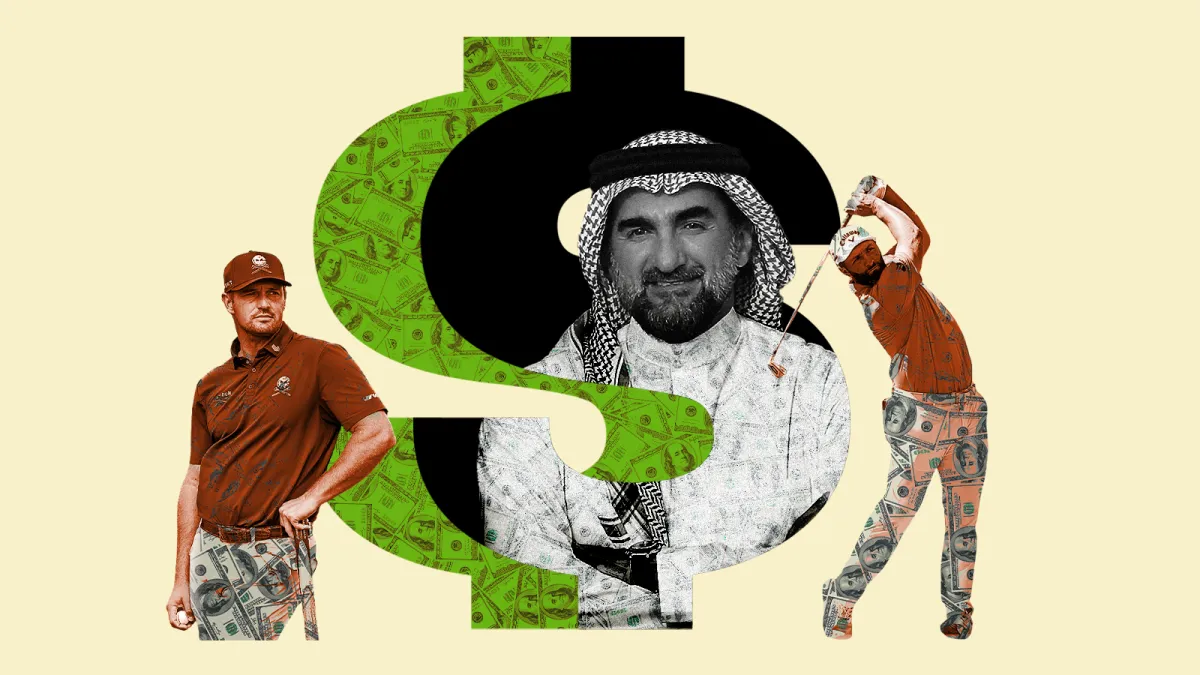
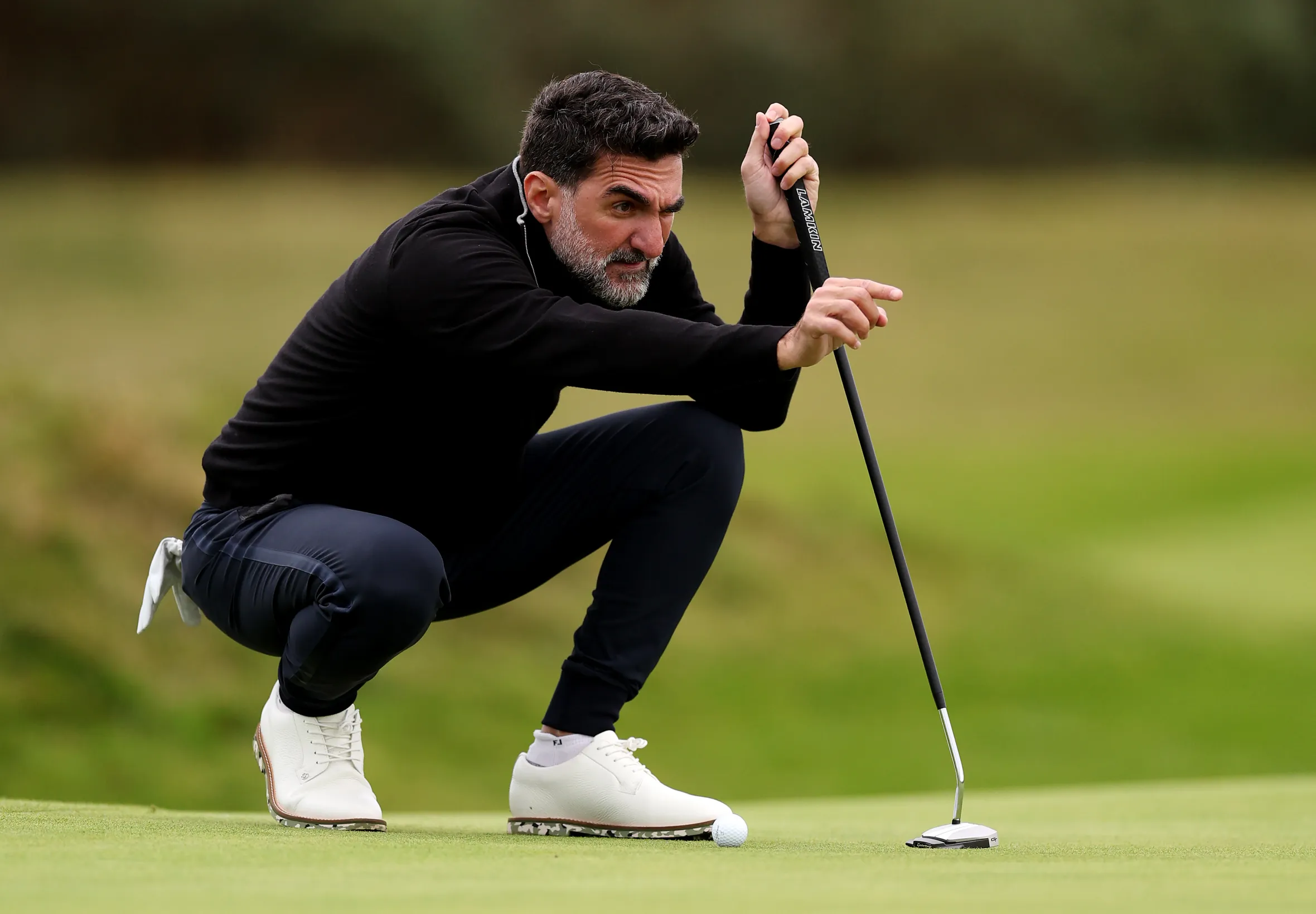
There are a number of putting mats in the high-rise office of Yasir Al-Rumayyan in Riyadh. The right-hand man of Saudi Arabia’s Crown Prince Mohammed bin Salman is an avowed golf fanatic, often playing early morning desert rounds, so the loss of his personal project, LIV Golf, will hurt him to his core. When the plug is pulled at the end of this season, it will have cost the kingdom an estimated $6billion (£4.4billion). To put that in Saudi sporting terms, it is 15 Newcastle Uniteds.
With the Saudi Public Investment Fund behind it, LIV wrenched golf off its axis and cast it somewhere between Croesian riches and existential crisis. Why did they do it? The largesse went beyond sport and was really about power, legitimacy and diversifying from the oil economy. They were helped by a tubthumping US president and big names who could not say no. This week LIV golfers are playing on a Donald Trump course outside Washington, DC with chiefs insisting they are restructuring and will have new backers for 2027, but without PIF power its days as a disruptor are surely done.
Four years after the rebel tour’s first tournament a host of players are rich beyond Babylonian fever dreams. Kevin Na, a player who had never come close to winning a major, signed for $25million. Sergio García got double that. The spiralling scale led to Dustin Johnson, the 2020 Masters champion, signing for $150million and, eventually, Jon Rahm, the last of the big-time spends, getting $300million.
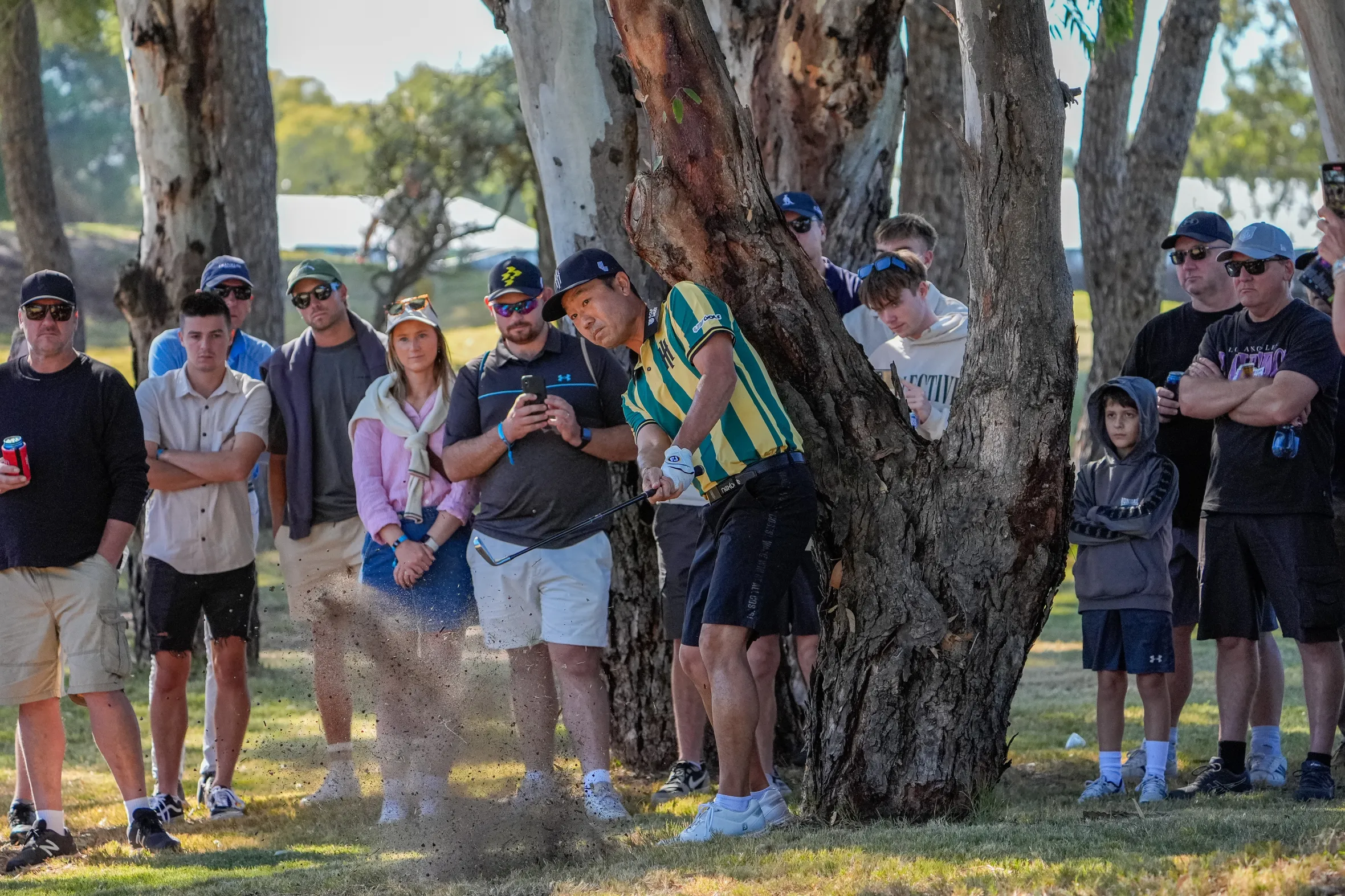 Na, playing at LIV Adelaide in 2024, received a reported $25million when he signed up to the rebel tour Asanka Ratnayake/Getty
It was a storm burst fuelled by insane prize money. At the 2022 Masters, arguably the most coveted prize in golf, the winner Scottie Scheffler took home $2.7million; two months later, at LIV’s first event just off the M1 in Hertfordshire, Charl Schwartzel won $4.75million. Al-Rumayyan, the PIF governor and LIV chairman, said anyone shooting a round of 54 could have another $54million. Of course, nobody managed that, but Rahm has made another $92million in just over two years at LIV, which is fast work given that only four players have won more in their entire PGA Tour careers.
The players could not believe their luck. They were soon travelling in style on Crystal Skye, dubbed the party plane — a Boeing 777 with a bar and gourmet kitchen where, on one occasion, TikTok showed the mullet-topped Pat Perez serenading peers with We are the Champions after winning $900,000 for finishing 29th. Private jets were the norm for the elite on the PGA Tour, but LIV was offering generational wealth to B and C listers too. Billy Foster, caddie to stars including Seve Ballesteros, told me bagmen now turned left on planes. “LIV was designed by the Caddies Association,” he joked.
Ultimately, LIV’s selling points — teams, shotgun starts, small fields and 54 holes (LIV is 54 in Roman numerals) — were not enough when books had to be balanced. Al-Rumayyan, who loved mixing with golfers, remains the PIF governor and Newcastle chairman, but LIV has a new board.
Simon Chadwick, a professor in Afro-Eurasian sport and editor of the GeoSport digital platform, says: “Once Saudi won the right to stage the (2034) Fifa World Cup in 2024 everything ground to a halt, and throughout 2025 spending on sport really slowed. The Saudi government undertook a review of what it was spending money on and what the returns were. Mohammed bin Salman’s view now is that national transformation is all about hitting targets.” So the Asian Winter Games were indefinitely postponed. The Line, a $500billion futuristic city, has been drastically scaled back. Esports is more important than golf.
In February LIV’s chief executive, Scott O’Neil, brought in to replace the more abrasive Aussie provocateur Greg Norman, admitted the tour would not turn a profit for at least five and maybe ten years. “Those comments likely didn’t help,” Dr Kristian Coates Ulrichsen, fellow for the Middle East at the Baker Institute think tank, says. “They drew attention to the loss-making nature of LIV and may have caused some anger at the assumption the funding would be guaranteed despite the lack of long-term prospects for a conventional ROI (return on investment).” Trouble in the Strait of Hormuz reinforced the realism.
A civil war raged because the American and European establishment, the PGA Tour and DP World Tour, stood to lose their best players who were uncontracted members. Events clashed. So did old friends. Sponsors got nervous.
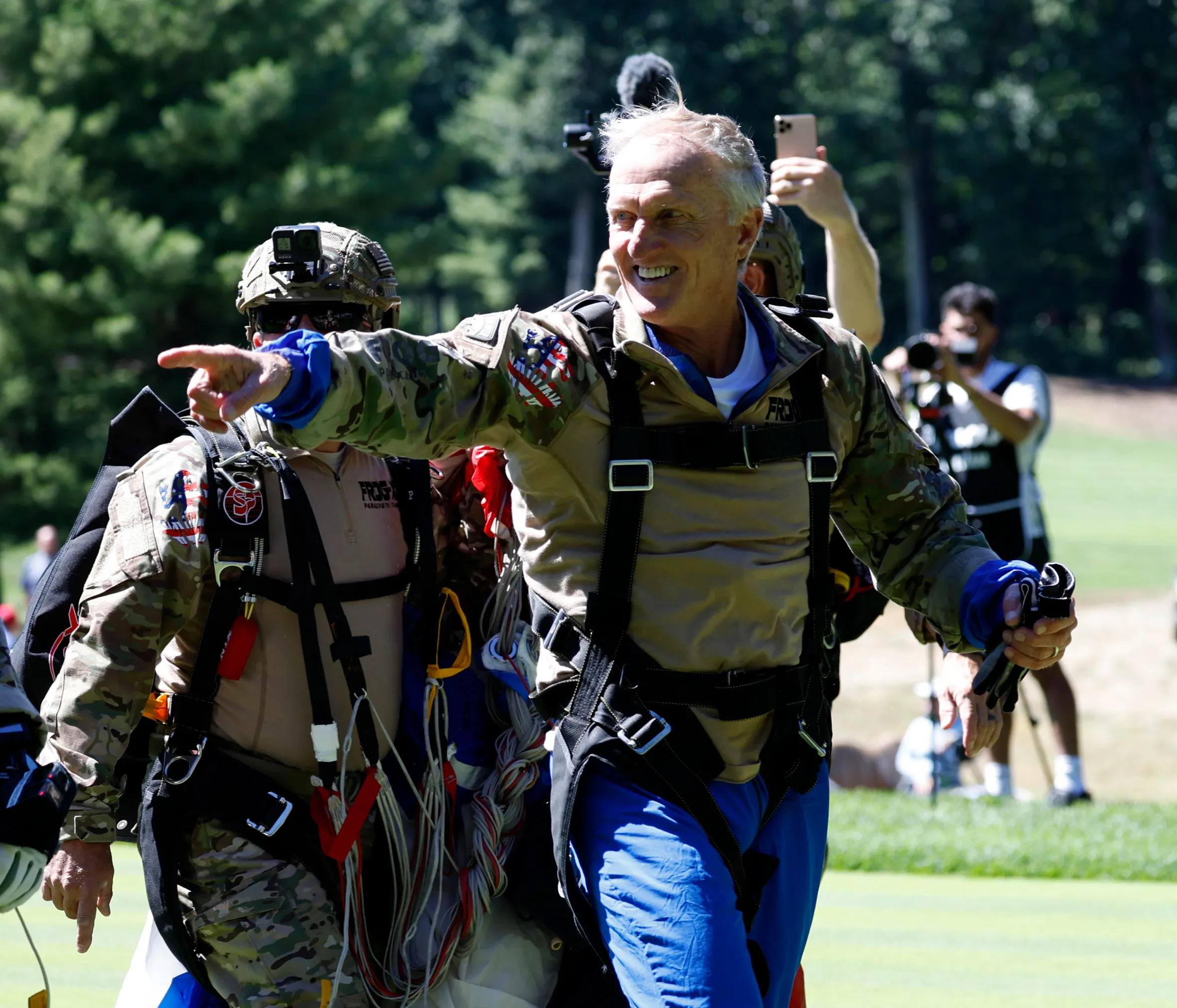 Norman made a spectacular entrance to the Boston LIV Golf event in September 2022, parachuting on to the courseFred Kfoury III/Icon Sportswire/Getty
There were fines and bans for playing on LIV, lawsuits, countersuits, senate hearings, Patrick Reed’s ill-fated $750million defamation lawsuit against journalists, Norman and Rory McIlroy’s loathe-in, and allegations the PGA Tour was funding anti-Saudi 9/11 protests at LIV events. A PR firm working for the PGA Tour scoffed at that and said that LIV were in a “dream world”. A genteel game got nasty as money talked. Incessantly.
Then, in 2023, it briefly seemed that war was over, with the sides agreeing to a framework peace agreement. It proved a placebo rather than a panacea, and a month later Jimmy Dunne, a PGA Tour board member, stood before a US senate committee investigating the agreement and said they had had no choice. “If they take five players a year, they can gut us.” The marriage of convenience was slowly dissolved when the PGA Tour secured $1.5billion from an American consortium in December 2023 and, to Al-Rumayyan’s disbelief, valued LIV at only $500million.
LIV was reportedly losing £100million a month and Ulrichsen says it is hard to see how PIF can review it positively, but adds: “LIV did provide a way for senior Saudi officials to maintain links with Trump during his time out of office.”
It is a good point. Initially, the outcry was about sportswashing and the dismembering of dissident journalist Jamal Khashoggi in the Saudi consulate in Istanbul. CIA files claimed Bin Salman approved Khashoggi’s assassination. He denied it. At a press conference in May 2022, Ian Poulter was asked if he would play in Putin’s Russia or under apartheid but, four years on, sportswashing is deemed an outdated term. Phil Mickelson’s cynical assertion that the Saudis were “scary motherf***ers” but worth dealing with to force change on the PGA Tour worked to an extent, but its shock value has faded so completely that Bin Salman was welcomed back to the White House last November. “He knew nothing about it,” Trump snapped at a journalist who dared to raise Khashoggi’s name in the Oval Office.
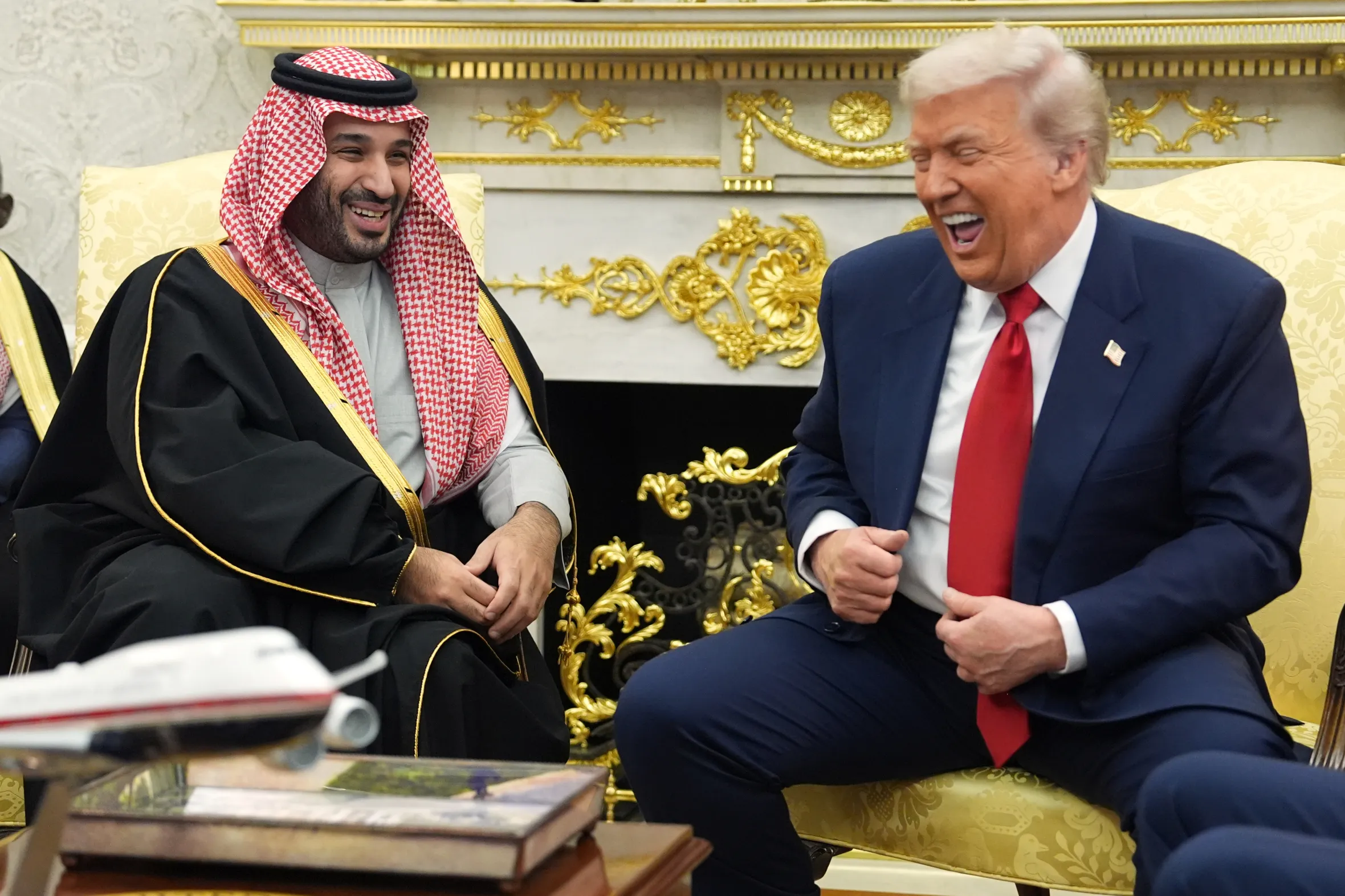 Bin Salman met with Trump in the Oval Office in NovemberEvan Vucci/AP
The enthusiasm and easy manner of Al-Rumayyan was crucial to it all. “When there was a lot of internal disruption in Saudi Arabia from 2015 onwards, he was one of Mohammed bin Salman’s trusted allies,” explains Chadwick. “So MBS knows he is loyal and what he has done to help him be next in line to the throne. I think LIV was MBS’s reward to Al-Rumayyan and there is no suggestion of him being moved aside now.”
One detail of the Saudis’ 2023 unification proposals was eye-catching. It suggested that as part of the deal, Al-Rumayyan would become a member of Augusta National, the home of the Masters and an uber-exclusive billionaires’ club. It sounded like the ultimate ego massage but cut to the core of Saudi ambition — they wanted access to the USA’s most influential business networks. “LIV emerged during Trump’s first term when MBS was becoming the de facto ruler,” Chadwick says. “And it seemed golf was one of the ways the USA and Saudi Arabia were able to engage.”
LIV Golf was born from the ashes of the Premier Golf League (PGL), the idea of British lawyer and golf fan Andy Gardiner. He wanted an F1-style, 48-man team event with $20million prizes and shotgun starts. Those prepared to back the PGL included Al-Rumayyan, but it failed to gain enough attention from either players or the PGA Tour, despite offering Tiger Woods $200million. The PGL turned to Europe, but the DP World Tour chose to sign a strategic alliance with the PGA Tour.
 One of LIV’s requests at talks with the PGA Tour was for Al-Rumayyan to be given membership at the ultra-exclusive Augusta NationalRichard Heathcote/Getty
By the summer of 2021 Golf Saudi and PIF had come up with what would become LIV, their own global tour, and pitched to the DP World Tour at a hotel in Malta. Some claimed this was worth close to $1billion over time but insiders say it was all promises. “They offered a wing and a prayer,” said one source.
And now the Saudis are going. Some players will stick with LIV if it continues, others will engineer routes back to the mainstream. We have reached an age when Rahm last week paid fines totalling more than Scheffler’s 2022 Masters prize money merely to be eligible for five DP World Tour events.
Meanwhile, to sate player envy, the PGA Tour hiked prize funds to record levels, with pots for some “signature events” doubling to $20million in two years, along with lavish schemes to reward players for their loyalty. Now it is making cutbacks and laying off staff. History will show LIV lighting a fuse and everyone blowing the bank.
Paul McGinley, the former Ryder Cup captain who was a DP World Tour board member until 2023, says: “I look at LIV and the last four years and, quite simply, it’s been a windfall for players on all sides. Players on LIV have won, players on the PGA Tour have won and players on the DP World Tour have won. But I struggle to see who else has won in all this turmoil.
“The sponsors are paying more money, TV is battling for viewing figures, and Joe Public is having to pay a lot more to come to these events. And in America the charity element is probably not making as much money than before these prize funds exploded and money had to be found. It’s been tremendous to be a player and anyone earning a percentage from them, but it doesn’t leave the game in a better place. Four years on and the tours are in a lot more difficult straits than they were before LIV. There’s been a lot of losers.”