
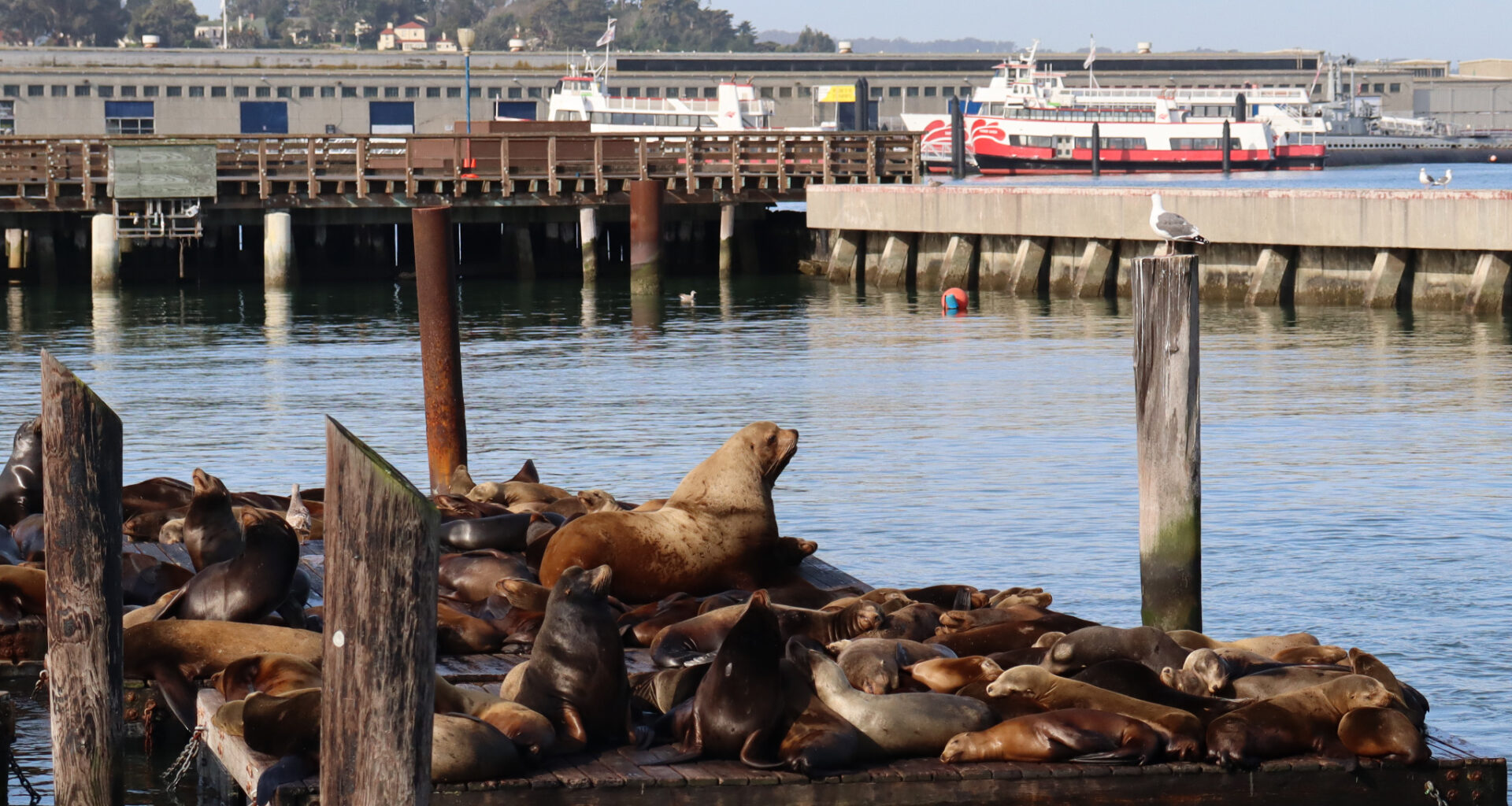
“Trust me, it’s Chonkers,” the girl said, snapping her gum, a cluster of other preteens in her wake as they beelined toward Pier 39’s K-Dock. “We’re going to know it when we see him.”

Staring at the blubbery pile of barking, yawning pinnipeds lounging in front of us, I’m not so sure. I start to think that if I believe it enough, any reasonably large sea lion could be him.
It’s around lunchtime on a recent Thursday, and the girl’s remark is the only time I’ve heard anyone utter the animal celebrity’s name since a photographer and I went out on “Chonkers Watch.” The lone exception was one other reporter I spotted darting through the sea lion viewing area, desperately trying to find anyone who would comment on him. “Who?” one woman asked, shivering in her freshly purchased Fisherman’s Wharf hoodie.
Article continues below this ad
Chonkers, a giant Steller sea lion, sits on a dock at San Francisco’s Fishermen’s Wharf, Thursday, April 30, 2026.
Haven Daley/AP
As of Sunday, it’s been days since the sea lion the size of a Prius has been seen at the San Francisco tourist attraction, dwarfing his fellow sunbathers and drawing an international legion of fans. This makes sense: A big animal surrounded by a bunch of smaller, lookalike animals is just funny. It tickles a primal part of the brain. Yet what surprised me was why, in a year that’s already seen a coyote swimming to Alcatraz and a historic avian flu outbreak spread to California marine mammals, people seemed to care now more than ever.
This isn’t the first time a Steller sea lion, the largest of all eared seals, has shown up at K-Dock. A different one was reported there as recently as 2023. Both individuals were likely from the Eastern population group found along the U.S. and Canadian coastline, which was previously considered endangered but delisted in 2013.
Make SFGATE a preferred source so your search results prioritize writing by actual people, not AI.
Add Preferred Source
But something about this one has warranted a phenomenon Sue Muzzin, a spokesperson for Pier 39, has dubbed “Bonkers for Chonkers.”
Article continues below this ad
“People from all over are coming back, day after day, because they want to see him,” she told me over the phone before our visit.
Chonkers the Steller sea lion rests on K-Dock.
Courtesy of PIER 39
The first sightings in March were posted on Reddit, where users first coined his name. San Francisco resident Joe Lo, who works near Fisherman’s Wharf and often swings by Pier 39 after clocking out, told SFGATE he first saw the sea lion that was noticeably bigger than the rest on March 14.
“He woke up and swam off and spooked the rest of the sea lions,” Lo told SFGATE.
Article continues below this ad
“I’d never seen one that huge before,” he added. “I thought it was an elephant seal.”
Chonkers the Steller sea lion rests on K-Dock.
Courtesy of PIER 39
I asked Giancarlo Rulli at the Marine Mammal Center what was up, but he wasn’t too surprised — appearances from Steller sea lions at the site otherwise populated by California sea lions are infrequent but not uncommon, he said. (The Stellers are commonly mistaken for their pinniped counterparts, but grow two to three times larger and are lighter in color.)
Still, Chonkers’ popularity grew. He appeared on “Good Morning America” and made national headlines in the New York Times and the Wall Street Journal.
Article continues below this ad
“That was the real firestorm for us,” Muzzin said. Normally, Pier 39’s sea lion webcam gets about 2,000 visits per day, she told SFGATE. The day after the WSJ article was published, they jumped up to 15,000. “Someone sent me a photo and there were three rows of people deep, looking for him.”
Chonkers the Steller sea lion rests on K-Dock.
Courtesy of PIER 39
The Marine Mammal Center was also flooded with phone calls.
“Prior to this week, there was a two week stretch where I was fielding anywhere from 10-20 interview requests (local, national and international outlets) a day alone just on Chonkers,” Rulli told me recently in an email. “Easily the busiest media stretch on a single animal story since northern elephant seal, Tolay, a pregnant female, tried to cross Highway 37 in late December 2015.”
Article continues below this ad
The experts I spoke with attributed Chonkers’ fame to not only his extraordinary size and commanding appearance, but also the length of time he’s spent at Fisherman’s Wharf. In the past, other Steller sea lions tended to visit for a day or two before heading out into the water again. Chonkers also comes and goes, but his stay has approached nearly two months.
“It’s given the story time to grow,” Adam Ratner, director of conservation engagement at the Marine Mammal Center, told SFGATE over the phone. “It’s been truly remarkable and different from anything we’ve seen before.”
Chonkers the Steller sea lion rests on K-Dock.
Courtesy of PIER 39
Ratner thinks people have also been drawn to the positive news at a time when marine mammals have been facing a myriad of threats, citing the avian flu outbreak and stressors imperiling gray whales migrating through the bay. Just why Chonkers sought out K-Dock is a little more difficult to parse, but Ratner boiled it down to one likely reason.
Article continues below this ad
“Chonkers is working smarter, not harder,” he said. The 2,000-pound animal presumably saw California sea lions had discovered a place where they could eat and nap at a safe distance from human impacts, and was inspired to join them. “It’s a chance for him to fatten up before breeding season starts in a month. He’s finding food and getting ready before he has to compete with animals that are bigger than him.”
Ratner confirmed that at least one other Steller sea lion has popped up at Pier 39 since Chonkers’ arrival. “He’s smaller” and younger, he said, lacking the distinctive mane Steller sea lions develop in adulthood. A few others have also been spotted around the bay during routine whale surveys in the past few weeks, but it’s likely a coincidence, Ratner said, as the opportunistic animals identify and seek out the wealth of food in the area: mostly anchovy, but also herring, capelin and salmon.
It’s not unusual for a Steller sea lion to take up residence with a colony of California sea lions, Ratner said. Both populations coexist at rookeries in the Farallones, Fort Ross and at Año Nuevo Island. They’re highly social animals and generally enjoy one another’s company.
Chonkers the Steller sea lion rests on K-Dock.
Courtesy of PIER 39
“Certainly you see some of the smaller sea lions startled when you have a 2,000-pound sea lion jumping onto the dock that is their deck and shaking it pretty violently,” Ratner said. “But he seems to be getting along decently well.”
Article continues below this ad
For that reason, experts don’t plan to intervene. Steller sea lions, particularly males, can travel long distances in a season, and it’s possible Chonkers could be heading as far as Southern California if he really is gone for good. In the meantime, he’s certainly made a name for himself: The massive animal has his own dedicated webpage where he’s touted as a “viral sea-lebrity.” Impressively, he evaded one of Mayor Daniel Lurie’s Instagram videos. A stuffed animal made in his likeness sold out within minutes but has since been restocked. If he’s lucky, he’ll go down in history like Humphrey the whale, or San Francisco’s wild parrots.
“It’s been wonderful to see so many people inspired or in awe of a marine mammal,” Ratner said. “Something we strive for as a hospital is building a sense of connection and awareness, and Chonkers has been able to capture people’s imaginations in that way.”
FILE – An aerial view of San Francisco’s Pier 39 and Fisherman’s Wharf.
JasonDoiy/Getty Images
Ratner said he’d like to see the media raise awareness toward other Steller sea lions that aren’t doing so well, like the Western stock found in Alaska and Russia. It’s still endangered and has been facing significant threats due to effects of fisheries on their prey, which have been compounded by the impacts of climate change.
Article continues below this ad
“People are discovering these magnificent animals the size as cars that share the same beaches as we do,” he said. “We hope his story can help inspire them that these animals still need help.”