
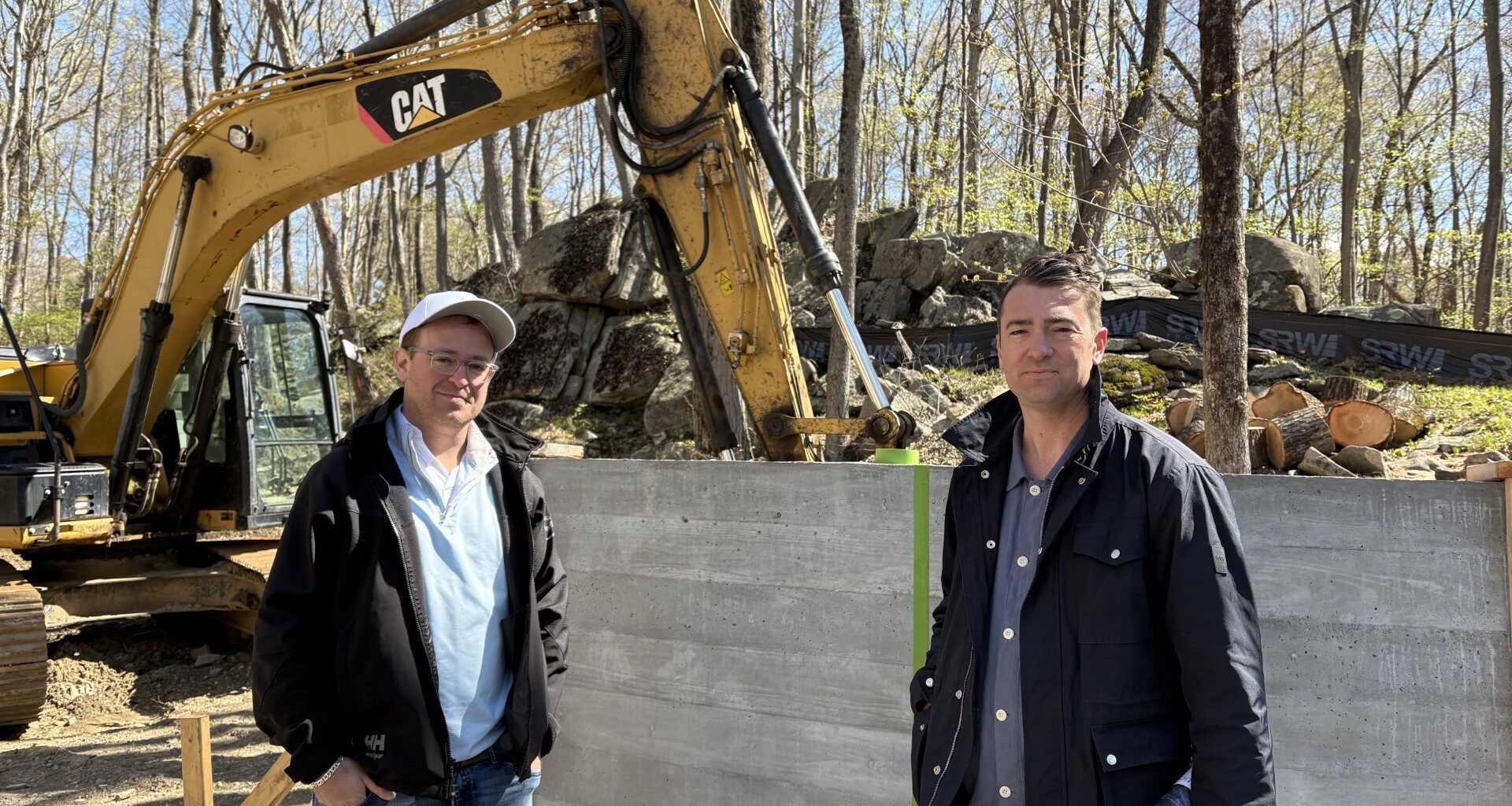
Carbon Custom Builders CEO Sam Fertik, left, and Further Architecture principal Justin Towart, in April 2026 at a wood-framed home on Indian Hill Road in Redding, Connecticut, whose owners are building an addition fashioned from poured concrete.
Alexander Soule/Hearst Connecticut Media
A design rendering for an addition fashioned from poured concrete for a mid-century modern home on Indian Hill Road in Redding, Connecticut.
Image courtesy Further Architecture
A curved component fashioned from poured concrete and staged for installation at an Indian Hill Road home, in April 2026 in Redding, Connecticut.
Alexander Soule/Hearst Connecticut Media
An interior rendering of a poured-concrete addition to a mid-century modern home on Indian Hill Road in Redding, Connecticut, with construction underway in April 2026.
Image courtesy Further Architecture
In many Connecticut towns, vistas are dominated by trees and and rocky outcroppings. In Redding, an unusual home expansion is underway that brings the two together, as owners tack on a curved concrete addition to their existing house that was built originally with cedar siding.

Carbon Custom Builders is currently sculpting the concrete expansion for a house on Indian Hill Road in Redding. Built in 1979 in the mid-century modern design, the original house features a cylinder-shaped entry, angular facades and steeply pitched roof lines.
Article continues below this ad
Under a Further Architecture design dubbed “The Veil”, the expansion will feature a convex facade curving out toward a big rock formation on the property. The addition will replace a sun room, creating a spacious new interior with large windows letting in light and outdoor scenery.
“Their desire was to make this their forever home,” said Justin Towart, principal of Further Architecture based in Stratford. “In terms of sustainability, often the most sustainable thing you can do is keep what you have and retrofit it.”
The use of concrete in construction dates back to ancient Rome. With the 19th-century invention of reinforced concrete, the material came to be adopted for home construction, starting with the William E. Ward House in Rye Brook, New York. With half the “castle” jutting into Greenwich, Ward House is thought to be the oldest reinforced concrete structure in the United States, according to the American Society of Civil Engineers.
Concrete as a structural material came into vogue in the 20th century modernist movement in architecture. On both the commercial and residential front, Connecticut is home to some striking examples, to include Hotel Marcel in New Haven; a Frank Lloyd Wright-designed house in New Canaan; a Rafael Viñoly project in Ridgefield; and Trinkaus House in Weston.
Article continues below this ad
If examples concrete in residential construction are still relatively rare, cement has come to be a common building material in the context of fiber cement siding, which mimics the look of wood or vinyl siding. In U.S. Census Bureau surveys, fiber cement siding trailed only vinyl siding and stucco as the most-common exterior construction material for homes started in 2024, with proponents citing its durability.
That is one of concrete’s advantages over competing materials — both in the context of holding up over time as well as any near-term nuisances or disasters. That extends to keeping insects, mice and woodpeckers at bay; resistance to mold or fire; or weathering storms that can exact punishment on paint, wood siding and shingles.
Critics of concrete note that if it creates energy savings over the life of a home, the production of concrete generates excessive greenhouse gases. And not all are in favor of the look compared to traditional materials like wood, brick, stonework or stucco.
In the case of the Redding house, the concrete facade is intended to evoke the look of a large rock ledge opposite on the property, Carbon Custom Builders CEO Sam Fertik said.
Article continues below this ad
From the designer’s eye, concrete offers the the ability to craft precise forms; soundproofing; and better retention of warm or cool interior temperatures, both through the mass of the material and by eliminating “thermal bridges” that cross through insulation to connect interior and exterior structures.
“It offers design and function,” said Fertik, who moved Carbon Custom Builders’ office last year to New Canaan from Westchester. “You just can’t do this with anything else.”
Includes prior reporting by Jordan Nathaniel Fenster and Mollie Hersh.
Article continues below this ad