
The bar target has been set. Pittsburgh Penguins general manager Kyle Dubas disposed of constricting norms and vagaries, and told the assembled media and a live TV audience that the Penguins lacked players who were in their later 20s who were impact players.
Dubas did more than simply acknowledged the Penguins have no primary contributors on the roster occupying the age brackets between the young players coming up, such as Ben Kindel and possibly Rutger McGroarty, and the still aging core-three with Sidney Crosby, Evgeni Malkin, and Kris Letang. No, Dubas didn’t stop there, he laid out what his willingness to trade some of his draft pick bounty and assets, but then kept going by actively recruiting potential players who may be unhappy in their current situation or approaching free agency.
“I think if you’re one of those players that’s a free agent or your situation in your spot is not going well, and you have some control, you could look at us and see very clearly you’re going to be supported by a great coaching staff that gets the most out of players,” Dubas said on Tuesday. “But you also have young players that are going to push from behind, and older players are going to set the tone. So I think Pittsburgh, for all that it is, as a city, a sports city is a great place to play, great place to grow and have a family.”
It would have been tampering if Dubas specifically named the handful of players he was likely referencing, but instead the transparency properly baited the hook for media, fans, and perhaps those very players he would love to slot into the lineup to turbocharge his hybrid rebuild.
The potential fallout could be enormous. If one or a couple of those players take the bait, the Penguins’ coming rebuild could quickly disappear into the Penguins’ rearview as they careen into the next era with nary a hint of further pain.
“But I think if we’re going to take a really big step next year, one that’s sustainable, it’s going to be by using the combination of this cap space that we have, but (also) the assets that we have, draft picks, prospects, etc., to acquire somebody. Is that going to be possible? We’re sure going to find out,” Dubas said.
However, as with anything in life, things are easier said than done. The cost for those mid-20s impact players surely isn’t cheap. A GM is able to swing an Egor Chinakhov deal only once or twice before other GMs hold their assets a little tighter lest they be the next victim of public mockery by being on the wrong end of a lost trade.
The Columbus Blue Jackets missed the playoffs by only a few points. You don’t think GM Don Waddell sees every lament and critique that he recouped only second and third-round picks for a player whose post-trade output was 18 goals with 36 points in just 41 games?
Now that Dubas is open for business, some of those free agents-to-be have a little more leverage, too. Jason Robertson, Auston Matthews are at the top of the list of players who meet Dubas’s criteria, but there are others.
But what is the actual cost to acquire a player such as Robertson?
Rewinding one year, the Colorado Avalanche set the market when they dealt Mikko Rantanen to the Carolina Hurricanes, acquiring talented youngster Martin Necas, forward Jack Drury, a 2025 second-round pick, and a 2026 fourth-round pick from Carolina.
Necas, 27, has 100 points with 38 goals this season. Colorado managed to get replacement value plus three more assets for Rantanen, which is what every GM with a potentially rotten apple wants.
The current going rate to pry Jordan Kyrou out of St. Louis is reportedly an NHL player, a top prospect, and a first-round pick. Of course, the NHL player portion of the deal won’t be a plugger or a player without significant benefit to the team.
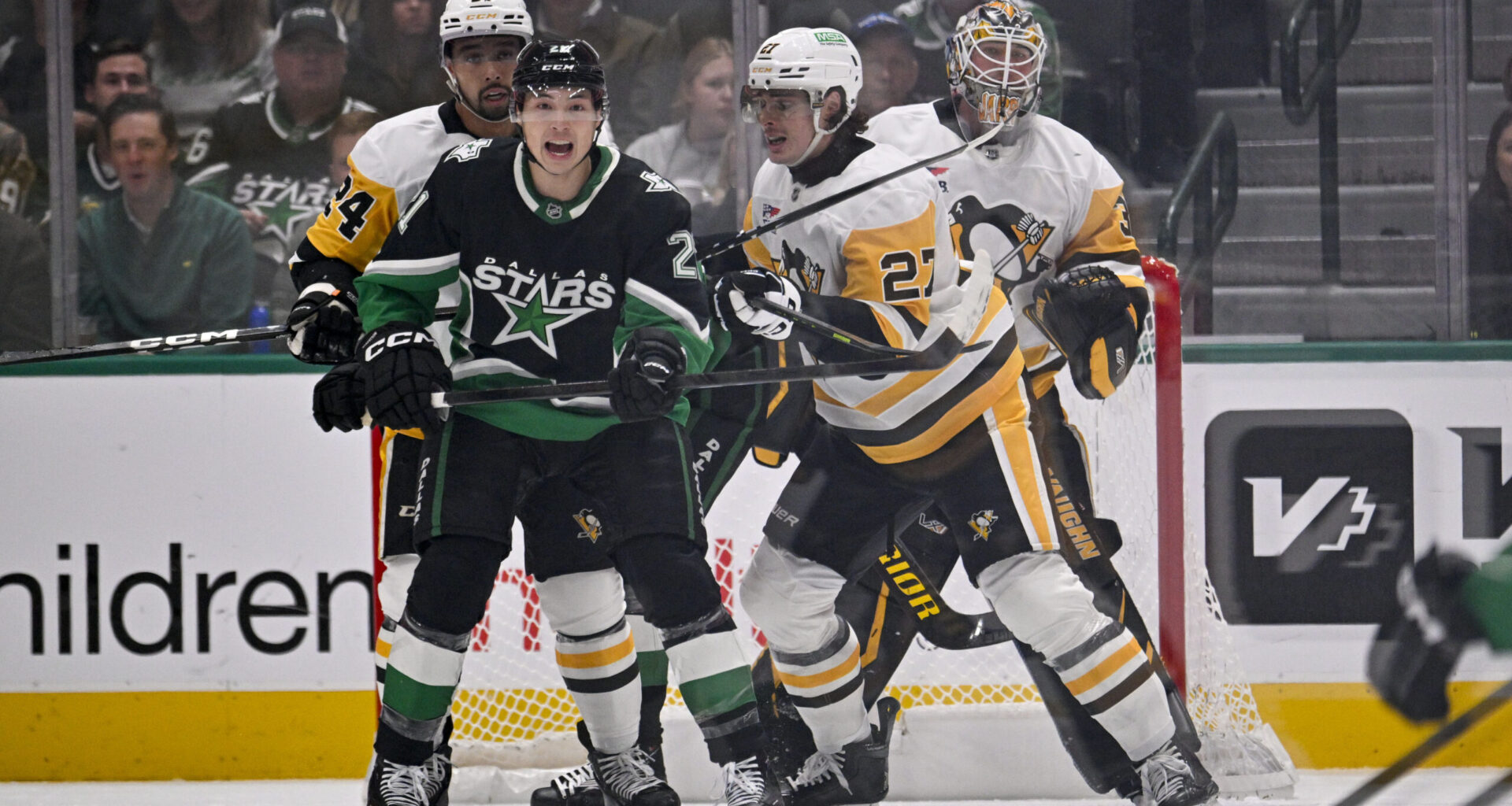
Indeed, the Penguins could field a competitive offer for Robertson if he and the Dallas Stars remain separated in contract talks, but it would cost something akin to Rickard Rakell, Rutger McGroarty, and a first-round pick.
Even that seems dubious given Rakell’s age (33), and McGroarty’s currently unknown ceiling. Will opposing GMs demand prospect Bill Zonnon? Or prospect goalie Sergei Murashov?
They will certainly ask.
Settling into something potentially more doable for both sides would be a package of Rakell, Will Horcoff, and a first for Robertson? Make no mistake, other teams will not simply accept a deal because it’s fair. Deals of this magnitude have multiple bidders, personal politics, and if the giver doesn’t wince in at least a little bit of pain, then it doesn’t get done.
This season, Robertson notched his third career 40-goal season by potting 45 goals with 96 points in 82 games. He is an elite LW, and Dubas’s leverage in any talks for Robertson would be the player’s pending UFA status on July 1, 2027, at the ripe old age of 27.
The factors working against the Penguins in this or any other deal would be the number of other teams with more attractive players and/or prospects and the number of other teams willing to participate in any trade auction.
The biggest fish on the market are Matthews and, yes, Connor McDavid, who gave the Edmonton Oilers a timeline to get their act together, but the organization has thus far looked more like a bungling sequel to a Jim Carey movie. Pretty much any Jim Carey movie.
It would be presumptuous to say absolutely not, but the Penguins simply do not have the horses to trade in such a blockbuster. Both of those centers are under contract for two more seasons and the cost would to acquire them will essentially be replacement value, or all of the Penguins prospects.
Not some of the Penguins’ prospects, ALL the Penguins’ prospects. Edmonton will not take Martin Gelinas, Jimmy Carson and three firsts for McDavid.
Veterans, Realistic But Reaching
**Jason Roberston
**Andrei Svechnikov
**Jordan Kyrou
**Brock Boeser
Perhaps Dubas likes Kyrou, who should cost a little bit less than Robertson, but had three-straight 30-goal seasons before this year’s collapse to 18.
There are other names floating in the NHL trade rumors, such as Brady Tkachuk, Robert Thomas, and Alex DeBrincat, but their availability is dubious at best. Drake Batherson’s name popped up in trade rumors last season, but Ottawa GM Steve Staios and Batherson aggressively shot them down, too.
Of course, there also exists the possibility of more disgruntled players or those who do not wish to remain in their current situation but who have not yet been outed. In the recent past, Carolina Hurricanes winger Andrei Svechnikov has had go-rounds with coach Rod Brind’Amour about his place in the lineup and usage.
Svechnikov, 26, has three years remaining on his current deal with a $7.75 million AAV and has 70 points this season, including a career-high 31 goals as he played on the top line with Sebastian Aho. However, Svechnikov’s speed and offensive instincts could make him an elite winger in a different situation, with 31 goals as a baseline rather than a top-end.
Another playoff loss could signal to Svechnikov to push for new scenery.
The Vancouver Canucks are in all sorts of trouble and chaos, and Brock Boeser might be a player more easily pried from the Pacific.
Boeser, 29, would cost significantly less than the bigger names on the market because his production is above average, but not worthy of elite status. Two seasons ago, Boeser scored 40 goals and 73 points in 81 games, but has only scored 25 and 22 over the last two seasons, respectively. The winger, who can play on both sides, just completed the first year of a seven-year deal with an average annual value of $7.25 million.
The primary notables are almost exclusively forwards. After all, defensemen are in such demand that teams do not give them up, but for the record, Cale Makar and Quinn Hughes will be UFAs next season.
The murmurs have started, though the full throttle trade rumors are currently taking a backseat to Dubas’s comments on bringing back Evgeni Malkin. Of course, perhaps the two issues are linked as well.
Tags: jason robertson kyle dubas nhl trade Penguins Trade Pittsburgh Penguins
Categorized:Penguins Trade Talk