

I thought I would pull together a list of my favorite ideas for IRAs. Along with 401(k)s, the tax advantages of IRAs make them great long-term savings vehicles. I broke my choices into three groups: keep it simple, maximize tax advantages, and go for capital appreciation.
In my own IRA, I have just one fund, Vanguard Capital Opportunity VHCAX. I established the account in the 1990s and have left my hands off since then. With a wide array of options in my 401(k) and, of course, in taxable accounts, I felt there was no need to complicate the process with more funds. If I had a less appealing 401(k), I probably would have broadened my reach.
In 2026, investors under 50 can contribute $7,500, and those 50 and over can contribute $8,600 to their IRAs.
Keep It Simple
No need to complicate things: Pick a great fund, put it in your IRA, and call it a day. Target-date funds are the best of the lot as they are low-cost and wide-ranging, and they manage the shift toward fixed income for you. Because target-date funds now live at the heart of 401(k)s, fund companies are devoting tremendous resources to researching the optimal glide path and monitoring investments. Just select the retirement year closest to yours.
We like target-date funds from Vanguard, T. Rowe Price, American Funds, and iShares the best.
Vanguard Target Retirement 2030 VTHRX invests primarily in four index funds, and it costs you only 8 basis points all in. The 2030 fund has 37% in fixed income and 4% in cash. Longer-dated target-date funds have more in equities.
Vanguard Total World Stock Index VTWAX is another fine one-stop option. You get exposure to the world via the FTSE Global All Cap Index. It only costs 9 basis points, and over the life of your IRA investment, those low fees will compound to increase your portfolio nicely. You can also choose the exchange-traded fund version (ticker VT) for 6 basis points.
Another option is a balanced fund, which would help you to dial down the risk. If your overall portfolio is very equity-heavy, this could be a useful option. T. Rowe Price Balanced RPBAX invests across seven actively managed T. Rowe Price strategies, and it adjusts those exposures tactically. This is a US-centric fund, so you won’t get the global exposure that you do with the above two funds.
Vanguard Wellington VWENX is a compelling balanced fund that generally keeps a 65% equity/35% bond mix. The equity side is a quality income portfolio, while the bond side is a moderate investment-grade portfolio. The venerable fund is coming up on its 100th anniversary in 2029, and its prospects are bright for the next 100.
Favorite Tax Plays
Some strategies are tax-inefficient because they throw off a lot of income or capital gains or both. So, they are best held in tax-sheltered accounts such as 401(k)s or IRAs. Often, these are supporting-player strategies, so be sure to have good core holdings at the heart of your IRA if it is playing a big part in your retirement.
Taxable-bond funds are the obvious place to start. You can hold municipal bonds in your taxable accounts and taxable bonds in your IRA and 401(k). High-yield bond funds and bank loans are two obvious areas.
Fidelity Capital & Income FAGIX and PGIM High Yield PBHAX are two of our favorite high-yield funds. High yield is a little tricky for investors because the big yields provide immediate income that will cover your bills, but about every five to 10 years, we have a recession and credit meltdown in which these funds suffer double-digit losses. So, they really don’t work as short-term investments. In an IRA, they work nicely when you are starting to tap your accounts in retirement, as the income they provide can fund a money market that you withdraw from.
Managers Mark Notkin and Brian Chang are aggressive investors at Fidelity Capital & Income and will shift assets among high yield, stocks, and cash, depending on the opportunities. Their tactical moves have worked nicely for the fund.
At PGIM, Robert Cignarella makes excellent use of a deep and experienced team that researches high-yield bonds. The fund has had success with issue selection, although it did lose more than its peers in the 2022 correction.
Treasury Inflation-Protected Securities are also solid investments for your IRA. They provide inflation protection by going up or down with inflation. However, those adjustments are taxable, so TIPS are not your friend in a taxable account. Vanguard Short-Term Inflation-Protected Securities Index VTAPX is still my favorite because it’s cheap, and its low duration helps you to isolate inflation protection without much interest rate risk. I own this in my 401(k).
I like a little protection against rising interest rates, the sneaky cousin to climbing inflation and the biggest threat to bond portfolios. T. Rowe Price Floating Rate PRFRX earns High pillar ratings across the board, and Fidelity Floating Rate High Income FFRHX has two High ratings plus an Above Average for the Parent Pillar. Bank loans adjust their coupons based on changes in interest rates, so rising interest rates don’t take bites out of their prices the way they do with conventional bonds. Returns and fees are pretty similar, though Fidelity Floating Rate High Income has a higher yield of 7.19% compared with 6.89% for T. Rowe Price Floating Rate. The Fidelity fund was taking on more credit risk as of its most recent portfolio; it had 17% in CCC rated issues compared with 10% for T. Rowe.
If you want funds that pull out all the tricks to generate income yet do so in a well-researched, risk-conscious way, consider some of our picks in the multisector bond Morningstar Category. They can invest in high yield, foreign debt, bank loans, and more. Pimco Income PONAX is a giant fund run by the skilled Dan Ivascyn, who is very good at pulling compelling ideas from across the firm and putting them to work.
I also like JPMorgan Income JGIAX. The core of the portfolio is made up of high-yield bonds and securitized debt, such as mortgage securities. Management also makes tactical moves to dial up or down risk levels depending on its read of the macroeconomic situation.
Going for Growth
If you want to use tax-free compounding to maximize capital appreciation while the rest of your portfolio provides diversification, here are some ideas.
Dodge & Cox Global Stock DODWX is another favorite. The value group’s global reach opens up maximum potential returns, as it has proved adept at investing both in the US and the rest of the world. I like the firm’s stability, too, for such a long-term-focused vehicle.
Vanguard Primecap VPMAX is the growth version of Dodge & Cox. It has a deep, stable team that’s focused on the long-term fundamentals of a company. Both firms have brilliant investors whom I trust to come up with great stock picks. To be sure, large growth is a tumultuous place right now, but we’re talking about a place to invest for 20 years or more here.
American Funds New World NEWFX straddles emerging and developed markets because it focuses on revenue from emerging markets rather than share listing in emerging markets. For a long-term play, that’s not bad. The chief draw here is American’s deep pool of managers and analysts who go deep on companies around the globe. Fees are modest, and prospects are bright. I own this in my 401(k).
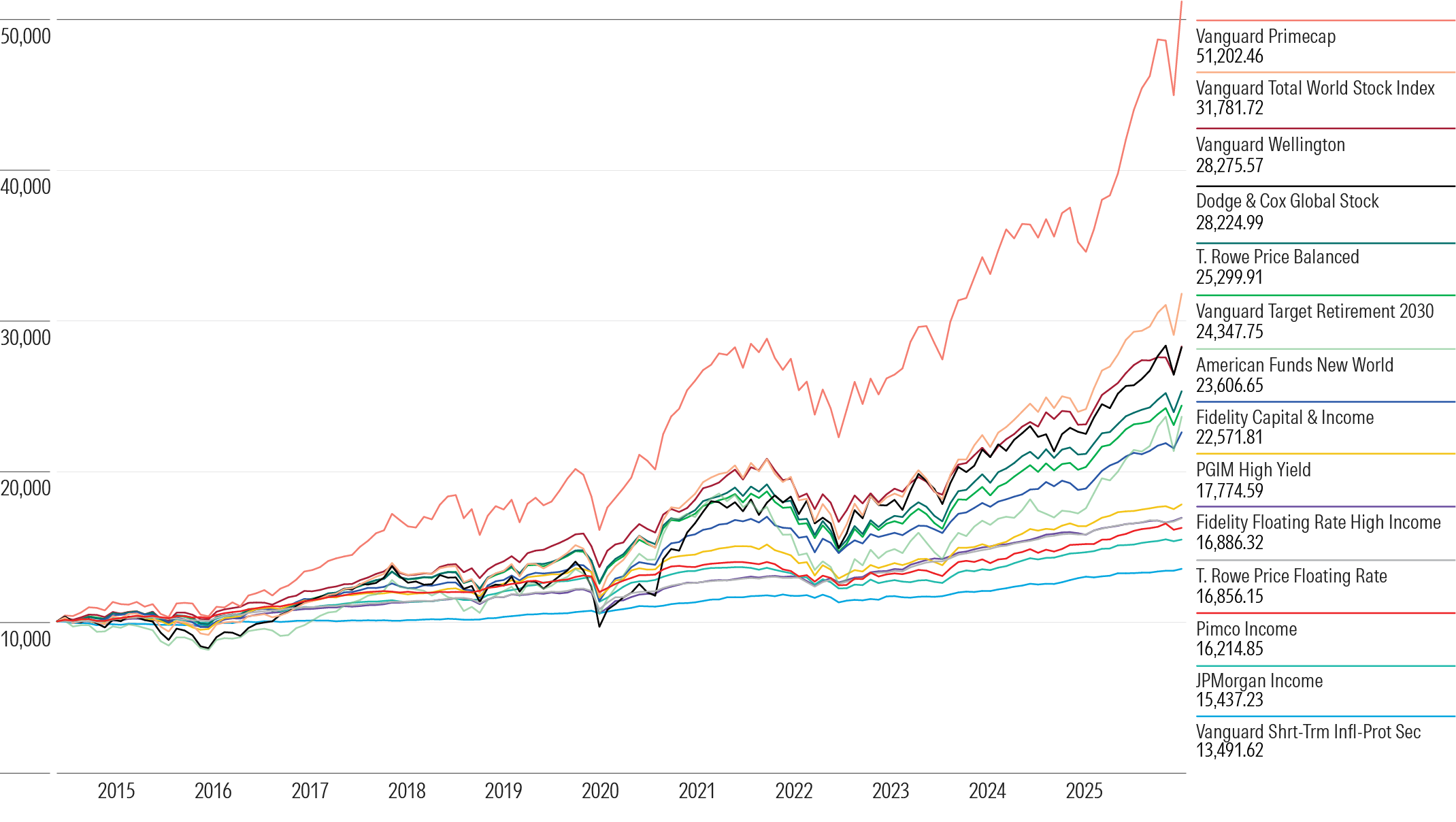 Source: Morningstar. Data starts with the youngest fund’s inception date in 2014 and goes through May 8, 2026.
 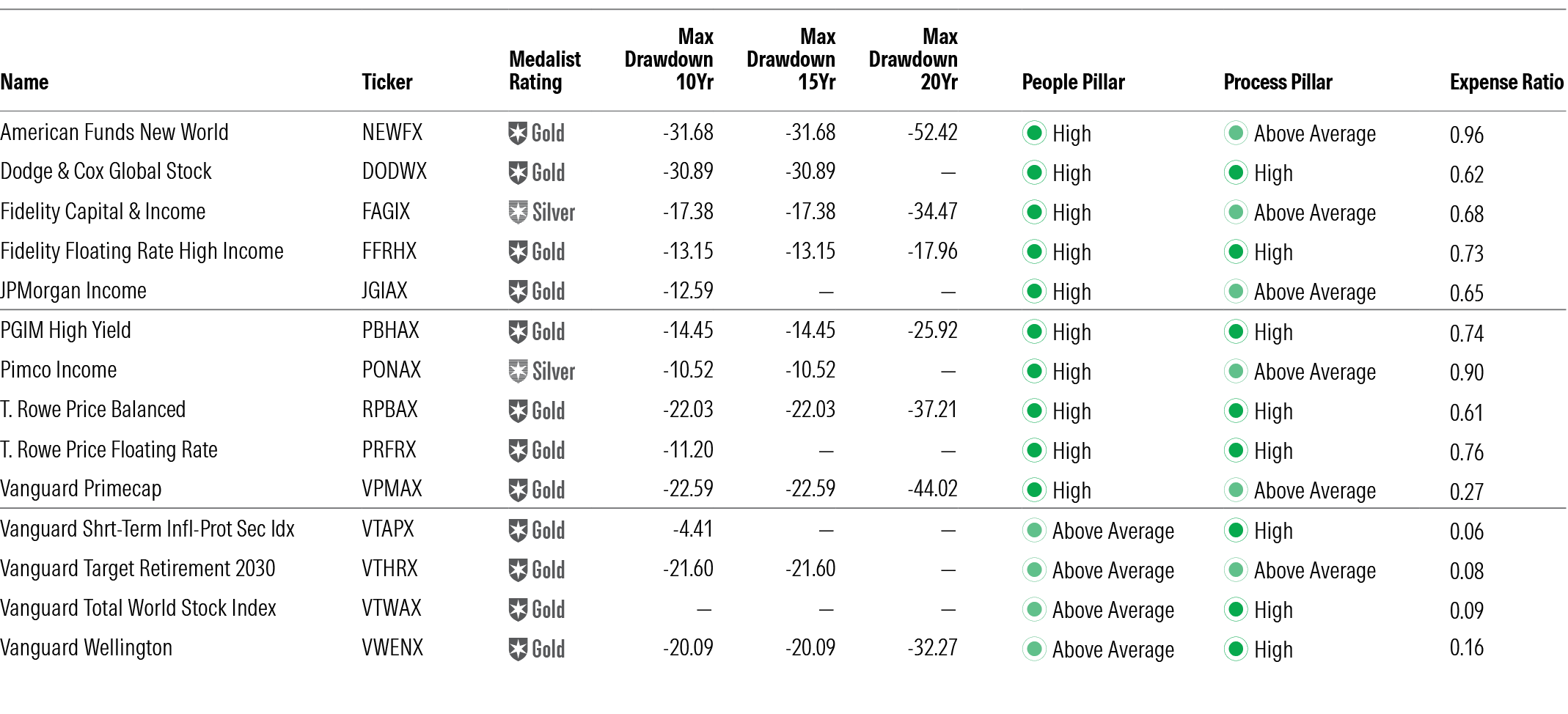 Source: Morningstar. Data as of May 8, 2026.
Since this article first appeared in the April 2026 issue of Morningstar FundInvestor, one fund was lowered to a Morningstar Medalist Rating of Neutral, and I removed it. Download a complimentary copy of FundInvestor by visiting this website.