
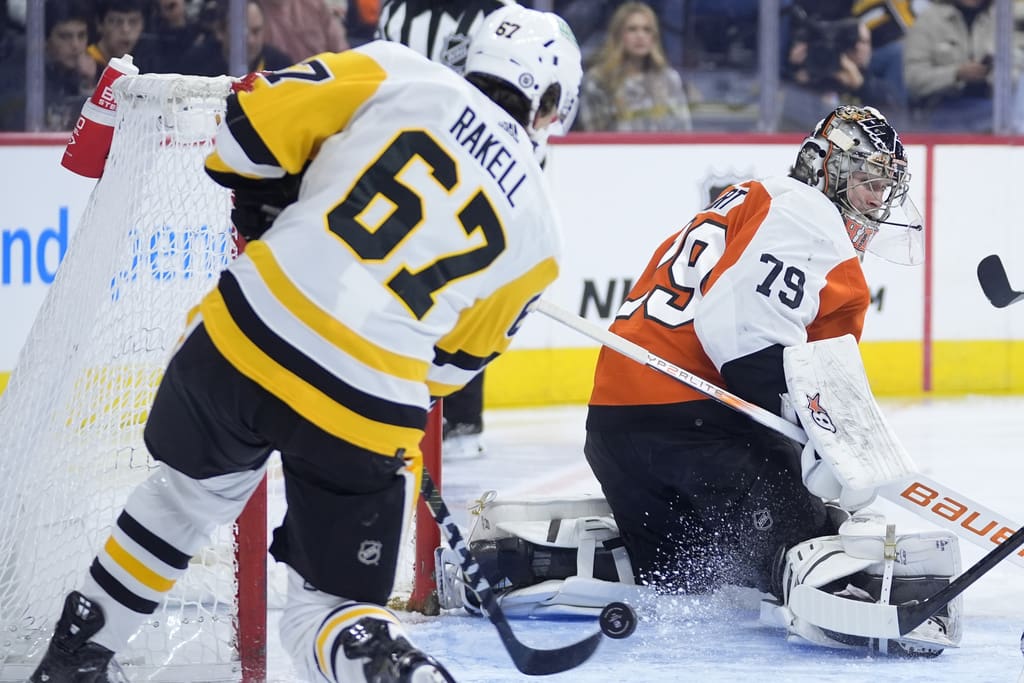
For some, report card day was a cringeworthy experience as bad grades and teacher comments pointed out not only academic shortcomings but behavioral, too. For others, it was a moment of affirmation and praise. As PHN continues its offseason report card series, the grades and analysis for Rickard Rakell are unlike any other in the class.
Rakell, 33, finished the season with 48 points, including 24 goals in 60 games, which are steep drops from his career highs of the previous season (35 goals, 70 points), and he even shuffled around the Penguins’ lineup.
Yet, it might have been one of Rakell’s best seasons. Somewhat ironically, his success might have been bad for the Penguins, and still may have increased his trade value. There is heavy nuance in judging Rakell’s overwhelmingly positive season.
Indeed, Rakell’s season was deep fried in nuance, from a slow start, to a scorching hot streak, mismatched advanced analytics, all while coach Dan Muse made a big move to put him at second line center later in the season, and then an equally big move to put him back on Sidney Crosby’s left wing during the Penguins’ ill-fated comeback attempt in Round One against the Philadelphia Flyers.
The PHN grades are based on the final performance judged against expectations. And in such, perhaps it was a little bit foolish to expect Rakell to again score 35 goals, but not so far from reality to expect him to be a consistent contributor.
Final Grade: Rickard Rakell: B+
Rakell was the stopgap top-six center following the Olympic break while captain Sidney Crosby healed from a torn MCL injury. After a few games and experiments, on March 7, Muse reshuffled his lineup to put Rakell at 2C and relieve some of the scoring pressure from rookie Ben Kindel, who had been centering Rakell and Bryan Rust in Crosby’s absence.
At first, Rakell centered Avery Hayes and Kevin Hayes. That didn’t stick, and Crosby returned a week later, but in April Muse moved Rakell back to the middle with Evgeni Malkin and Tommy Novak.
Rakell had sparingly played center before with tepid results, but this time, the slick forward exploded for 23 points in 16 games, including 12 goals, all the while juggling different positions.
However, Rakell’s success in the middle also changed the team. The Penguins shifted toward a more open, high-powered offensive attack, drifting from their more conservative, gritty offensive ground game. With the greater reliance on the rush game, the Penguins surged into a playoff spot and second place, claiming their first post-season berth since 2022.
The downside for the Penguins is that their talented future Hall of Famers having success in that style makes it more tempting to abandon other responsibilities than an open bag of chips, but when the Flyers closed that bag, the Penguins got stubborn, and angry, and frustrated. The Penguins were a victim of their own success, and that success was launched by Rakell’s success.
Rakell did himself and the Penguins a lot of favors by playing improvingly well in the middle. His faceoff proficiency improved by leaps and bounds from nearly incompetent to only slightly below average.
Throughout the season, Rakell played with his typical speed and finesse, but he was also noticeably harder to play against, both defensively and deep in the offensive zone. That hard play in the corners and defensively didn’t abate when he wasn’t scoring, and in fact, it might have increased.
Rakell’s future with the Penguins could be somewhat tenuous. Penguins general manager Kyle Dubas admitted that Rakell was available at both the 2025 NHL trade deadline and through last summer, but the offers didn’t meet his threshold. While Dubas specifically said the price for Rust was “sky high,” a similar ask for Rakell was assumed.
Rakell’s turn in the middle might have done enough to convince a rival GM who needs a top-six forward or second-line center capable of putting digits on the scoreboard. At 33 years old with two years remaining on his contract, this summer would be the peak of Rakell’s trade value.
His shooting percentage was competitive with last season, his scoring chance rate and expected goals for were also on par with his career year. Had Rakell played more than 60 games or been more offensively proficient in the first couple of months of the season, his grade would have been a resounding A+.
But he might have played so well that Dubas gets an offer he cannot decline.
Tags: Penguins report card Rickard Rakell
Categorized:Penguins Analysis Penguins Offseason Analysis