
The United States’ Natural Resources Conservation Service on Thursday issued a dire forecast for Western states, ahead of what’s expected to be a very active wildfire season.
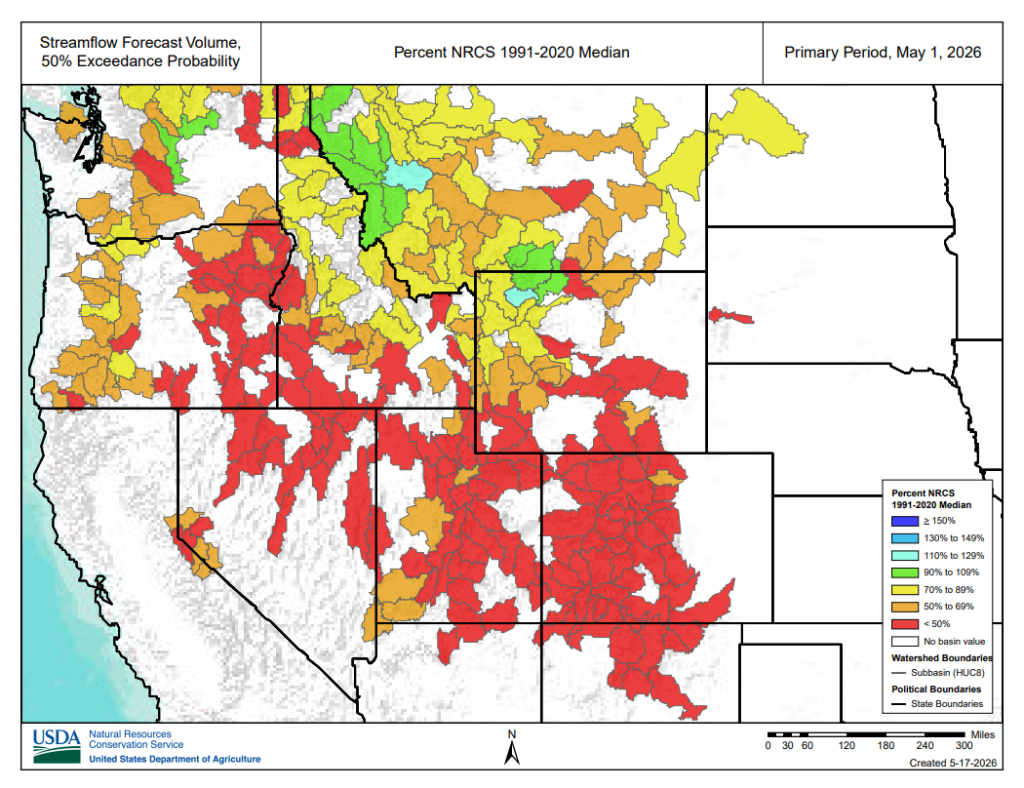
The Service, overseen by the Department of Agriculture, said many of the states’ rivers are expected to have extremely low streamflows for the spring and summer seasons.
“Many of the rivers are likely to experience well-below median streamflows, which may rival the lowest flows on record for the region,” the Service said in the Department’s most recent Water and Climate Update. “Water shortages are anticipated in many locations, especially for entities that rely on surface streamflow water, without the benefit of having access to stored reservoir water.”
Service officials said the low streamflows will have major impacts on wildlife, recreation, city municipalities, power generation and agriculture.
 Credit: USDA
“Unfortunately, this year in the West and southern tier, it has been very dry and very warm,” Physical Sciences Laboratory research meteorologist Andrew Hoell recently said. “We’re talking about some historically warm conditions and at the same time below average precipitation. That sets up the land surface to be able to burn.”
Hoell was the lead author of a recent study that found the “La Niña” and “El Niño” phases of a fluctuating water temperature climate pattern called the El Niño-Southern Oscillation act as accurate predictors of wildfire severity up to a year in advance. The pattern entered its La Niña phase last fall, and was followed by the historic snow drought and early spring heat wave, which created drier and more flammable fuels.