


The rape of Europa, by Titian
On Sunday I argued against the widespread depiction of Europe’s economy as moribund because its productivity growth has lagged America’s. The productivity numbers aren’t wrong, exactly, but they are misleading: America’s faster growth reflects its dominance of a narrow sector, IT, and has not translated into lagging European productivity measured in terms of the value of the goods an hour’s labor can produce.
In laying out this argument I relied on data from the World Bank. As some economists pointed out to me, however, estimates from the International Monetary Fund look somewhat different. This is odd, and I’ll look into the discrepancy.
I am, however, fairly sure that the picture I derived from World Bank data is right, partly because the story fits together, but also because it turns out that a third source, the Paris-based Organization for Economic Cooperation and Development — which is good for many kinds of data! — has estimates of exactly the variables I’ve been talking about. Namely, productivity per hour at constant prices, which is what the misleading numbers focus on, and PPP in current prices, which is actually the relevant variable.
The source is the OECD Data Explorer. Here’s productivity in the euro area relative to productivity in the US, at constant and current prices:
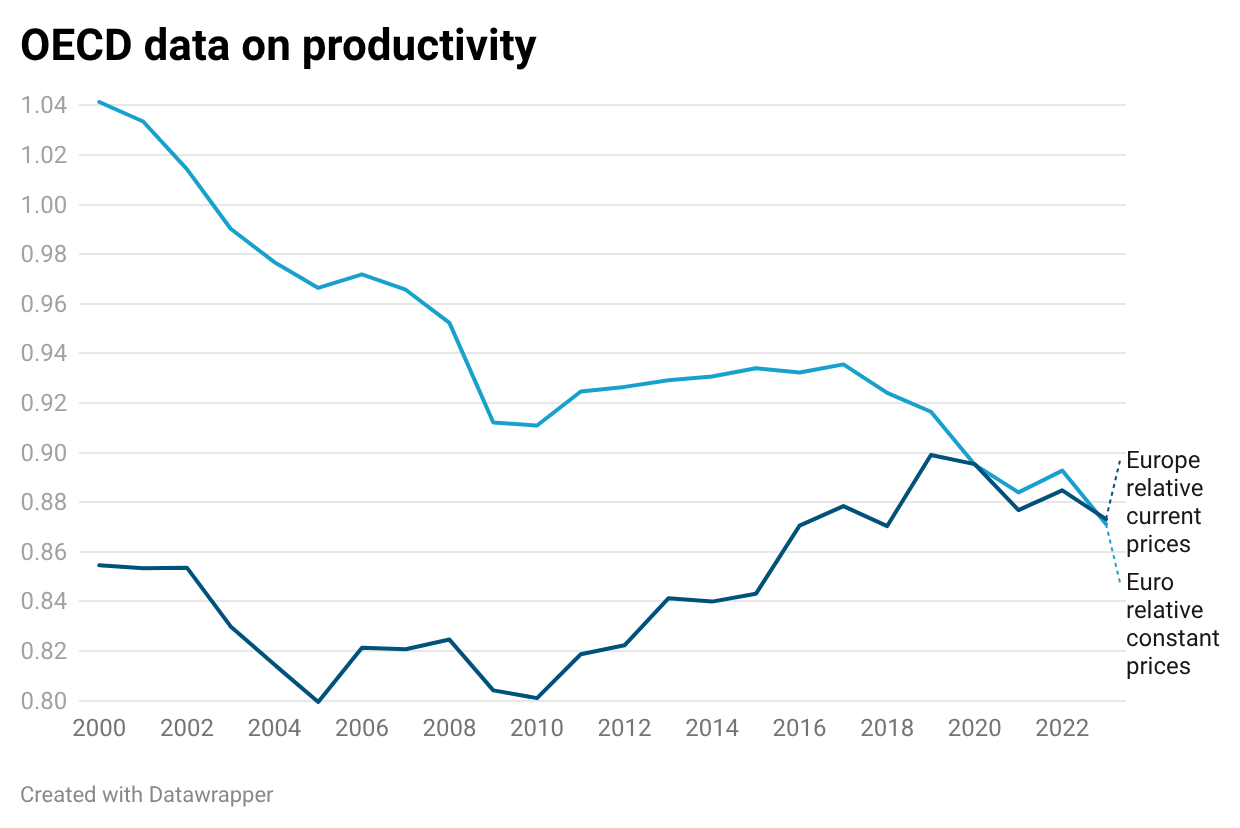
That’s the same story I told yesterday: European relative decline if you use constant prices, no trend using current prices.
Again, I am not saying that all is well with Europe. But the common diagnosis of the continent as a museum, unable to keep up with modern technology, rests on bad data analysis.