
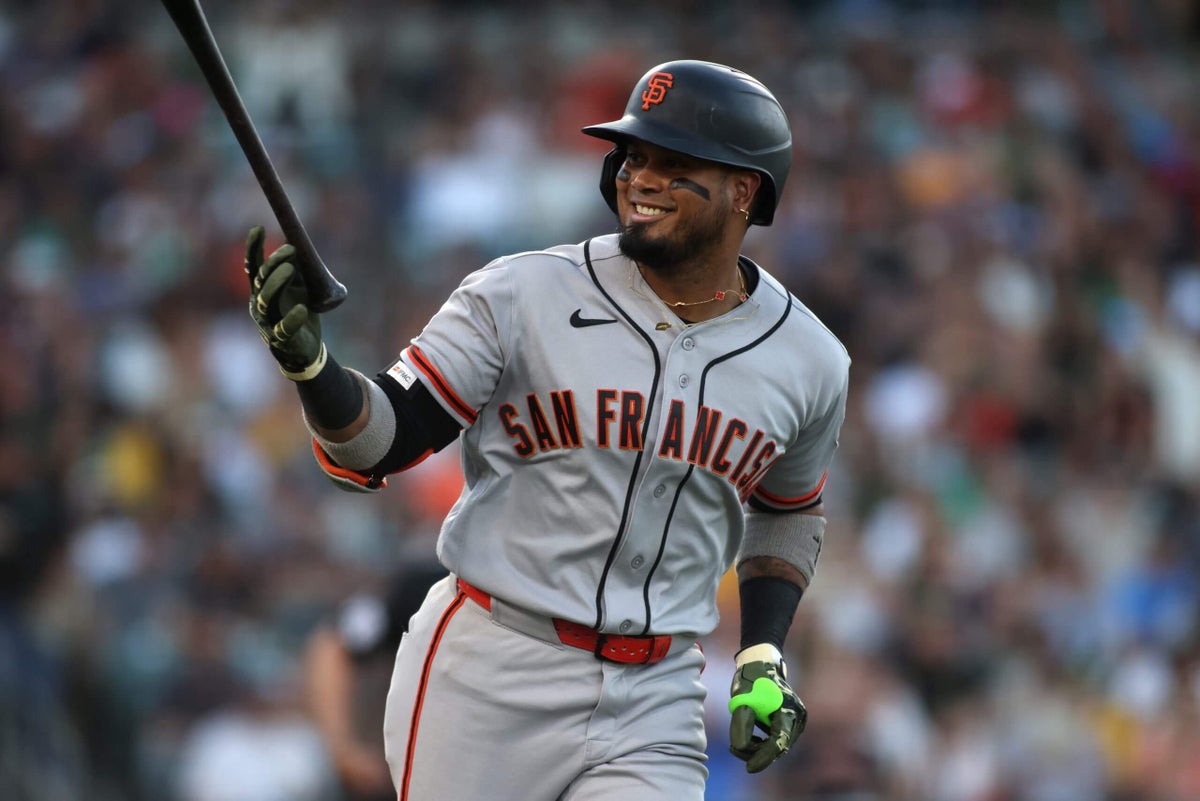
With two outs in the ninth inning of Friday night’s San Francisco Giants game, Luis Arraez singled up the middle for his fourth hit. Giants announcer Duane Kuiper was optimistic — not that the single would lead to a comeback victory, necessarily, but that the extra at-bat for Matt Chapman, up next, could turn his season around. “Sometimes, all it takes is one at-bat,” Kuiper said.
Chapman ended the game by hitting a ball so poorly, so awkwardly, that it started in foul territory, then rolled back into play. The exit velocity was 50.1 mph, the launch angle was -66 degrees and the official distance traveled was one (1) foot. It could, perhaps, end up being the worst-hit fair ball of the 2026 season. It was not the hit that turned Chapman’s season around. It was not the hit that turned the Giants’ season around. It was just the final out of a 5-2 loss to the Athletics.
It felt close to a breaking point. It was almost time for people in and around the Giants Cinematic Universe to call for Big Changes, even though the definition of Big Changes would have been vague to the point of being nonsensical and completely unhelpful. The yelling would have felt good in the moment, though.
In the two games following that final out on Friday, however, the Giants scored 16 runs and collected 24 hits. They probably should have scored a lot more runs, considering they were 3-for-17 with runners in scoring position on Saturday, with all sorts of hard-hit outs sprinkled in throughout the weekend. All of the hitting was enough to get the Giants out of the cellar in a lot of offensive categories. They’re no longer last in home runs, leapfrogging the Brewers, Red Sox and Marlins. They’re now ahead of the Padres, Blue Jays and Mets in adjusted OPS. The aforementioned Chapman was all over both games, with well-timed doubles and runs driven in.
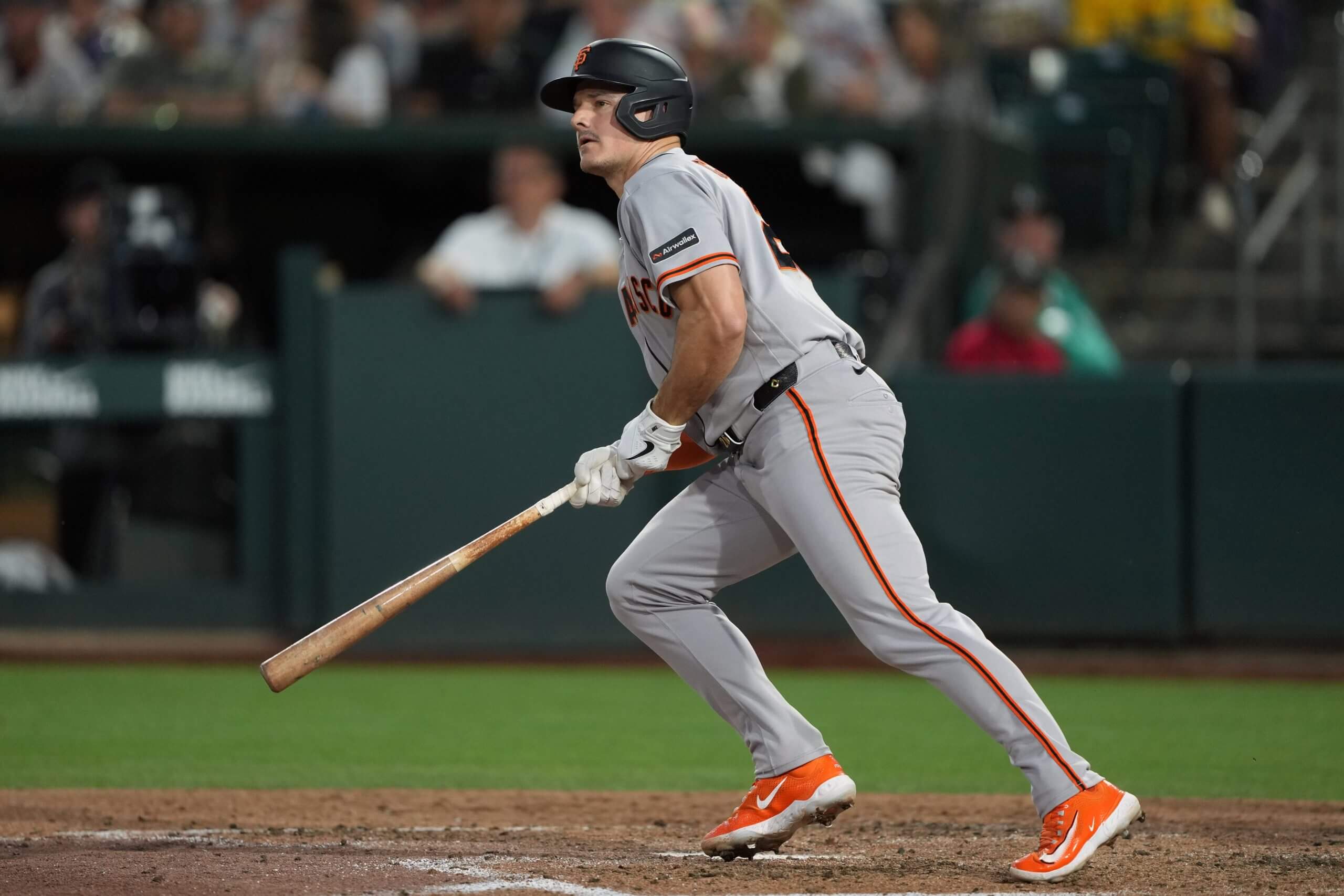
After two strong games this weekend, is Matt Chapman finally back on track? (Darren Yamashita / Imagn Images)
If you’re not familiar with the it’s so over/we’re so back meme, now’s a great time to catch up, because it’s apparently going to be the theme of the Giants’ season. Good luck to you and your poor brain if they don’t stick to one identity or the other. In the most basic zoomed-in view, the Giants have surpassed expectations for the road trip so far, and success against the Diamondbacks would make for an unambiguously excellent road trip. The obvious counterpoint is that every time they get close to making you feel better, they step on a rake, and, boy, does it keep happening, over and over again.
The question before us: Can the Giants actually hit?
Before the season, the answer seemed obvious. Yes, they were going to score some runs, but the pitching was going to be an issue, especially the bullpen. So far, the actual problem has been the exact opposite, with a top-10 bullpen by ERA and expected ERA and a lineup that can disappear for weeks at a time.
I have a half-baked theory, though. It’s almost three-quarters-baked, with just a tiny bit of goop on the toothpick when you pull it out. It starts by looking at what hasn’t changed for the Giants. It also doesn’t answer the question, but we’ll get to that. Here are some year-to-year numbers that have remained relatively static:
Statistic
2025
2026
Avg. exit velo.
88.9
88.4
Bat speed
71
71
The bats are just as fast, if not a little faster, when you account for the Arraez effect. The difference between the exit velocities is nominal, and the Giants were never a bat-speed or exit-velocity darling, even when they were going well. This helps us because the lineups between last season and this season are mostly constant. If there were huge red flags, they’d show up in the numbers that measure the physical side of baseball.
The numbers that are changing are more about approach and attack plans:
Batted ball statistics, by percentage
Statistic
2025
2026
Barrel rate
7.6
6.3
Launch Angle
15
13.7
Ground ball
40.6
44.8
Fly ball
27.9
24.8
Before the weekend, the Giants were barreling fewer balls according to both Statcast and your own danged eyes, but the ground-ball rate was what really stood out. Last year, they had the eighth-lowest ground-ball rate in baseball, and that’s a stat where lower is typically better. This year, the Giants have the seventh-highest ground ball rate. Again, a lot of these are the same batters, for the most part. They’re just hitting the ball much, much differently.
But it’s not a matter of slower bats. It shouldn’t be a matter of age-related decline, not yet. This is why the 2026 Giants are so maddening.
Let’s go back to the half-baked theory. It has to do with what’s changed, and it’s a two-parter. The first is that the league has changed, almost certainly because of ABS. There are more walks than there have been in a long time:
Season
BB%
2026
9.4
2025
8.2
2024
8.6
2023
8.4
2022
8.2
The Giants, on the other hand, are dead last in walks by a mile. Whatever the rest of the league is picking up on, the Giants are running in the opposite direction. And, again, these are mostly the same players. They were excellent at drawing walks months ago. Months!
Another thing that’s changed, though, is that the Giants are attacking the ball differently. As in, their bats are literally traveling differently through the zone, and it hasn’t been a good change.
Attack angle by season
2025: 10 degrees
2026: 8 degrees
Attack angle is a new enough stat to where I’m not going to pretend to be an expert on it, but it’s definitely a number that allows you to say “something’s changed.” The Giants are attacking the ball differently than they did last year.
At the same time, according to Baseball Savant, the league is pitching up more. It might or might not be related to ABS, but the change is dramatic:
Season
High pitch %
2026
20.6
2025
17.7
2024
17.8
2023
18.4
2022
18
Think of this like the difference between a .270 hitter and a .300 hitter — it doesn’t seem like much, percentage-wise, but the difference is both substantial and noticeable. So as the Giants are attacking the ball differently, the league is showing off a new look. The combination has been screwing them all up. They’re hitting more grounders in an increasingly fly-ball league, and their chase percentage is shooting up. It’s not helping that they’re seeing hotter fastballs than almost any other team in the league.
The half-baked theory is that in an effort to increase the team’s bat-to-ball skills, they’ve become more vulnerable to chasing down as they’re increasingly worried about pitches at the top of the zone, which the league is throwing more than they were expecting. That’s how you get more grounders and fewer walks as the rest of the league is going in the other direction.
Again, there’s more than a little muffin goop on this toothpick, and I wouldn’t swear by this specific theory, but the Toronto Blue Jays also come up in a lot of these searches for the worst-hitting teams in 2026, and their pennant-winning, bat-to-ball lineup was an offseason model for teams like the Giants. Both teams are struggling in a similar way this season, with the Blue Jays ranking 29th in walks, just ahead of the Giants, in a league where everyone else is walking at a much higher rate.
There’s an adjustment to make on the offseason tweak, in other words, and here’s where it gets tricky to assign blame. It takes a village to put an attack plan in a hitter’s brain, and somewhere along the way, it got all screwed up. It’s hard to know who the loudest voice in the room is when it comes to the organizational attack plan for hitters, but it didn’t work. Not only did it not work, but it was implemented as the league started attacking hitters differently. It’s like the Giants put on an extra layer of clothes for the snow, only for the temperature to rise 10 degrees, a miscalculation that made the original correction much worse.
If there’s good news, it’s that this seems like something that can be fixed. You’d much rather have problems with a team’s approach than a team’s physical capabilities, at least in theory. Think of the Giants like a pitcher who needs to work on his mechanics, not one with declining velocity and a barking elbow. You’d much rather have the former than the latter, a pitcher like Kyle Harrison, say.
So maybe the Giants can be the Kyle Harrison of baseball teams, if that makes you feel better. Which it does not.
You get the idea, though. The Giants made offseason adjustments, but were preemptively out-adjusted by the league out of their cleats. Now it’s time to readjust. Maybe the weekend was a sign that they’ve already done so, and they’ll wind up being the competent-to-strong lineup they were expected to be in the first place.
That’s not guaranteed. The 2026 Giants might be a team that’s designed to struggle against a league that throws more pitches up in the zone, and the expected adjustments might never come. But if you’re looking for reasons to help explain why this team is so different this season, even with a lot of the same players, here’s a start. The league changed around them, and it’s up to them to figure it out. Maybe they already have.