
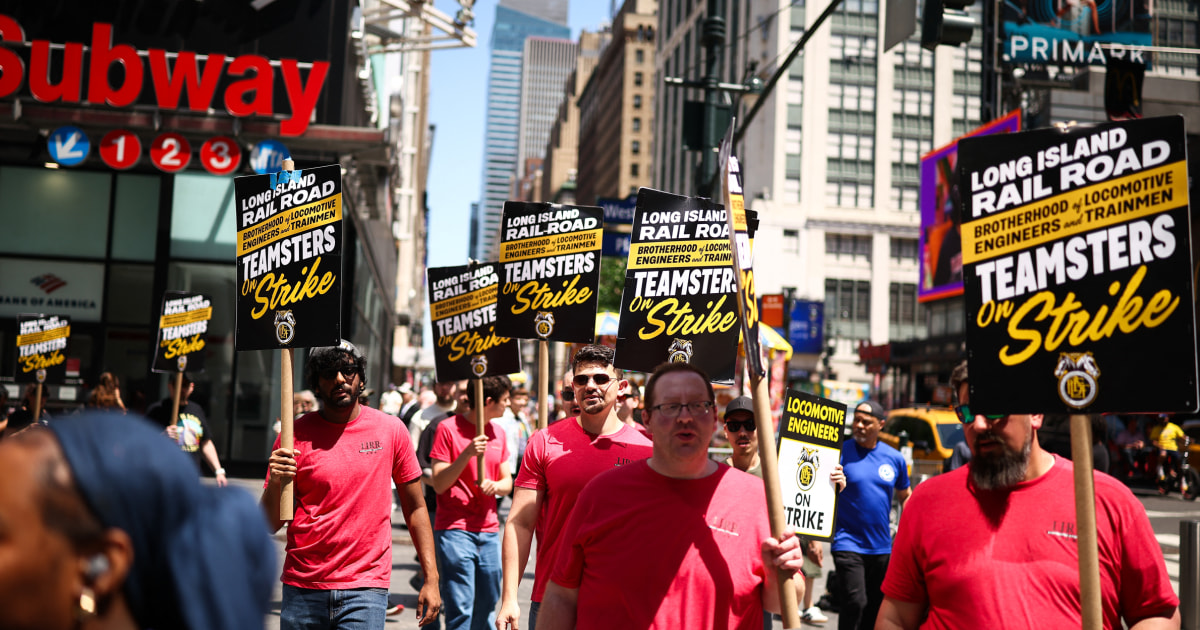
It was manic Monday for thousands of Long Island Rail Road riders trying to get in and out of New York City on the third day of a labor strike that has shut down the nation’s largest commuter railroad.

Subscribe to read this story ad-free
Get unlimited access to ad-free articles and exclusive content.

This was the first weekday test of the alternate travel plans that the Metropolitan Transportation Authority and government officials drew up for the more than 250,000 commuters who ride the LIRR on workdays.
But as the evening commute got underway, union leaders warned that this could be the new normal for a while after another round of negotiations ended without an agreement.
“Unfortunately, from our perspective, in true MTA fashion, it’s take two steps forward, and one step back,” Kevin Sexton of the Brotherhood of Locomotive Engineers said after the talks wrapped up Monday afternoon. “Every time we think we’re close to a deal, it’s always a counter.”
Earlier, MTA lead negotiator Gary Dellaverson said the unions “have shown us that they have no sense of urgency of getting this resolved.”
Sexton and other union leaders dismissed Dellaverson’s claim as “laughable.”
Over 3,500 LIRR employees walked off the job at 12:01 a.m. Saturday when the long-running contract negotiations broke down over the wage and cost-of-living increases that workers are demanding and which the MTA has been resisting.
Upon arriving in New York City on Monday, many commuters were greeted by the sight of dozens of striking union workers outside Penn Station and other city travel hubs chanting “No contract, no service! No contract, no peace!”
Fearing a rush hour nightmare, New York Gov. Kathy Hochul had urged commuters to work from home if possible.
“Let’s face the facts: It’s impossible to fully replace LIRR service,” she told reporters at a news conference Sunday.
But after the Monday commute was in the books, Hochul said it went “smoother than expected.”
“I do want to thank the thousands of New Yorkers who heeded our request to stay and work from home,” the governor said. “I thank their employers.”
As Hochul spoke, negotiators for the five striking labor unions and the MTA, which runs the LIRR, returned to the bargaining table to try and hammer out a deal.
The five unions are the Brotherhood of Locomotive Engineers and Trainmen (BLET); Brotherhood of Railroad Signalmen (BRS); International Association of Machinists and Aerospace Workers (IAMAW); International Brotherhood of Electrical Workers (IBEW); and Transportation Communications Union (TCU).
Hochul also met with the MTA leadership. “Our goal is to get this over as soon as possible,” she said.
Out on Long Island, Nassau County Executive Bruce Blakeman has called on Hochul to suspend congestion pricing during the strike.
“It is a shame that we will charge people in New York state an additional $9 to travel on a public roadway that they already paid for with tax dollars, especially during this strike when they have no choice in many instances but to use their cars,” said Blakeman, a Republican who is trying to unseat Hochul.
Congestion pricing is designed to reduce gridlock and pollution while funding public transportation. It is opposed by many Republicans, most notably President Donald Trump, who has endorsed Blakeman against Hochul.
Hochul has said there’s no “legal mechanism” to suspend congestion pricing.
“Anyone who tells you they can doesn’t understand federal law,” the governor said.
In advance of the first LIRR labor strike since 1994, the MTA mapped out emergency transit alternatives, including free shuttle buses from seven locations in Long Island to two subway stations in Queens and additional subway service.
New York City Mayor Zohran Mamdani posted on X that police officers will be deployed along major roadways and inside subway stations to “ensure traffic is moving, prevent illegal parking and keep commuters safe.”
Mamdani also said inspectors are making sure parking garage operators aren’t jacking up rates for motorists driving in from Long Island by reminding them “that parking rates cannot be increased without the required 60-day notice.”
MTA officials have blamed union leadership for walking away from negotiations, saying the transit agency remained willing to continue bargaining.
“We made it clear we are available if they want to come back and negotiate,” MTA CEO Janno Lieber said Sunday. “They walked out and they went on strike.”
The coalition of unions representing roughly 3,500 LIRR engineers, signal workers, machinists and other workers has accused Lieber and MTA leadership of forcing a shutdown by refusing to agree to wage increases after years without raises amid rising living costs.
In a statement Sunday, the unions said the two sides were separated by less than a percentage point before talks broke down Friday night and argued the strike was “completely avoidable.”
Before the unions went on strike, New York State Comptroller Thomas DiNapoli warned the work stoppage could cause up to $61 million in lost economic activity each day. He said his estimate was based, in part, on inflation and ridership trends.