

Warmer weather is here, and more people are planning to head to the beach. But just a reminder that we’re not the only ones returning for the season. Sharks are too. And experts say they are preparing for a busy summer.
Experts are using technology like camera tags to record important data, giving researchers a sharks eye view of the world. And drones are being deployed as acoustic tags which ping every minute, letting researchers track their movements, where they hang out and with whom.
This year, the Atlantic White Shark Conservancy will be spending more time off Nantucket studying the dusky shark, which they say is an exciting new project. The dusky shark is a large species of requiem shark that can reach up to 13 feet in length. A 2025 study confirmed that they are preying on seals off the coast of Nantucket.
“Studying that dusky shark predatory beavior, that predator-prey interaction with seals in depth, it’s all very new,” said Megan Winton, a senior scientist at the Atlantic White Shark Conservancy. “I know not everybody is going to be thrilled that there’s now a second species of shark hunting for seals in the waters off our beaches.”
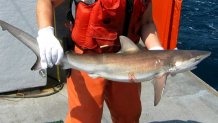
Dusky shark (Carcharhinus obscurus). (Photo by: HUM Images/Universal Images Group via Getty Images)
Beachgoers should keep in mind that their search for food can bring sharks very close to shore.
“Your depth matters more than distance from the beach because we now know that not only white sharks but dusky sharks are coming here to hunt for seals, and they do that in shallow water close to shore. We’ve seen sharks as big as 15 feet long in less than 5 feet of water,” Winton said.
Dusky sharks may be smaller and not as fast as great white sharks, but they’re just as hungry. So the advice is not to get between them and their food, and it should be a great beach day for all.
Dr. Greg Skomal, senior biologist with the Massachusetts Division of Marine Fisheries, explained that the dusky and great white sharks are just some of the many shark species seen in area waters.
“We get about a dozen or so species of sharks that visit Massachusetts waters,” he said. “I know the white sharks get quite a bit of attention, but one of the species that’s been visiting is the dusky shark. The unusual aspect of the dusky shark is it is a unique species and it also feeds on seals. We discovered this off the coast of Nantucket over the last couple years. They’re feeding on seals close to shore much like white sharks do.”
Skomal said the goal of studying dusky sharks is to better understand their behavior so they can provide information to beachgoers to enhance public safety.
And if you do see a shark while in the water, he offered this advice: “Number one, please don’t panic.” He said you should keep your eyes on the shark and then leave the water slowly, without splashing or exhibiting any erratic behavior.
“Just slowly leave the water and you’ll be fine, absolutely fine,” Skomal said. “The shark you see is not likely to be the one that is going to bite you.”