
It’s been a month since the Detroit Red Wings’ season came to an unceremonious ending.
And with another month to go before player movement picks up, fans have plenty of questions — reflecting on last season’s collapse and looking ahead to what has to change next season.
We tried to answer some of those questions in a May mailbag.
(Note: Questions have been edited for clarity and length.)
Was the Justin Faulk trade still worth it even though the Wings didn’t make the playoffs? How badly does losing a first-round pick hurt the team? — Zac B.
It’s a legitimate debate. On one hand, Faulk was tied with Lucas Raymond for fourth on the team in goals (five) and was sixth in points (eight) after the trade, so he did help the Red Wings. And they still have him for another season, in which I’d expect him to play 20-plus minutes a game in all situations. That’s all valuable, in my eyes.
But the move was made to make the playoffs, and the Red Wings did not. Meanwhile, their first-rounder, which ended up landing 15th, belongs to St. Louis. That stings extra hard for a non-playoff team, although considering the pick was stunningly left unprotected, it could have been a lot worse!
I still lean to the “yes” column, though. As much as the 15th overall pick should net a good prospect, I also don’t think it will be anything the Red Wings don’t already have. The players you’d be looking at around that range include big-bodied scoring winger Oscar Hemming, undersized puck-moving RHD Ryan Lin and big, two-way center Oliver Suvanto. And Detroit already has prospects who fit those profiles.
Maybe someone exciting slips on draft day, and I’ll feel differently. However, as of now, I don’t think the 15th pick is likely to be a massive difference-maker for their farm system. Meanwhile, Faulk makes a real, tangible impact right now.
I also want to add that, while the question gives me hindsight in answering it, I still think you have to judge these things based on the information available at the time of the deal. On the morning of the trade deadline, the Red Wings had the fourth-most points in the Eastern Conference and seventh-most in the NHL. So it was reasonable to expect the pick would be more like the 23rd or 24th — or at least the 20th — when they traded it.
I’m also just imagining what the conversation would be if the Red Wings had stood pat at this deadline, only to collapse in March. In that scenario, I think all the criticism would have been about general manager Steve Yzerman sitting on his hands, hoarding picks and prospects, and not giving his group a real chance to survive the injuries that followed. And it would have been justified!
So, to me, the Faulk trade was the right idea, though I readily acknowledge that the pick being in the top 15 hurts the value considerably.
In your opinion, what have been Steve Yzerman’s three biggest mistakes as GM over the last seven years? — Bruce E.
I’m going to exclude draft hindsight here, as every team can point to players it wishes it had picked in retrospect.
One obvious one would be the Jake Walman saga, in which the Red Wings attached a second-round pick to move the defenseman to San Jose to clear cap space in the summer of 2024, only to see him traded to Edmonton for a first-round pick later that season.
I’m sure Walman’s huge workload in San Jose helped solidify his value in the intervening time period, but it’s hard to buy that the market went from negative value in the summer to first-round value at the trade deadline.
And it wasn’t the only poor blue-line decision Detroit made that summer, as the Red Wings also let Shayne Gostisbehere walk in free agency. Detroit’s left side was certainly getting crowded, with Albert Johansson needing a roster spot, Simon Edvinsson ready to become a regular and Olli Määttä still under contract, and they were in a tough spot cap-wise, to be sure.
However, the Red Wings let Gostisbehere leave for Carolina at a lower AAV than they were already paying him ($3.2 million, compared to $4.1 million), and for only $1.2 million more than the player they tried to replace him with, Erik Gustafsson, who spent most of this past season in Grand Rapids.
Twisting the knife: Gostisbehere was quite comfortable on the right side, meaning the left-side jam didn’t apply to him. And, to top it all off, the biggest addition Detroit made that offseason — the place they ostensibly spent the cap savings from Walman and Gostisbehere — was Vladimir Tarasenko, who they traded away for nothing after just one season of a clearly bad fit. And to top it off, they also traded Määttä early in the 2024-25 season.
All of that ties into the big, overarching mistake, in my view: failing to replace Mark Howe with an official director of pro scouting when he retired in 2021. That issue was compounded by Pat Verbeek’s 2022 departure to Anaheim, as Verbeek was also highly involved with pro scouting, meaning the Red Wings lost two top pro scouting voices in short succession.
While we’ll never know the exact machinations of Detroit’s decision-making process regarding free agents and trades, it’s hard to ignore the track record since then. It’s not that Detroit has catastrophic contracts or hasn’t added any useful players. Still, the mistakes have added up (Tarasenko and Justin Holl lead the list, but the redundant addition of J.T. Compher after signing Andrew Copp a year before has aged into a predictable issue) without nearly enough real “wins.”
Trading for Alex DeBrincat and John Gibson was a major success during that period. But beyond those two, the only real high-impact “find” for more than a short-term deal was, ironically, Walman, whom they ended up losing a second-round pick to trade away.
Do you believe our current core is good enough for Detroit to become a contender before Larkin is past his prime? If not, what should Yzerman do? — Super M.
Assuming we define contender as being a top-six-to-eight team in the league, I’m skeptical, especially for a sustained length of time.
Part of that is because Larkin probably only has a few prime years left — you can argue it’s less, if you mean “peak” prime years — and Detroit doesn’t have an obvious heir apparent at No. 1 center. There are good players on the team now, and more coming, but even good prospects need time to become true impact players. And time is not on the Red Wings’ side.
It’s a tough spot to be in, and I won’t pretend to have a magic answer as to how to handle it.
However, the two real options are:
1. Do everything they can to improve the core now, adding via trade and/or free agency to try and get this team to contender status starting next year, while also banking on internal improvement from young players.
2. Start aggressively looking for a long-term potential top-line successor at center, so that you’re able to lengthen a potential window beyond Larkin’s prime.
Keep in mind, though, that Option 2 would likely mean trading at least one top player off the current roster, with no guarantee the player(s) they target will ever become a 1C.
Neither option has any guarantee of success. And in a perfect world, obviously, you’re trying to do some measure of both. But it’s a rough spot to be in, especially in a market that has exhausted its patience.
How likely is it that Bobby McCann is going to be wearing a Red Wings jersey next season? — Bruce F.
This shallow free-agent market means players such as McMann will have many options on July 1. But I certainly think he’s a strong candidate. He was on my offseason targets board last month, and I singled him out as a particularly good fit in a recent article.
The reasons are simple. McMann is one of the fastest skaters in the NHL, with a top speed in the 99th percentile, according to NHL EDGE. He has size at 6 foot 2 and uses it, with 165 hits last season (more than all but two Red Wings). And, crucially, he can score, with 29 goals last season and 20 the year before that.
It’s not a long track record, mind you, as McMann wasn’t a full-time NHLer until age 27. That leaves some uncertainty. However, his traits are exactly what the Red Wings need alongside Larkin and Raymond next season, which could help them slot their other forwards in much more naturally.
Dallas has a tough cap situation this offseason. Do you think Mavrik Bourque could be dealt? Do you think he’s what the Wings would be looking for, and is he good enough to fill that second-line center spot? — Nick M.
I think teams find a way to hang on to their good young players, but considering the Stars also have to keep Jason Robertson, maybe Bourque becomes an exception. If so, he’d be a good target, albeit not necessarily as a center. He’s more often been on the wing in Dallas, but he’s a 20-goal scorer at 24, and specifically scores the type of goals the Red Wings need more of, bringing hard offense around the net.
Even with the cap crunch, he won’t be cheap to acquire. However, he’s a worthwhile target, for sure, and the positional versatility doesn’t hurt.
I know the Wings need help with their five-on-five scoring, but I am also interested in how they use their bottom six. Who are some players they could target that can play fast, physical and chip in some goals from time to time? — Paul Z.
Minnesota’s Michael McCarron comes to mind, but I think the Red Wings’ bottom-six answers for next season are already in the organization.
Michael Brandsegg-Nygård has been a physical force in the Calder Cup playoffs and has one of the best shots in the organization. He’s ready for a third-line role next season. Carter Mazur will need to be on the roster for 2026-27 and would bring grit and some scoring potential to a fourth-line role. And if the Red Wings can find a top-line left wing, they can bump Emmitt Finnie down the lineup to bring his speed and tenacity to the third line. That’s before considering Nate Danielson, too.
So while there’s room for a heavy, physical addition such as McCarron in the bottom six, for me, the priority still has to be at top-line left wing. The Red Wings’ young forwards are ready to bring those other elements.
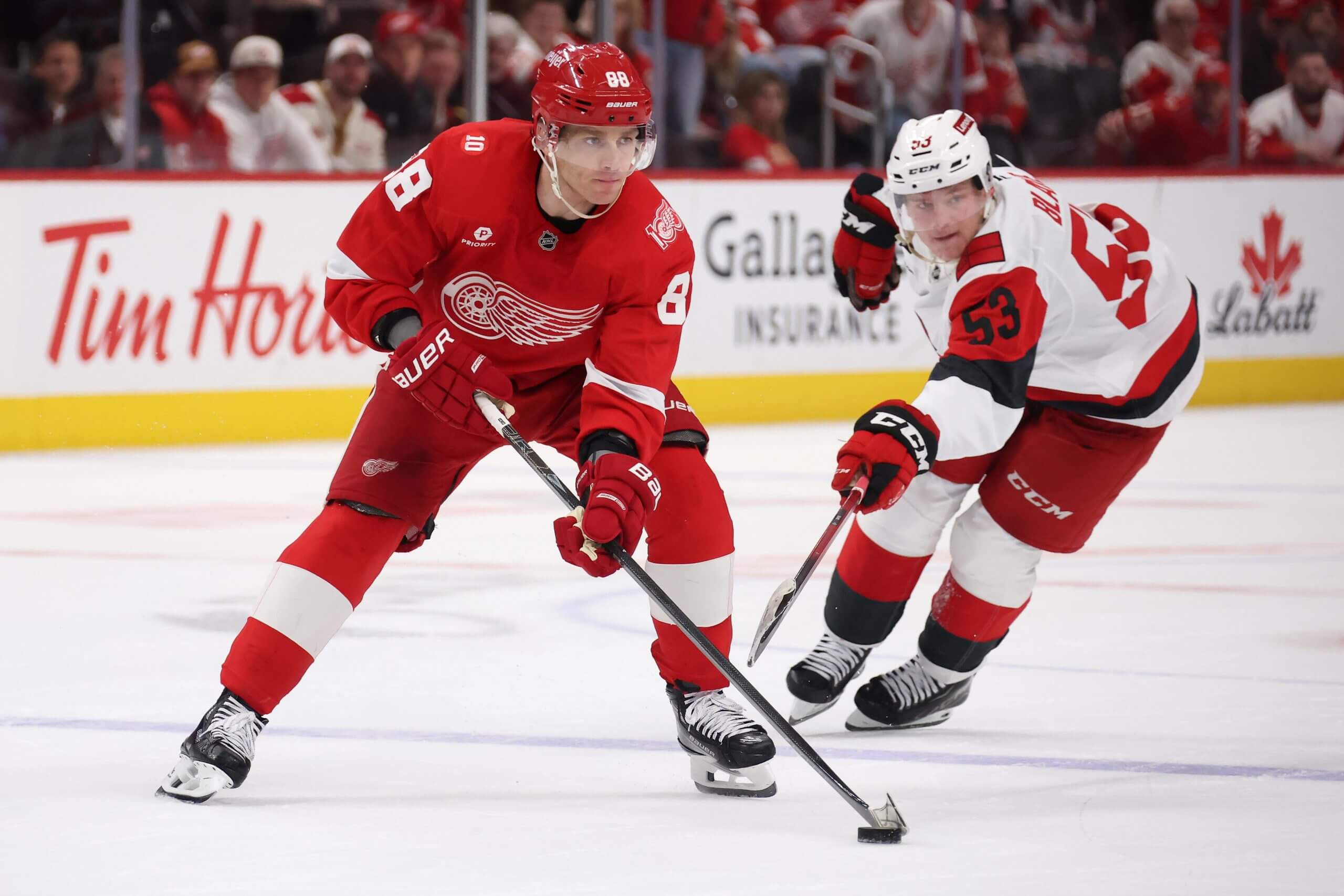
Patrick Kane will be an unrestricted free agent on July 1. (Gregory Shamus / Getty Images)
Given the desire to be harder to play against, does Patrick Kane’s overall five-on-five play warrant a roster spot? — Greg S.
It’s a fair question, as Kane isn’t giving any big hits or winning a ton of puck battles in the corners, but the answer is yes.
Just like not every heavy, hard-to-play against player is going to contribute significant offense, not every offensive player is going to be digging out pucks and punishing bodies. However, it’s obviously preferable when they do.
But the bottom line is that Kane, even at 37, is one of the Red Wings’ top five-on-five producers. His line still tends to win its shifts. And for a team that struggles mightily at five-on-five, I think that’s worth keeping, even at the expense of some individual heaviness and defense.
If the Red Wings don’t make significant changes, are they in danger of finishing in 7th or 8th place in the Atlantic Division? — Frank A.
Yes. I mean, they finished sixth last year, and that was ahead of the two-time Stanley Cup Champion Florida Panthers, who are a strong bet to bounce back next season.
Eighth would surprise me, as I’m not ready to say the Toronto Maple Leafs are going to pass them. And I still don’t see any reason the Red Wings can’t catch the Boston Bruins, though I felt that way this season, too, and the Bruins finished ahead of them.
Plus, there are always surprises. Will another team catch the injury bug, as the Panthers did this season? What does this offseason have in store for the division?
So I’m not picking them to finish bottom two in the division right now. As bad as the Red Wings’ final six weeks were, they still were right there with Montreal, Buffalo, Ottawa and Boston for the vast majority of the season, even if there were some warning signs under the hood.
However, they still ended up with a sixth-place divisional finish this season, and if they don’t make meaningful additions, yes, finishing in the bottom two is a very real possibility.