
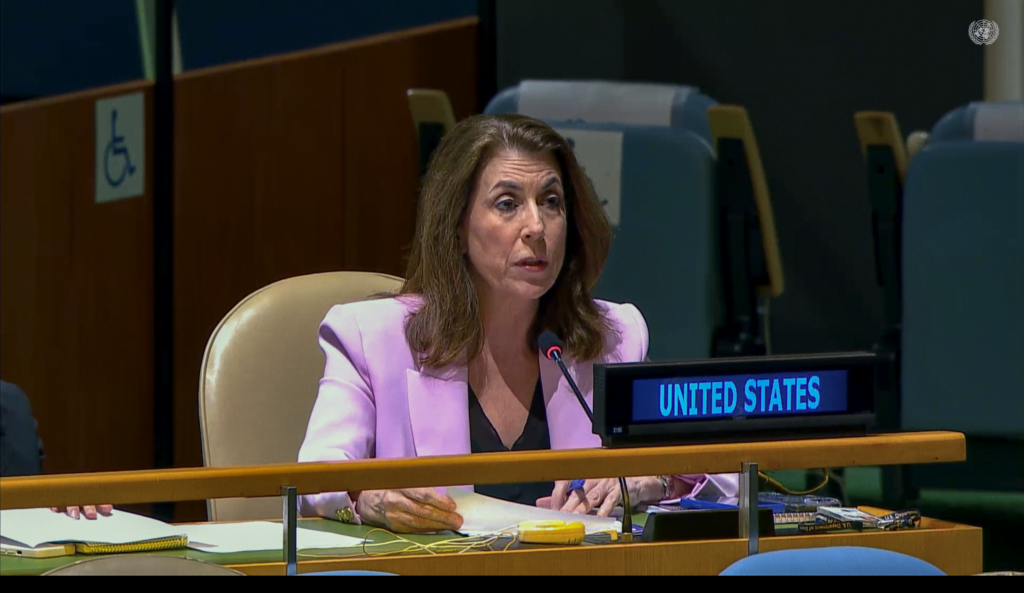
Ambassador Tammy Bruce
Deputy Representative of the United States to the United Nations
New York, New York
AS DELIVERED
Madam President, President Trump has been clear in seeing the potential of the UN and illustrating with his leadership how we can tackle and overcome the world’s toughest problems. We are committed to working with our friends and partners in meeting these challenges, but how we do it matters.
Throughout the negotiation of this resolution, the United States has been consistent in conveying our opposition to this initiative. The United States did not support seeking an advisory opinion from the International Court of Justice on climate change and has many concerns about the Court’s opinion. We understand the concerns that Vanuatu and other countries have about specific environmental threats and the importance they attach to the Court’s opinion, and we acknowledge that some changes were made to moderate the text of the resolution in certain respects in response to Member States’ concerns during negotiations. However, the United States continues to have serious legal and policy concerns about this resolution.
In brief, this resolution is highly problematic in calling on States to comply with so-called “obligations” that are based on non-binding conclusions of the Court on which UN Member States’ views diverge. The resolution includes inappropriate political demands relating to fossil fuels and on other climate topics, and we believe there is no basis for the resolution’s mandate to the Secretary-General to report on the complex and nuanced legal issues addressed by the Court. The United States was not alone in our concerns about this initiative, and many similar concerns were voiced by States across regional groups during the negotiation process. The consultations made clear that there is no broad agreement among UN Member States about the merits of the Court’s advisory opinion, the Court’s advice on the legal issues it addressed, whether and how the opinion is relevant to activities of the General Assembly, or the textual elements of the revised draft resolution itself.
We will highlight a few of our most significant concerns today.
As an initial matter, the Court’s advisory opinion is, by definition, not binding on UN Member States; it was not issued in a contentious case between States on the basis of State consent but rather pursuant to the Court’s advisory function. Yet the resolution improperly treats the Court’s opinion as irrefutably authoritative and as setting out binding obligations on States.
The resolution also amplifies legal errors from the Court’s opinion.
For example, the resolution calls on States to comply with so-called “obligations” that are based on the Court’s expansive and unfounded view that States have a legal duty to prevent significant transboundary harm to the global climate as a whole. Not only is this a legally wrong conclusion, but such an expansive legal rule would impermissibly interfere with each States’ sovereign rights to regulate and manage its own energy policy.
The resolution repeats the Court’s failure to recognize the climate treaties are the sole source of a State’s climate obligations and the Court’s misinterpretation of those treaties.
And we disagree with the Court’s conclusions relating to the duty to cooperate, the principle of non-refoulement, and on guarantees and assurances of non-repetition, among other conclusions highlighted in the resolution.
The resolution also goes beyond the Court’s conclusions in several concerning ways. For example, we are disappointed that the resolution selectively repeats the Court’s view that the principle of common but differentiated responsibilities and respective capabilities applies to all climate change obligations, and not just when Parties to climate treaties have expressly included this principle as a guide to interpretation. In doing so, the resolution conspicuously omits the Court’s own important caveat that how this principle guides a State’s obligations depends on where it falls on the spectrum between the most developed and least developed countries, and that States have evolved to have greater responsibilities as their economic development and contributions to greenhouse gases have increased over time. Such States should not be given a free pass.
When referencing the Court’s views on human rights, the resolution mischaracterizes the Court’s conclusion by adding references to the human rights of “peoples,” despite the clear understanding that international human rights law applies to individuals and not groups. With respect to sea-level rise, the resolution takes the Court’s views on the impact on sea-level rise on maritime boundaries and statehood as a launching point to make broad, conclusory and expedient assertions that go beyond the text of the Court’s opinion and are not founded in international law.
In other instances, the resolution singles out certain groups for preferential treatment, and makes alarmist political statements, such as the idea that “climate change is an unprecedented challenge of civilizational proportions.” Such hyperbolic statements are not appropriate in a resolution on an ICJ advisory opinion.
The resolution purports to avoid duplication of existing framework for the international community’s consideration of climate matters. Yet the resolution urges States to promote goals set by the climate process, such as so-called “just transitions” from fossil fuels, and decides to include the Court’s advisory opinion on the General Assembly’s future agenda. These elements of the resolution create avenues for encroaching on and duplicating the existing framework.
Finally, we have substantial concerns about the resolution’s request that the Secretary-General issue a report on how to “advance compliance” with the advisory opinion. Even the Court emphasized the limited role that international law plays with respect to climate change and avoided assigning liability or concluding that internationally wrongful acts have been committed by any State or States. There is no basis in the Court’s opinion for the General Assembly to provide the Secretary-General with this type of mandate, and we are aware of no similar precedent. We urge the Secretariat to avoid wading into the complex legal issues addressed by the Court and avoid duplicating or complicating work that is part of the entirely separate processes under the UNFCCC.
For all of these reasons, the United States opposes this resolution and encourages all Member States to do the same.
###