
BUFFALO, N.Y. — Jarmo Kekäläinen checked off the first big item on his offseason to-do list, signing coach Lindy Ruff to a two-year contract extension less than 48 hours after the Buffalo Sabres’ season ended.
Kekäläinen called that move a “no-brainer” during his end-of-season media availability on Wednesday. Ruff, 66, is a franchise icon and a finalist for the Jack Adams Award. He coached the Sabres to first place in the Atlantic Division and their first playoff berth in 15 years.
That removes one element of uncertainty heading into the offseason, but Kekäläinen still has a lot to figure out when it comes to this roster. The Sabres were one goal away from advancing to the Eastern Conference finals. They have the core pieces in place to be back next season.
“This is just the beginning,” Kekäläinen said.
But there are a lot of decisions for the Sabres to make this summer that will impact the roster in 2026-27 and beyond. And during an answer about Josh Doan, Ruff provided the words that should guide the entire organization this offseason.
“There’s always areas to improve,” Ruff said. “If you’re not improving, you’re not keeping up. If you think you’ve arrived and it’s, ‘Boy, I’m here now,’ then you’re not getting better.”
Here’s a look at some of the key items remaining on Kekäläinen’s offseason to-do list.
1. Alex Tuch’s contract
Exit interview day didn’t provide a ton of clarity on the Alex Tuch situation. Kekäläinen said he wants Tuch back but needs to find a contract that makes sense and also allows the team to get better under the salary cap. Tuch has loved his time in Buffalo, but he’s going to do what’s best for him and his family. If the Sabres are going to bring Tuch back, they may need to leverage the fact that they can give him eight years while other teams can only give him seven. To that end, an eight-year deal at $9 million per year is worth more total money than a seven-year deal worth $10 million per year on the open market. This doesn’t strike me as a situation that will be resolved quickly, but it’s an important domino for the offseason. The Sabres have $12.9 million in salary cap space entering the offseason. If they want to make room for Tuch, it could require shedding Jordan Greenway’s salary and moving out some other money.
2. Zach Benson’s contract
Kekäläinen wasn’t shy about how he feels about Zach Benson. He cracked a smile when asked about him on Wednesday and gushed about his game. He wants to get Benson locked up to a long-term contract. But Benson’s case is an interesting one. Will he want to sign long-term when he’s only just begun to scratch the surface of his potential? He had 43 points this season after overcoming some early-season injuries. He then had nine points in 13 playoff games and was one of Buffalo’s most consistent and valuable players. With the cap going up in the next few years, Benson could bet on himself and sign a shorter-term deal to cash in on a bigger payday down the road. The question is whether there is a number that would convince him to sign longer-term. AFP Analytics projects Benson to make $6.95 million per year on a seven-year contract. That would be a bargain for Buffalo and a smart piece of business.
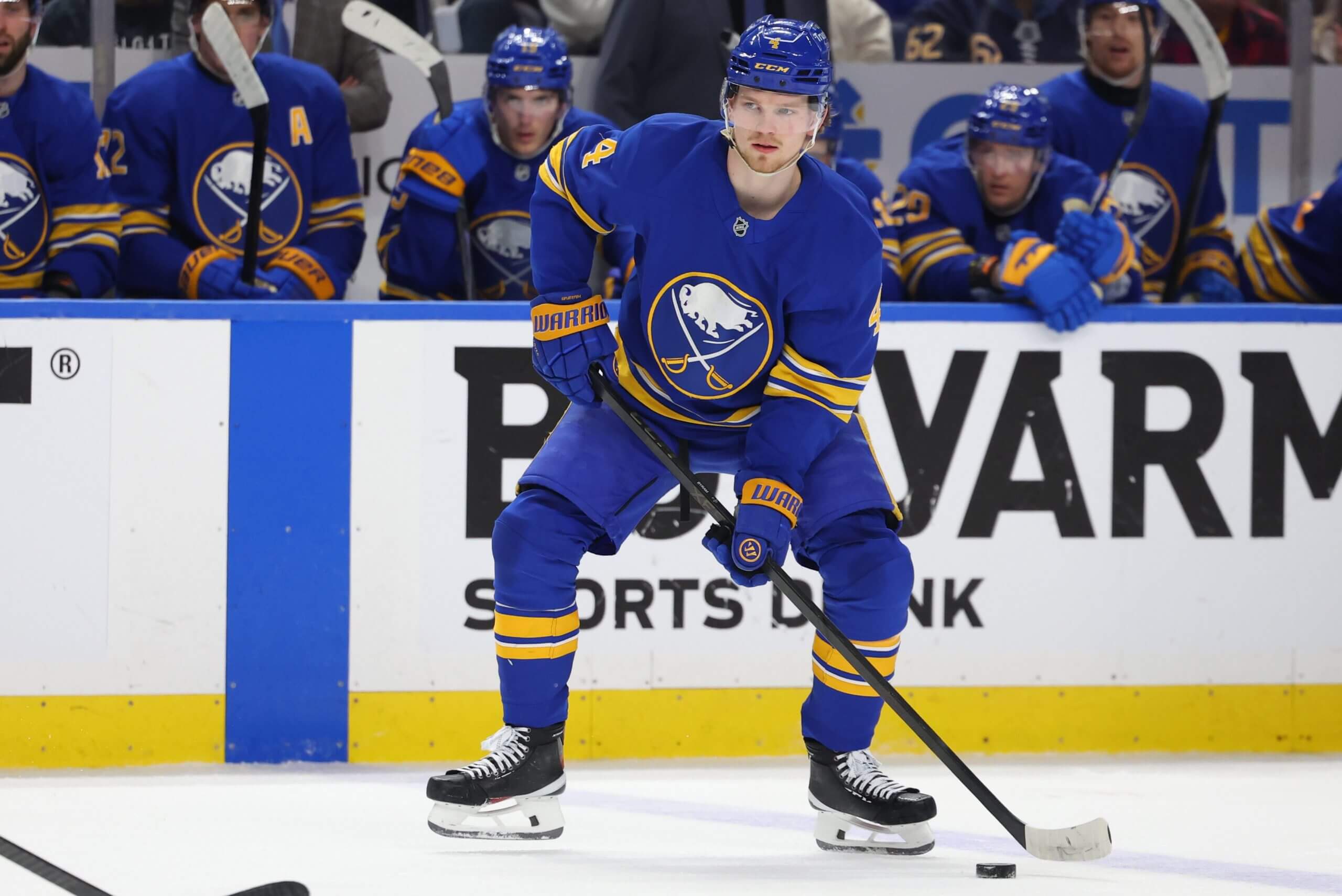
Bowen Byram had seven points in 13 playoff games for Buffalo. (Timothy T. Ludwig / Imagn Images)
3. Bowen Byram’s contract
Bowen Byram said he thought after he signed his extension last summer that he wouldn’t have to talk about his contract for a while. But he signed a two-year deal, which means he’s eligible to sign an extension again this summer. Byram is now one year away from hitting unrestricted free agency, and Kekäläinen told him in his exit interview that he would love to keep him in Buffalo. The Sabres’ top-four defensemen were a major reason why the team had the success it did this season. All four are 26 or younger, but Byram is the only one who doesn’t have a long-term contract.
He wants to play for a winner, and the Sabres now check that box. The question is whether he sees a path to the type of role he wants in Buffalo with Rasmus Dahlin, Owen Power and Mattias Samuelsson also eating up big minutes. Byram did get more time as the quarterback of the second power-play unit this season, but if he wants to be a top pair defensemen and get the contract that matches that role, free agency might be his best bet. If he’s happy with his role here, the Sabres should be able to find a way to keep him around beyond next season.
“I think the top four of our defense is our driver, our engine,” Kekäläinen said. “Their mobility, ability to move the puck, ability to support offense but also play good defensively. There’s a lot of untapped potential there, too.”
4. What’s up with the center depth chart?
Kekäläinen made a point in his end-of-season news conference to point out how many talented, young centers the Sabres have right now. Tage Thompson, Josh Norris, Ryan McLeod, Jiri Kulich, Noah Östlund, Konsta Helenius, Sam Carrick, Peyton Krebs and Tyson Kozak are all capable of playing center. Thompson moving to the wing would free up a spot. And at least one of Östlund, Helenius or Kulich could do the same. But it feels like the Sabres may be able to move a center in a trade. That’s a rare position to be in with one of the scarcest positions in hockey. The Sabres don’t want to get too young at the top of their center depth chart, though, so they have to be judicious about what they do here. This is a nice problem to have, but it’s a puzzle they have to figure out.
5. Goalie question marks
Both Ruff and Kekäläinen praised the Sabres’ goalies and hinted at the idea of sticking with a three-goalie rotation again in 2026-27. The way those three goalies played is a major reason why the Sabres won the division. The team had the best save percentage in the NHL from Dec. 9 to the end of the season, with Ukko-Pekka Luukkonen and Alex Lyon doing the heavy lifting. Rookie Colten Ellis showed some promise, too.
But it’s also fair to say the Canadiens’ advantage in net is a big reason they were able to beat the Sabres in seven games. Finding a path to upgrading in net is possible, but it would be challenging. Fitting a big-money goalie into the 2026-27 salary cap picture isn’t simple. The status quo might be the likeliest outcome here.
6. The rest of the free agents
Tuch (UFA) and Benson (RFA) are the big-ticket items to handle, but the list of expiring contracts runs deeper.
Krebs, RFA
Beck Malenstyn, UFA
Michael Kesselring, RFA
Logan Stanley, UFA
Luke Schenn, UFA
Tanner Pearson, UFA
Josh Dunne, UFA
Krebs, Malenstyn and Kesselring are the items of note here. Dunne could be brought back, too, given the role he played this season. Krebs and Malenstyn are both due for raises. Both expressed a desire to come back to Buffalo and finish what they started here. Of the two, Malenstyn seems likelier to get away, given his status as an unrestricted free agent. If he hits the market, he could have plenty of suitors given the way he played in the postseason. His combination of speed and physicality will be in demand. The Sabres value what he and Krebs bring to the locker room and on the ice. AFP Analytics projects Krebs’ next deal to come in at around $3.5 million per year on a three-year deal and Malenstyn’s next contract to be around $2.6 million per year on a three-year deal. Those are noticeable raises given a cap crunch this summer.
Kesselring is another interesting case, even if his rights are limited as a restricted free agent. The Sabres have a clear top four on defense. Conor Timmins and Zach Metsa are also signed for next season. Injuries derailed Kesselring’s season, but he still has the potential to be the mobile, top-four defenseman the Sabres thought they were getting in that trade with Utah last summer. He wasn’t thrilled about being squeezed out of the lineup this season, but signing a short-term deal and proving himself could be his best path to getting back on the path to becoming the player he wants to be.