
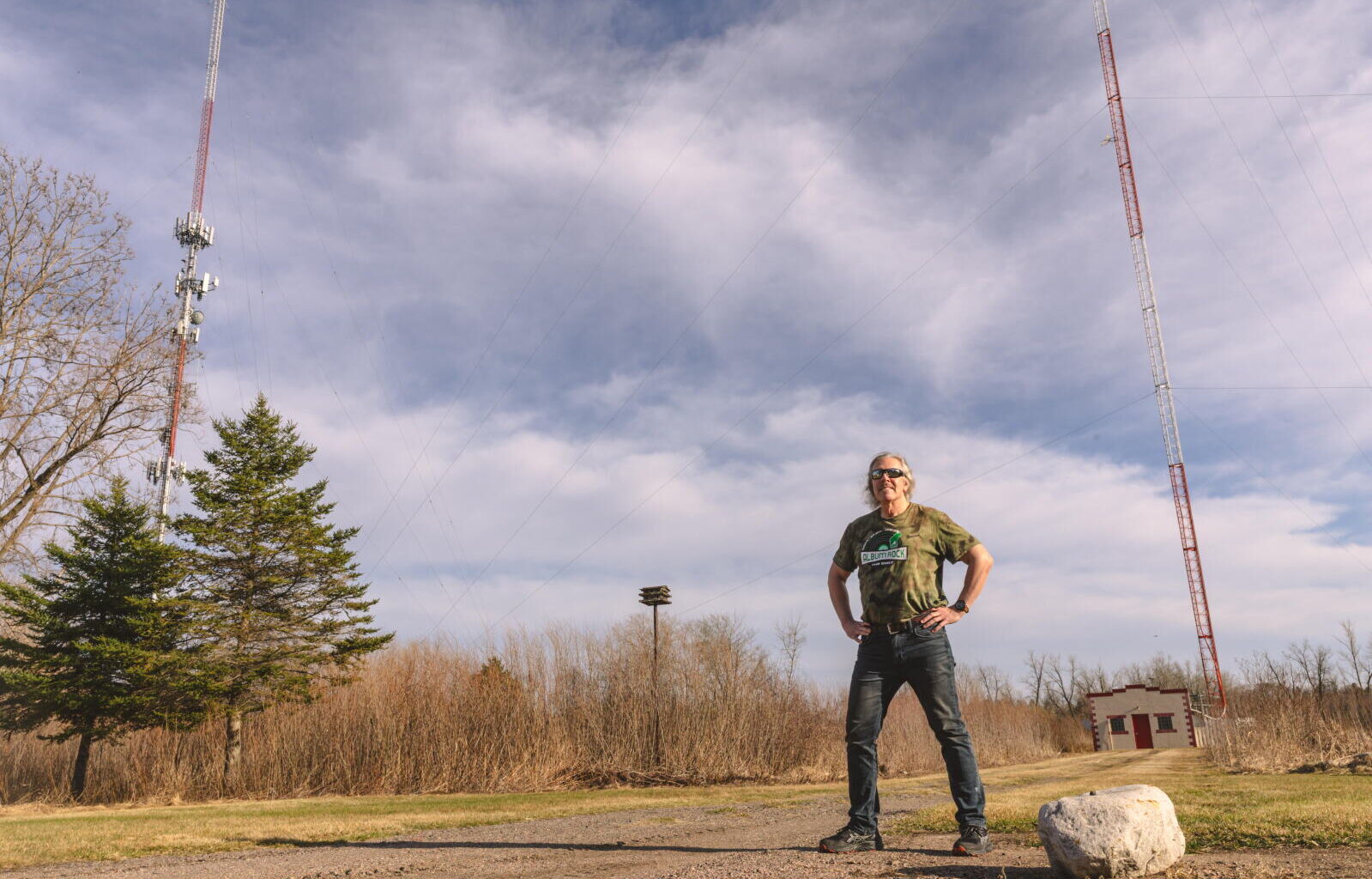
SAUK RAPIDS, Minn. — On a recent warm afternoon, Al Neff stood in the parking lot of Tri-County Broadcasting’s radio headquarters, affectionately known as “The Red House.”
With towers in the distance, he described how the swampy conditions of the area help the building’s six radio stations propagate their signal across all of Central Minnesota, and how the founders of the station purchased the land from local farmers who saw it as useless.
“You can’t grow corn on a swamp,” he said. “But you can grow radio.”
Neff, 64, has worked in broadcasting for 45 years and has become a favorite to listeners who know him or discovered him as they wandered the dial.
For the past 10 years, they’ve found him on WXYG “The Goat,” a station he founded in 2016 playing music from the 1960s to the 1980s.
He began his career in 1981 at St. Cloud State’s student-led KVSC-FM, but his interest in the medium began much earlier.
“I was raised in Wyoming and Montana,” Neff said. “My dad was in the oil fields. We moved every year. By the time I left home when I was 18, we’d moved 17 times, so I was always displaced.”
He said that despite the constant change the cultural touchstones helped him stay grounded — many of those constantly broadcast throughout the country.
“Radio was always wherever we went — you know — the local radio station,” Neff said. “But even more exciting to me was the late-night reception that you could get on AM clear-channel stations.”
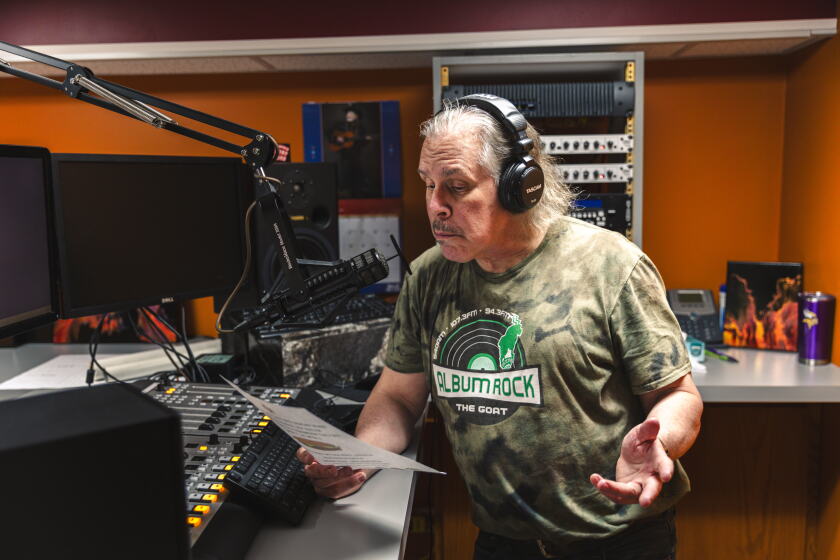
Al Neff reads information as is typical for his “Into the Music” program on WXYG. The album rock station is called “The Goat,” and is broadcast on AM-540 and FM-107.3 and 94.3.
Jayda Saatzer / For St. Cloud LIVE
Clear-channel stations are AM radio stations that enjoy extra protection from radio wave interference so they can be used to broadcast cross-country in case of emergency. In the US, clear-channel stations were standardized in 1941 to facilitate wartime communication. Because they use AM frequencies, clear-channel stations can “skip” their signal off the Earth’s atmosphere, allowing some stations to be heard thousands of miles from their origin.
“WLS was probably the most important for me — that’s out of Chicago,” Neff said. “Late at night I could tune in as soon as the sun (went) all the way down — if the weather was right.”
As a kid, he would tune in WCCO, Minnesota’s clear-channel station, then switch to WLS later in the night.
“(WCCO) had a great show — the CBS Radio Mystery Theater, which was a spooky radio show that I loved to listen to,” Neff said.” After that, I (would) flip over to WLS and listen to the late-night DJ who could kind of play whatever he wanted. It was like a treasure hunt for me late at night. So that’s what gave me the fascination with radio. It was my companion.”
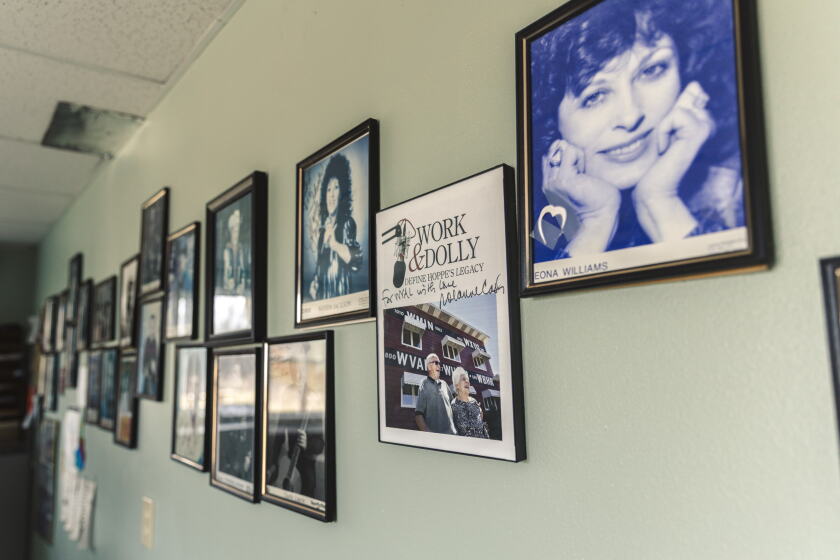
Autographed photos, including one showing Herb Hoppe and his wife, Val, in front of the building, line the halls of the Sauk Rapids station house.
Jayda Saatzer / For St. Cloud LIVE
When Neff was just 12 or 13 years old, his middle school English teacher hosted a class activity where students passed around a book and a tape recorder, with each student reading a passage. At the end of the activity, the teacher played back the whole tape. Neff said hearing his voice played back on the tape was the first hint that he could have a career in radio.
When Neff was 17, his father moved his family to the small northern town of Marble, Minnesota, near Grand Rapids and Hibbing. A senior in high school, Neff decided to follow his passion and got a job at local station KXGR (now KMFY) in Grand Rapids.
“They played The Beatles and America and The Eagles and stuff like that,” he said. “I liked what they did. My mom was getting on my nerves, and so (I thought), maybe I’ll just go get a job.”
He said so jokingly, but Neff quickly experienced a trial by fire.
“I walked in there with my bell bottoms in 1979, and they had an announcer whose car had broken down on vacation, so there was an opening (on-air) the day after next. This was on a Thursday, and they wanted me to be on the air Saturday, so I had to adjust my whole mindset, you know, very quickly.”
You can’t grow corn on a swamp. But you can grow radio.
Al Neff
It was at KXGR that Al Neff was born.
“My first name is Jeffrey — Jeffrey Allen; If you do the math on that, you realize that I grew up as Jeff Neff every year,” he said with a chuckle. “So that part wasn’t fun. Some skinny kid and I got a funny name, plus my dad bought me an accordion, skinny kid with an accordion and a funny name, not good.”
Still, he had a chance to redefine himself.
“It was crucial in my development as an emerging young adult person; I got to get rid of that baggage,” he said. “But then for a while, it was like I was masquerading as this guy named Al. It took a while to actually become Al.”
Home in Central Minnesota
Neff built a sizable following at KXGR, but eventually his father moved the family out of Marble and back to Wyoming. Al bounced around a few stations in there and Montana until he came to St. Cloud to attend St. Cloud State University in 1981. He joined up with SCSU’s student-led radio station right away.
“Al worked in just about every leadership role KVSC had to offer during his time as a student, so his influence is undeniable,” said Dan Seeger, the current station manager. “Al was definitely one of the people who regularly stood up for the integrity of KVSC, both as an outlet for experimentation and as a place where people could share their pure love of music with the listener.”
Neff worked at KVSC throughout his time at SCSU, and it was there he first developed his “Into the Music” radio program — a show designed to both entertain the listener and teach about the artists, events and eras behind the music.
“His ‘Into the Music’ program and his general approach to using the airwaves to educate stand as aspirational examples for a lot of our DJs,” Seeger said.
Neff also worked at the country-focused WWJO while an undergraduate. After his parents experienced health issues, he became the legal guardian of his sister, Tracy, and stayed in St. Cloud, where he earned his master’s degree.
In 1994, he left WWJO to move the active rock station, WHMH, which allowed him to play heavier, more intense rock than he could at KVSC.
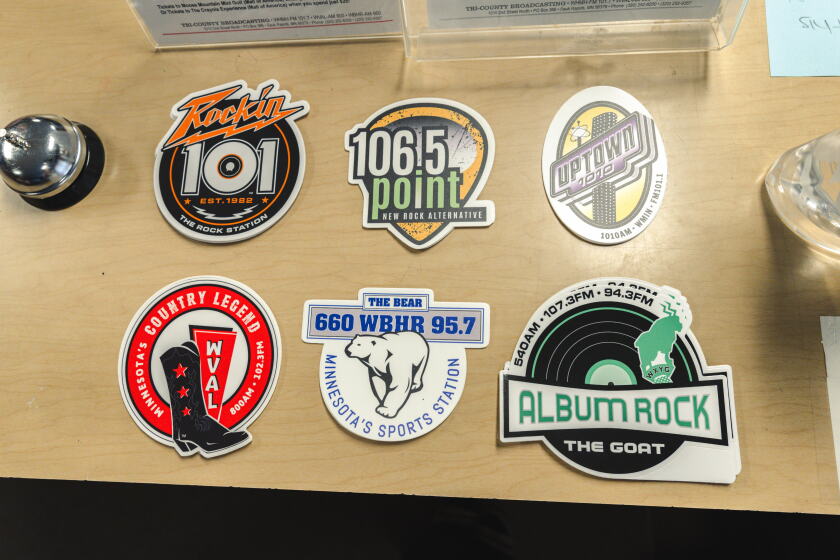
Decals of the various stations that operate out of the “red house” are shown on a table in the entryway.
Jayda Saatzer / For St. Cloud LIVE
“I took a cut in pay,” Neff said. “You know, now I have a master’s degree, and I’m working for minimum wage overnights at a radio station that doesn’t even have hot water. Like, I went to the bathroom, and I realized that there’s no water heater. And I lived in a camping trailer — that was a colorful chapter — because there’s no money in radio. So, I lived in the camping trailer for seven years in the woods. It’s very rock and roll. I look back on it fondly.”
Neff left WHMH in 1997, jumping to WVAL classic country station and staying there until 2002.
Neff began teaching in SCSU’s mass communications department, with a focus on radio and broadcasting. In 2002, he moved to Colorado to teach, but returned to Central Minnesota years later to found WXYG “The Goat” in 2016.
The Goat focuses on music released during the 1960s, ’70s and early ’80s. The station features a vast catalog of more than 4,000 songs from the era, a point of pride for its DJ.
Tune in
Fans in Central Minnesota can listen to the Goat by tuning to AM 540 or FM 94.3. Anyone can listen to the online stream at www.540wxyg.com/wxyg-streaming.
“WXYG the Goat is very different than other stations,” Neff said. “As far as I know, we are the only station in the country that goes as deeply into that era of music, which I think is the most dynamic era of music in the history of popular culture. Why do we do it? Because we’re a funky, little, family-owned operation next to a swamp, right?”
Neff co-founded The Goat with another broadcasting great, Lee Arnold, who is credited with pioneering the progressive, album rock radio format.
“I programmed the first progressive rock radio station in the south — WTAI — and that was in ‘68. In 1972, I programmed WORJ in Orlando, that was the highest-rated progressive rock station in America,” Arnold said.
“There’s an entire audience out there who are just so tired of this thing called ‘classic rock’ with their repetitive nature of playing the same 200–300 songs over and over and over again. There’s a giant audience for people who really love music.”
The Goat went on the air and featured Neff as its main DJ and Arnold working behind the scenes.
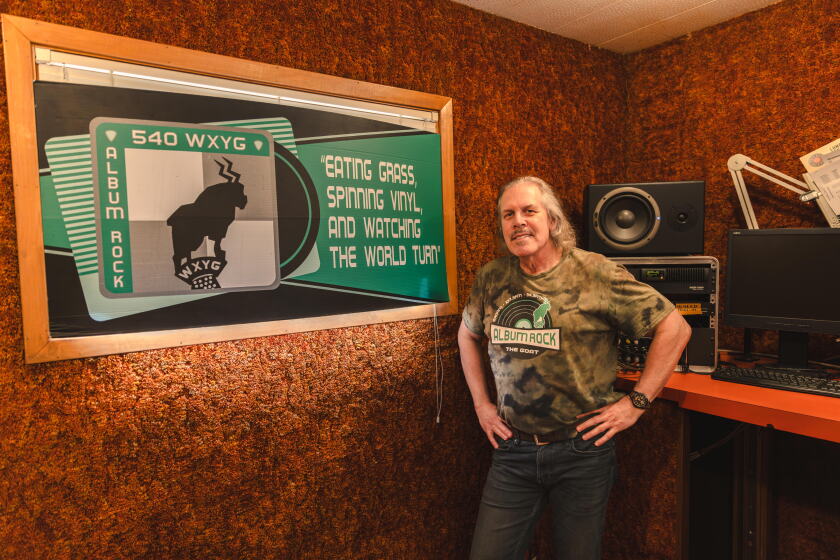
With a voice and personality as timeless as the carpet-walled studio in which he works, Al Neff has set a standard and carved a path for other broadcasters to follow.
Jayda Saatzer / For St. Cloud LIVE
“He’s absolutely brilliant!” Arnold said of Neff. “Al is the secret sauce. We have listeners all over the world through our (Internet) stream — a lot of them are people in radio and a lot of them I’ve known for years — and every one of them comes back to me and says, ‘Al is the best disc jockey I’ve ever heard.’”
Today, WXYG continues to broadcast from that little red house on the edge of the swamp. Its regular programming includes not only a massive rotation but also Neff’s iconic “Into the Music” program and a special guest DJ feature that allows listeners to come on the air with him and share their favorite tracks.
Neff believes the most important impact he’s made on broadcasting in Minnesota is through his combining his two passions — radio and education. Specifically, he views his “Into the Music” program as among his most important work.
“I think that, If I’ve made an impact, it would be my focused intention of making an impact with ‘Into the Music,'” he said. “Because it’s such a valuable educational tool the way that I do it. I really think that there should be more education on cultural literacy. It can emerge into a much larger dialogue about this music. A lot of generations just don’t have the connection points. Music is one of the great unifiers if people are willing to look across the boundaries.”