
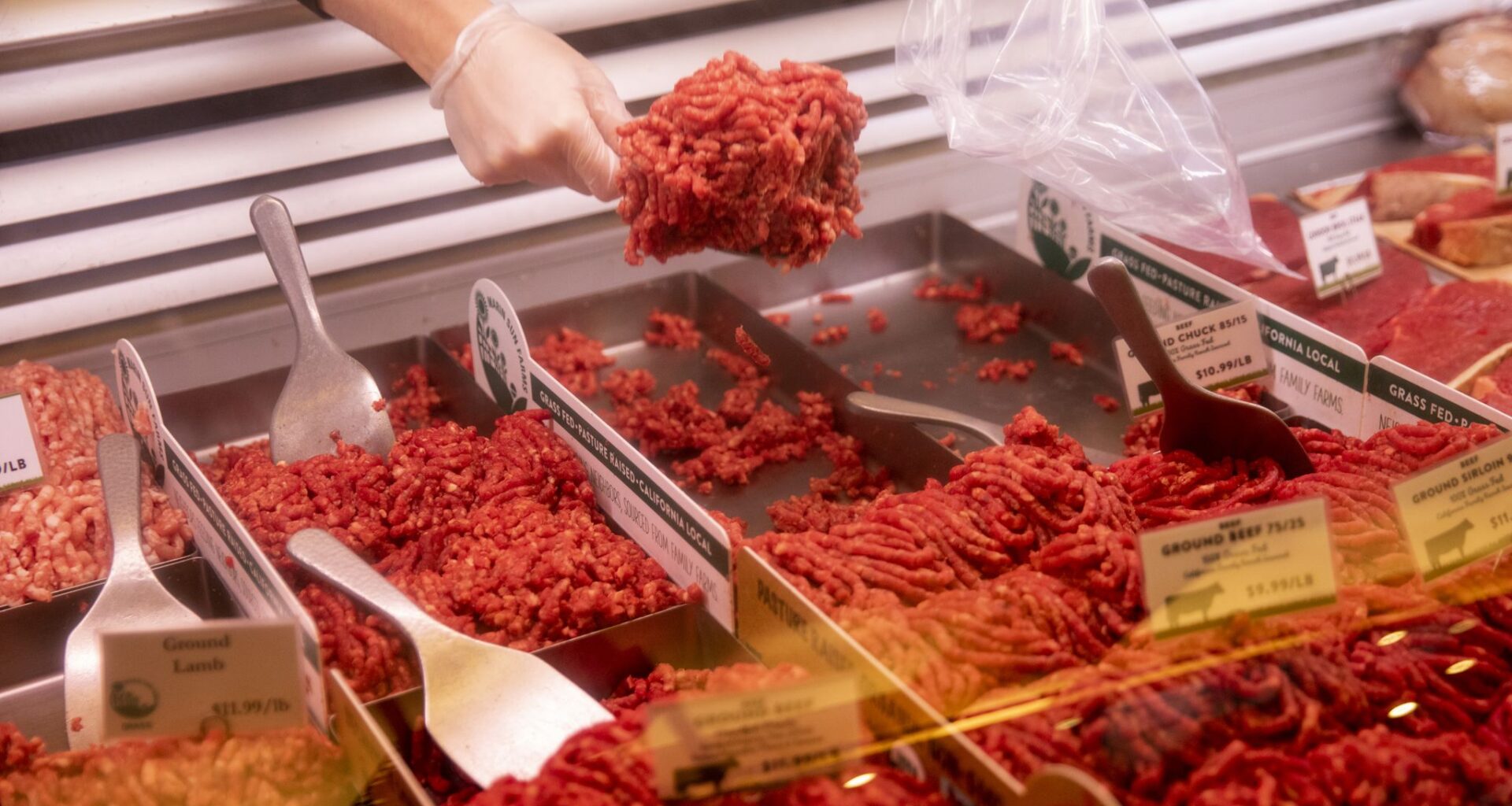
An employee prepares an order of ground beef for a customer at an Oakland butcher shop in 2020. Ground beef prices are up nearly 19% compared to this time last year.
Jessica Christian/S.F. Chronicle
Breaking out the barbecue this weekend? The cost to grill up a few burgers might surprise you.
Since around this time last year, ground beef is up 18.9%. A block of cheddar is up 5%. And if you want lettuce on there, that’s 7.5% more expensive. A tomato will set you back a full 50% more than it did a year ago. And if someone wants a cup of coffee, that’s going to cost 29% more.
These numbers are from the most recent Bureau of Labor Statistics data. Every month, the government agency measures prices for a preselected group of goods and publishes how they’ve changed compared to recent months and years. The report for April 2026 indicates an overall 2.9% year-over-year increase in the “food at home” category, amid overall yearly inflation of 3.8%.
Article continues below this ad
Overall, grocery prices are rising at the fastest pace we’ve seen in about four years.
It’s not all bad news: After weathering the avian influenza outbreak, egg prices are down 56% compared to a year ago. If you want to put American cheese or bacon on your burger, those are down 6% and 2.6%, respectively. Buttering your bun before it hits the grill will be nearly 12% less expensive than last year’s barbecue.
San Francisco Chronicle Logo
Make us a Preferred Source to get more of our news when you search.
Add Preferred Source
Inflation is nowhere near as bad as when it reached double digits in 2022. But the big-picture rise is still coming in above the 2% target economists like to see. It’s a sign that the Iran war, tariffs and other policy choices by the Trump administration are impacting the cost of living for just about everyone.
• Read more: The best way to save money as grocery prices spike? Make these easy shopping swaps
Article continues below this ad
• Also: This San Francisco grocery store is consistently the cheapest
• Inflation spotlight: Here’s how much the $1.50 Costco hot dog deal would cost if it kept up with inflation
Bell peppers and other produce are seen at the Casa Guadalupe supermarket in San Francisco in 2025. The higher cost of some grocery staples can be attributed to Trump policies.
Santiago Mejia/S.F. Chronicle
How tariffs and the war in Iran play out on grocery shelves
Often, the president has surprisingly little control over kitchen-table issues like grocery and gas prices. The price of eggs began spiking in late fall 2024 and reached a high of more than $8 in March of last year, but experts said Trump didn’t deserve any blame for the continued rise — nor credit for the fall.
Article continues below this ad
Similarly, when gas prices fell last summer, experts said there weren’t specific Trump policies that had made a meaningful impact. In California, for instance, the drop was attributed to refinery repairs.
But this year, things are different. Trump’s widespread tariff policy hit many of the countries we rely on for imports, like Mexico, which saw a 17% duty placed on fresh tomatoes. The U.S. imports about 70% of its tomato supply, and 90% of that comes from Mexico. A third of the coffee we enjoy comes from Brazil, which was subjected to a 40% tariff that was later removed but is still under 50% tariffs for instant coffee.
Tariffs on aluminum and steel — currently 50% for all imports of raw materials — are also leading to increases for canned goods, said Nate Rose, the vice president of communications and public affairs at the California Grocers Association.
And the war in Iran has driven up fuel prices: Gasoline costs are up 28.4% year over year, and electricity is up 6.1% nationally, according to BLS data.
Energy costs are food costs, said Daniel Sumner, a professor of agricultural economics at UC Davis. Cleaning, drying, freezing, keeping things cool in transport — “all of that is energy intensive,” he said.
Article continues below this ad
As the Iran war goes on, price climbs are likely to do the same. Wesley Grubbs is an independent design technologist based in Oakland and the creator of Inflatacart, a grocery list app that tracks inflation with BLS data. He said because BLS data is based on the previous month, we’re not seeing the full extent of the Iran war’s impact on grocery prices just yet.
“I’m really curious to see what we see in the next reports that’ll come out in mid-June,” he said. “I’m expecting a lot of the costs to just keep jumping up.”
Sumner said another impact of the Iran war likely isn’t yet reflected in grocery prices: Fertilizer costs. Many of the raw materials that go into making it travel through the Strait of Hormuz. The produce for sale in the grocery store right now was fertilized before the war began, but those supplies will run out.
• Read: How much more expensive are your groceries? This app does the inflation math
• Read: You should always buy these things when they’re on sale at the grocery store
Article continues below this ad
Shoppers walk through H Mart in Dublin. Grocery prices are still rising for a variety of reasons.
Don Feria/For the S.F. Chronicle
Non-political reasons for price increases
Not every increase can be directly attributed to political decisions. Global climate change is not specifically the fault of the Trump administration, and it’s challenging to link individual weather events to it, though climate experts agree the decisions made by many countries have contributed to a rise in global temperature and adverse weather.
Heavy rainfall and flooding in South America have contributed to rising coffee prices. Multiple instances of freezing weather in Mexico this past winter impacted tomato crops, constraining supply.
Another challenge in those specific categories is what’s known as inelastic demand. No matter how high the price gets, most coffee drinkers will still buy coffee. Even when tomato prices rise, few people find substitutes for pizza or pasta sauce. Eggs are another example of inelastic demand, which is why those price shocks were felt so acutely. Econ 101: Sustained demand + shrinking supply = upward price pressure.
Cattle herds naturally cycle through larger and smaller populations — typically over the course of eight to 12 years, per the USDA — and we hit the bottom of one of those cycles last year, Sumner said. Drought has also contributed to a decline in herd sizes. And that’s been happening right as the protein craze has swept the nation, with hungry shoppers scouring shelves for the most cost-effective way to hit their macros. But beef is easier to substitute than some of these other categories: Ground pork, ground chicken and other protein sources typically work about as well.
It all adds up to a challenging time for grocery store owners, Rose said. Net margins are tight — 1.7% — meaning there’s little choice but to pass on costs to consumers.
“We have this very complex global food system that is a beautiful thing, because you know you go to the store and there’s such abundance there,” Rose said. “But it also can be fragile.”