
ST. PAUL, Minn. — This should be one fascinating summer for the Minnesota Wild.
Expectations are higher than ever, with president of hockey operations and general manager Bill Guerin proclaiming last week that they’re in a Stanley Cup window “now.”
“We want to make sure that we don’t just open the window three-quarters of the way,” Guerin said. “If there’s a chance for us to get better, we will.”
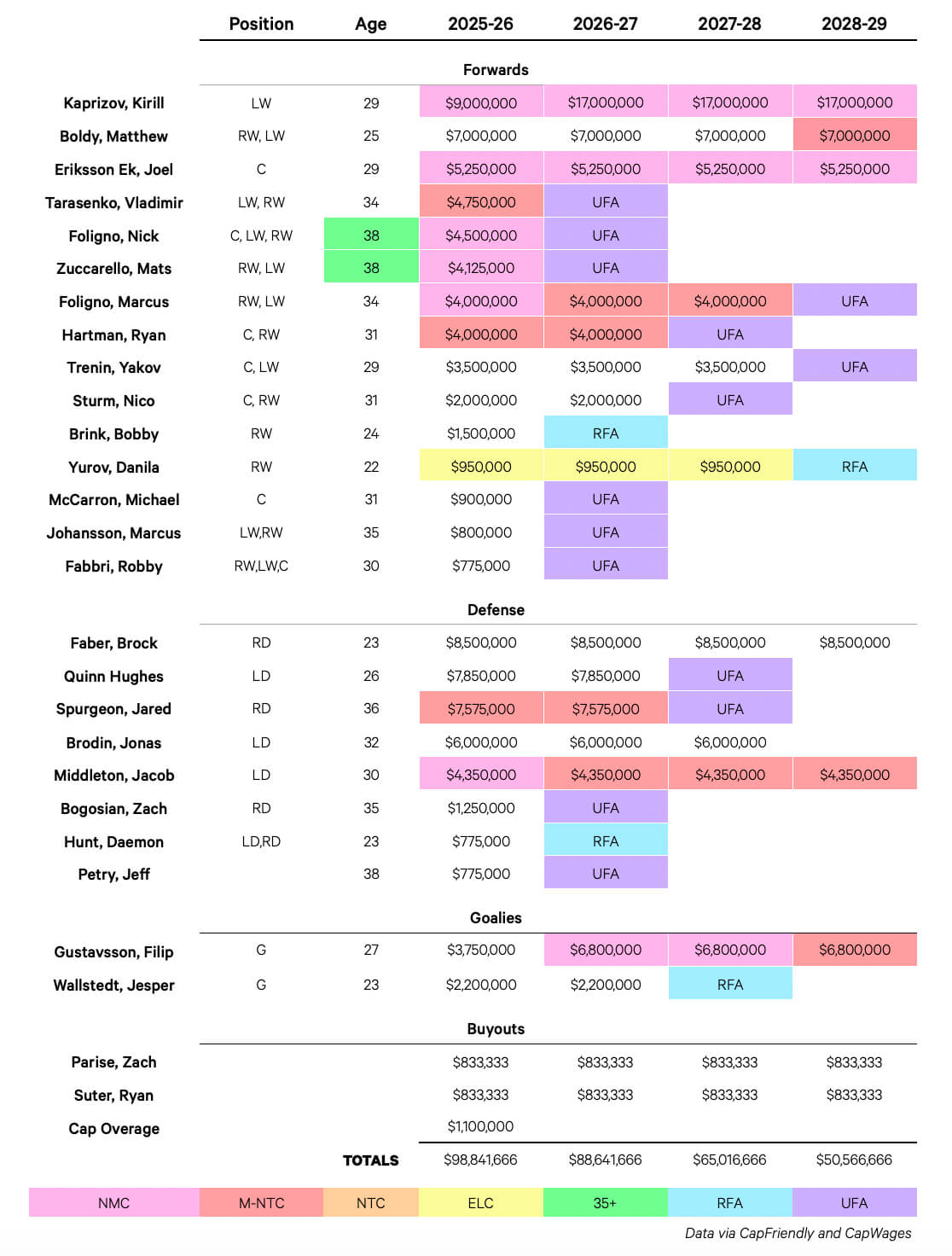
Kirill Kaprizov is just starting his new eight-year, $136 million contract, but he also just turned 29. The Wild need to pounce at the height of his stardom.
Quinn Hughes is only 26, but is locked up for only one more year, for now. He is eligible to sign an extension on July 1 — as long as eight years if it’s before Sept. 15, when the new CBA kicks in, or seven after — but in the rising-cap world, star players like him could opt to sign shorter-term contracts so they can hit more homers later in their careers. A three-year extension would also align him conveniently with the end of brother Jack’s contract with the New Jersey Devils.
Oh, and the Wild traded a ton of their top prospects and draft picks over the past few years to get into this win-now window. That check will come due as they try to add more.
The Wild were good enough this past season to win a first-round series for the first time in 11 years. However, a second-round loss showed they need more, specifically in the seemingly endless search for a No. 1 center, which, aside from extending Hughes, will be the No. 1 priority this summer.
The free-agent market is paltry at best, so Guerin will likely have to make his mark via trade.
Who could that be? No doubt Guerin has called or will call on everybody from Auston Matthews to Robert Thomas to Jack Hughes to Nico Hischier to Tomas Hertl to Dylan Larkin. He could veer a different direction if a No. 1 center is unattainable, instead going after a top-six winger such as Brady Tkachuk if he’s available.
And if a big trade doesn’t happen this summer, Guerin will surely be scouring the landscape in-season the way he did with the Hughes blockbuster.
Guerin has already mortgaged a large part of the future in trades for Hughes and David Jiricek and may not want to trade more young roster players (Jesper Wallstedt, Danila Yurov) or prospects (Charlie Stramel, Hunter Haight, Adam Benak). If not, he’ll have to consider outside-the-box deals, maybe even deals that involve core pieces.
“Nobody in this game’s untouchable,” Guerin said.
That being said, the reality is there are players we’d bet our houses the Wild would not move.
A big caveat here is that we had touted prospect Zeev Buium in the “not going anywhere” category of this piece last summer, which shows Guerin is willing to go anywhere if the trade is worth it (as Hughes was).
Here’s how we think the roster shakes out from a trade availability standpoint.
“Not going anywhere”Matt Boldy
Boldy has elevated himself to superstar status after a 40-goal season and Olympic gold medal victory. The Wild believe he’s pretty darn close to Kaprizov — a 1A and 1B situation — and he’s a steal on his current contract ($7 million average annual value), so it’s hard to imagine a scenario in which Minnesota trades Boldy and finds itself better. Could he be the answer at No. 1 center? Guerin and John Hynes both said at their end-of-year pressers that it’s doable in short stints but that they wouldn’t want to do it full-time. Hynes essentially said the responsibilities that come with that move could take away from Boldy’s offense.
Kirill Kaprizov
The soon-to-be $17 million AAV man holds a full no-move clause and is the best player in franchise history. So, no, he’s not going anywhere. Kaprizov drives the team offensively and will hold every scoring record by the end of his time in Minnesota; he already holds many after just six seasons. The end of this year’s playoffs was disappointing, with Kaprizov having one shot on goal in Games 4 and 5 combined, and the scrutiny will grow with being the league’s highest-paid player. Guerin met with Kaprizov for an hour last week before he returned to Russia, and there’s no doubt the Wild are looking for more consistency next season and beyond.
Brock Faber
Faber, 23, is growing into a franchise defenseman, blending shutdown defending with a blossoming offensive arsenal as he racked up career highs in goals (15) and points (51) this season. The acquisition of Hughes really opened Faber’s eyes to what he can do with the puck. He plays in all situations, and entering the second year of an eight-year deal at $8.5 million AAV, he has future captain written all over him. He’s also not going anywhere, especially since Hughes loves playing with him.
Quinn Hughes
The Wild paid a hefty price to land the 2024 Norris Trophy winner (Buium, Marco Rossi, Liam Ohgren and a first-rounder), and he proved to be worth it, transforming the Wild into a serious Cup contender, controlling the game from the back end. Hughes has sounded interested in staying in Minnesota. The only way Hughes moves into a different category on these trade tiers is if there’s an impasse in negotiations or he tells Guerin he doesn’t plan to sign. In that case, the Wild would have no choice but to move him in the next 10 months, but it seems unlikely.
“Unlikely now”Jesper Wallstedt
It remains to be seen if a true No. 1 center becomes available, but with Filip Gustavsson having offseason hip surgery, it just doesn’t seem logical to trade Wallstedt now. If the Wild don’t make a big splash this summer and Gustavsson returns next season healthy, though, you can bet Guerin would consider using Wallstedt as the cornerstone piece in another blockbuster, especially because he’ll need to be paid handsomely in 2027. After what they gave up for Hughes, the Wild don’t have many attention-grabbing assets anymore. Wallstedt could be that guy.
Filip Gustavsson
Offseason hip surgery would likely preclude any team from wanting him, with a new five-year contract ($6.8 million AAV) kicking in July 1. It also carries a no-move until July 1, 2028, but the opportunity to start more elsewhere could eventually persuade him to waive. He said at his end-of-year interview that if the Wild ever approached him about his no-move, he’d look at it as “another team that really wants you. … If I play good enough, wherever I am, someone’s gonna want to have me as a goalie, and that’s how you have to look at it.”
“Would listen on the right deal”Danila Yurov
There are precious few NHL-ready prospects the Wild can throw into a blockbuster now that Rossi, Buium, Ohgren and Marat Khusnutdinov are gone. The Wild haven’t found use for prospects Carson Lambos and David Spacek, so it’s not like they’d move the needle. Yurov and Stramel may. Yurov skates well, is solid defensively and will only get better offensively. He had a decent rookie year, and it seems it’s just a matter of time before he’s a terrific NHLer, which could be a shame, as he may not be long for this organization.
Joel Eriksson Ek
With so few trade assets, the Wild will have to find ways to draw the attention of teams willing to trade top-six centers or wingers, especially with many other teams having the motivation, cap space and assets to pursue those players. If you’re re-signing Hughes and acquiring another top player, you’re going to need to free up cap space, too. Any team would want Eriksson Ek, who has three years left at a bargain $5.125 million (with a no-trade clause that would prevent him from being moved to 10 teams). He plays a hard brand of hockey, which has made him prone to injury, especially at the worst times, including the entire 2023 playoffs, the second half of 2024-25 and the second round this season.
Jonas Brodin
Availability is the best ability, and Brodin has missed 94 regular-season games the past four seasons — at least 20 each season — plus the entire second round this year. The quandary with trading Eriksson Ek and Brodin is that it’s clear how invaluable they are to the Wild when they’re out. If you trade either, you’d better find suitable replacements.
Marcus Foligno
Guerin adores Foligno, who plays the game hard, the way Guerin used to play it (minus the goal scoring). However, he has become a $4 million-per-year fourth-liner. He’s the type of respected veteran that teams covet, and many would find that price palatable. Most offseason trades, though, come pre-July 1, and Foligno’s no-move doesn’t become a 15-team no-trade until July 1. So it seems unlikely.
Jared Spurgeon
The 2010 free agent out of juniors is the biggest success story in Wild history, the captain and the record-holder in virtually every defenseman category. He also still plays at a high level, coming off a solid regular season and first round against Dallas before the roof caved in on him in the second round without his partner, Brodin. With one more year at $7.575 million and a no-trade blocking 10 teams, you have to wonder if Guerin would consider it.
Ryan Hartman
Hartman can also block 10 teams with his no-trade and has one year left on his contract at $4 million. If the Wild don’t plan to re-sign him past this season, they either have to trade him at the deadline or risk losing him for nothing next July 1. The issue, of course, with trading Hartman is that he’s always an insurance policy for a team with little center depth. He’s about the only player the Wild have ever felt comfortable centering the top line beyond Eriksson Ek.
Jake Middleton
Middleton has a no-move clause until July 1, and since most trades happen around the draft, that could protect him until it becomes a 15-team no-trade. Middleton is coming off a miserable second round in which he was on the ice for 13 goals against, including the tying and winning goals in the decisive Game 5. The issue with trading him is that the Wild already have an undersized blue line, and he’s their biggest and most physical defenseman if they don’t re-sign the oft-injured Zach Bogosian. But Daemon Hunt sure looks like he’s turned into an every-night player, and trading Middleton would open the door for the more inexpensive pending restricted free agent.
The “to make room” category
These are players who could still be on this team next year but also could be dealt to fit a re-signing UFA — Michael McCarron, Mats Zuccarello, Marcus Johansson, Vladimir Tarasenko, Nick Foligno, Zach Bogosian, Jeff Petry and Robby Fabbri — or trade acquisition under the cap.
Nico Sturm
We saw the best version of Sturm late in the playoffs, but he wasn’t that guy for most of the season. The two-time Cup winner started late due to a back injury, and that injury played a role in his inconsistency. The Wild spent a second-round pick on McCarron partly because they needed more from Sturm, who was then a healthy scratch down the stretch and for parts of the first round. Sturm only has one year left at a $2 million AAV, but if the Wild pay the high price for McCarron, they could try to move Sturm and sign Nick Foligno closer to the minimum.
Yakov Trenin
Trenin had a much better season than in 2024-25, leading the league in hits and providing a big boost in the bottom six. He wasn’t as good in the playoffs, with some costly penalties. He has two years left on his four-year, $3.5 million AAV deal. He could be part of a bigger trade or moved to clear space for another addition. It’s a little concerning that he barely killed penalties down the stretch.
Daemon Hunt
Hunt might have played himself into a regular spot on the blue line next season. He stepped in nicely after Brodin’s injury and held his own under the fire of his first playoffs. He can play second or third pair and on the penalty kill. Hunt is an RFA this summer. It would make sense to bring him back unless the Wild truly believe in the future of Viking Gustafsson Nyberg or that Hunt’s inclusion could push a trade over the top.
Bobby Brink
Brink showed flashes in his first foray in Minnesota. The Minnetonka native has playmaking ability, is relentless on the forecheck and plays a two-way game. However, he didn’t get much time in the playoffs other than a few games when Zuccarello was hurt. The pending RFA is likely to return but will have to earn his spot in the lineup.