
Editor’s note: Each day, Hogs Haven compiles a collection of articles, podcasts & tweets from around the web to keep you in touch with the Commanders, the NFC East, the NFL and sports in general, with a sprinkling of other stuff. Enjoy!
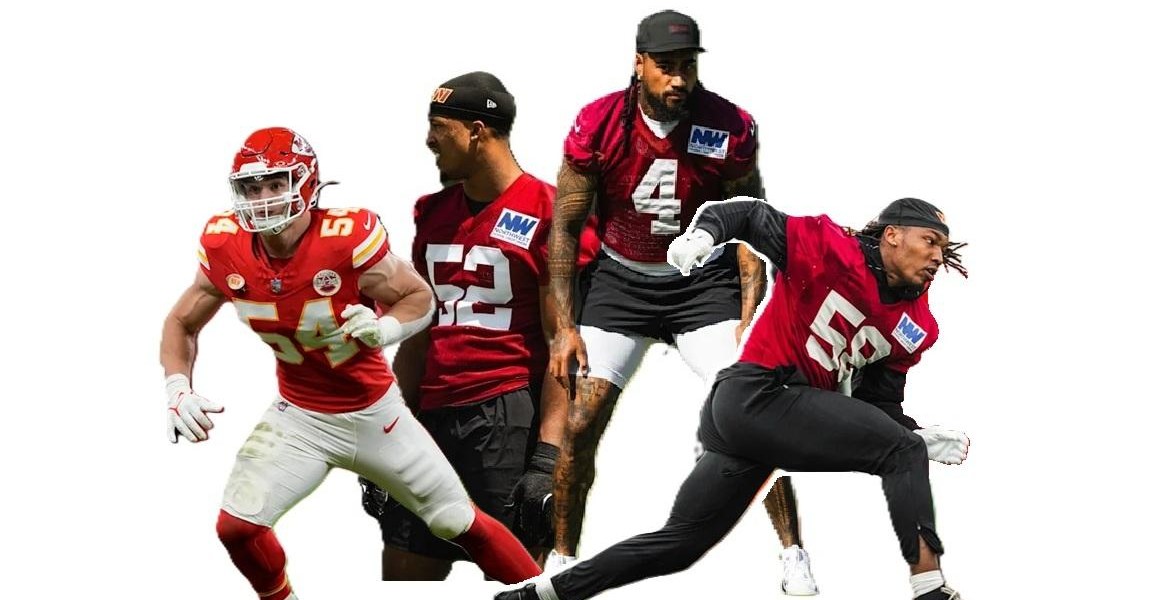
Washington Commanders Linebacker Room May be NFL’s Most Athletic
Chenal is the foundation — the one constant in an otherwise fluid rotation. At Kansas City, he was used as a downhill enforcer in a scheme that prioritized gap discipline and short-yardage dominance, and he delivered. He finished the 2024 season allowing just a 58.3% completion rate on targets in coverage while posting a 14.4% run stop percentage, elite numbers for an inside linebacker.
In Washington’s base set, Chenal could very well be the MIKE — the traffic controller. His job is to set the front pre-snap, fill gaps decisively, shed blocks at the point of attack, and eliminate cutback lanes before they develop. On first and second down against run-heavy personnel, Chenal is on the field. Period. He’s the one guy in this room who doesn’t rotate out based on matchup — he’s the anchor everything else is built around. Sonny Styles may soon join him, but one can never be 100% certain with a rookie.
The Blitzer: Frankie Luvu
Frankie Luvu is the wildcard, and he’s a good one. He brings a pressure-creation element from the linebacker position that most teams can’t replicate with a traditional ILB. Luvu generated 51 pressures over the 2022-2023 seasons combined — exceptional production from a 4-3 off-ball linebacker. That number jumps when he’s given freedom to blitz from the WILL spot.
In terms of the rotation, Luvu is the second off-ball piece who stays on the field as the Commanders shift from their base into their 4-2-5 nickel package. His alignment disguise and first-step quickness make him a genuine chess piece. Alongside Chenal and Styles, Luvu gives Washington an interior that can stop the run AND generate pressure without burning a safety on a blitz — a combination that opens up the rest of the defensive call sheet.
Jones will use Luvu in a variety of ways: as a traditional blitzer off the edge, as a spy on mobile quarterbacks, and as a zone dropper in Cover 3 to clog the intermediate throwing window.
The Rising Piece: Sonny Styles
Styles is the most intriguing developmental asset in this group — and the highest ceiling player in the entire room. The Ohio State product played a hybrid safety/linebacker role in college that makes him tailor-made for the modern game. His athleticism — a 4.46 forty with a 40.5-inch vertical — gives Jones a genuine matchup creator across the field.
In the rotation, Styles could very well be the green dot. His assignment is straightforward: stop the run, carry athletic tight ends vertically, take away the seam, and bracket slot receivers when the coverage calls for it. Against the Travis Kelce and Sam LaPorta types of the NFC, Styles is Washington’s answer.
3 things to watch during Commanders OTAs
Jayden Daniels in a new offense.
Yes, the Commanders and David Blough are still in the early stages of installing their new offense, and no, the team isn’t going to show much of anything that it will run during the season. However, that doesn’t mean there will be a lack of things to learn from that side of the ball. Not only will it be the first time we’ve seen Daniels lead an offense since the Commanders’ game against the Minnesota Vikings, but it will be in an entirely new scheme with new responsibilities. And that’s going to be interesting.
Here’s one thing we do know about Blough’s system: Daniels is going to be under center more frequently than at any other point in his playing career. Blough and head coach Dan Quinn are excited about this addition, with both saying that it will add a dimension to the run game and play-action. On paper, this makes sense for the Commanders’ offense; they had the fourth-best rushing offense in football last year, and Daniels’ ability to make throws on the move makes him a good fit for the role.
But Daniels has not operated much under center aside from a handful of plays at the professional and college levels, so it might take some time for him to adjust and get the footwork down. Fortunately, that’s what this time of the offseason is for, and Daniels has the work ethic to get acclimated to being under center more often.
It will be interesting to see how Blough uses personnel groupings compared to last year’s offense under Kliff Kingsbury. There was a glimpse of that during the open rookie minicamp practice, when there were multiple tight end sets during 11-on-11 drills. Blough’s offense, which can be traced back to Chicago Bears’ head coach Ben Johnson’s scheme, uses more motion — a significant departure from last year’s offense — to get players open. Players like Terry McLaurin, Antonio Williams and Chig Okonkwo all thrive when put in motion, so the new scheme could be a good fit for their skill sets.
The Commanders won’t reveal their full hand with dozens of reporters on the sideline, but the practice should provide a good baseline for how much they plan to use things like motion and lining up under center going forward.
How big are OTAs for Commanders players?
“Every year, I think it is a big deal. As a player, I would never miss an OTA. Because it shows commitment to the program, and I was a UDFA (undrafted free agent), so I felt like I had to be there.”
Paulsen continued, noting that the OTA is significant for an NFL team. “I think it is important, especially with two new coordinators, but every year, there are guys that don’t come. I will say this to defend them: Laremy (Tunsil) is a good example of this. Laremy, his first year here, didn’t come to OTAs. Did that affect his play at all? Absolutely not. That’s part of his process at this point. He comes to what he needs to come to.”
Paulsen then told of how he recalled former Redskins DeSean Jackson and Trent Williams would not attend an OTA, “but that doesn’t bother me as a player, if you are ready to go. He added that Jackson and Williams were always ready to go when training camp arrived.Expert NFL picks: Exclusive betting insights only at USA TODAY.
“For me, it (OTA) was always extremely important for me to attend. If I’m a coach, I want people there. But I also understand that people have different processes. As long as they handle their business when they’re away from the facility, and are ready to go for mini-camp and training camp, I’m okay with that.”
As Paulsen mentioned, being an undrafted free agent, he was never going to mess around and miss an OTA. This might be a contributing factor to how Paulsen managed to make an NFL team, playing in eight regular seasons. That being said, most players understand they should be there for the good of their career. In addition, the Commanders having two new coordinators, most players will understand the need to be present for the new material provided and taught.
Treylon Burks has a golden opportunity to emerge as Commanders’ early WR2 favorite at OTAs
At 6-foot-2, 225 pounds, the big-bodied Burks offers a different look than his positional counterparts. The 2022 No. 18 overall pick is physically gifted and has the makings of an intriguing deep and red-zone threat. Meanwhile, the quartet of promising third-round rookie Antonio Williams, Jaylin Lane, Luke McCaffrey and Dyami Brown all do most of their damage from the slot.
Of course, voluntary practices without pads will only take Burks so far in terms of making a favorable impression. However, the Commanders are notably installing a new system under first-year offensive coordinator David Blough. There are no wasted moments when implementing change, giving anyone who picks up the system quickly a leg up on the rest of the group.
Jaylin Lane needs to prove himself all over again with the Commanders
Lane had some nice moments. His punt-return prowess was exceptional, but concentration issues limited opportunities on the offensive rotation. And now, the former Virginia Tech standout has to prove himself all over again.
The competition for places has increased. Van Jefferson Jr. and Dyami Brown were both signed in free agency. The Commanders spent the No. 71 overall selection in the 2026 NFL Draft on Antonio Williams, who could be a steal if he puts everything together. That’ll make things more difficult for Lane to firmly establish himself, though it’s unlikely that his roster spot is in any danger right now.
New offensive coordinator David Blough’s schematic concepts should also benefit Lane. He is elusive with the football in his hands, and there will be a lot of quick releases to create yards after the catch opportunities. That fits the second-year pro’s skill set, but standing out from the crowd is the only way he’ll get his share of targets.
The Commanders were never going to stand still. There is a chance that even more reinforcements will arrive at the receiver unit in the near future. Brandon Aiyuk and Stefon Diggs are being heavily linked in the media, though there is no real substance to it right now. This is all out of Lane’s hands, so focusing on what he can control is the primary objective.
How to: Protect your quarterback
Thursday’s newsletter referenced scheme changes in Baltimore and Washington that should better protect their franchise quarterbacks. One reader, David, asked a great question:
💬 Why does Ted Nguyen reference being under center as a way to protect mobile quarterbacks like Lamar Jackson from injury? Being in the shotgun gives them more time to read blitzes, routes and avoid pressure. Am I wrong?
I texted Ted and got his answer:
“Playing in the gun means your quarterback will be involved in the run game. So you’re calling more zone read, bash reads, concepts where your quarterback is a runner.
“Playing under center, you’re handing the ball off and then you’re running play action off of it where you’re getting guys open with the run fake. There’s less indecision.
“And when you’re running play action, you’re probably less likely to run than you are to pass, at least compared to shotgun fakes, since guys are more likely to be open downfield.”
The article we’re referencing covers offensive playcalling changes for 13 teams. Back to OTAs.
PHOTOS | In the lab for OTAs (earlier this month)
The Washington Commanders were back on the field to continue Phase 2 of their offseason workout program. Check out the top photos from the practice.
Joshua Josephs Scouting Report, Talking RB Room & Rico Street Scores Joins | Get Loud | Commanders
David Blough’s Offense Changing? Is Antonio Williams Ahead of Terry McLaurin for Commanders Attack?
The Cowboys evolution to a multiple 3-4 defense
Switching to Parker’s 3-4 defense isn’t just about relocating a player from one area to another. It’s a fundamental reconfiguration of how space is defended and how pressure is applied, with one word defining everything. Multiple. By shifting schemes, the defense aims to become unpredictable, turning itself into a shape-shifting weapon designed to neutralize explosive passing attacks. Today, we’re going to take a closer look at what to expect from this transition.
4-3 base defense – power and penetration
To start with, let’s get a better understanding of the old before we switch over to the new. The traditional 4-3 structure has been the league’s favorite way to set its defense for many years. It’s a straightforward approach, but very effective. The math puts four defensive linemen in the trenches, two defensive tackles clogging the middle, and two speedy edge rushers on the outside to come after the quarterback.
Behind them are three linebackers named Mike, Sam, and Will, who collectively are responsible for navigating through blocks, running down ball carriers, and dropping into pass coverage. Secondaries between the 4-3 and 3-4 tend not to vary much and run similar schemes.
3-4 structure – space, leverage, and illusion
Initial thought might lead you to think the 3-4 structure puts fewer bodies up front, but it’s actually the opposite. The three accounts for your beef in the middle, consisting of a giant nose tackle sandwiched between two oversized defensive ends. The jobs of these guys change from one-gap assignments to two-gap, where instead of attacking upfield, they hold their ground and control the spaces on either side of the blockers in front of them.
The four from this alignment are your linebackers; however, two of them are typically lined up on the outside of the line of scrimmage as edge rushers, while the other two are off-ball linebackers. The edge rushers are versatile players who stand upright and may attack forward or drop back, while the other two linebackers cleanly sift through the chaos and chase down ball carriers. All of this is designed to create more uncertainty for the offense and force them to react after the ball is snapped.
Multiplicity vs. Simplicity
Let’s start looking at Christian Parker’s scheme more specifically. Against a multiple defense, you break the huddle thinking you are playing Hedwig, but by the time the ball is snapped, you are staring directly at The Beast. A multiple defense is a chameleon. It seamlessly morphs its fronts and coverages on the fly without tipping off the offense as to which type of players are on the field. It relies heavily on player flexibility, which is why the term “hybrid” will be synonymous with Parker’s system. Having players from several positions instantly switch from one type of responsibility to another allows the defense to disguise its intent without having to alter its personnel groupings.
Rather than showing your cards and allowing the offense to exploit mismatches, the defense lies low and lurks in the bushes. They are forcing quarterbacks to be quick on their feet and process in an instant to successfully crack the code. But it takes the right type of players to pull it off.
The Athletic (this story is free to read)
Packers running back Josh Jacobs arrested on domestic abuse charges
Green Bay Packers running back Josh Jacobs was arrested Tuesday and booked into Brown County Jail on five charges related to an alleged domestic violence incident over the weekend, according to the Hobart-Lawrence Police Department in Wisconsin.
The charges against Jacobs, 28, include felony strangulation and suffocation, and four misdemeanors: battery (domestic abuse), criminal damage to property (domestic abuse), disorderly conduct (domestic abuse) and intimidation of a victim. Jacobs’ arrest stems from an incident that occurred Saturday morning, according to a police news release, as police were dispatched to a disturbance complaint at approximately 8:37.
Supreme Court rejects NFL’s bid to step into coach Brian Flores’ racial discrimination suit
The Supreme Court on Tuesday turned away an appeal by the NFL stemming from coach Brian Flores’ landmark racial discrimination lawsuit, allowing his case to proceed in federal court instead of closed-door arbitration overseen by the league.
The high court declined to review a lower court decision that allowed Flores’ case to move forward in open court instead of arbitration, in which Commissioner Roger Goodell would serve as the decision maker.
Flores alleged that the league had discriminated against him and other Black coaches based on their race and denied them coaching and general manager positions.
Flores sued the NFL after he was fired from his job as head coach of the Dolphins after leading the team to a 24-25 record over three years. He had interviewed for coaching jobs with the Giants and Broncos, but the two teams declined to hire him. Flores is now defensive coordinator for the Minnesota Vikings.
In response to the lawsuit, the NFL and teams sought to compel arbitration based on the coaches’ employment contracts and a provision of the NFL Constitution that gives the NFL commissioner, Goodell, authority to arbitrate disputes between coaches and member clubs.
Flores opposed the move, arguing that Goodell, as the league’s leader, was inherently biased toward the NFL and its teams because he reports to the clubs and has financial incentives and a professional obligation to act in the league’s best interest.
A federal judge allowed some of Flores’ claims to move forward in open court instead of in arbitration. The U.S. Court of Appeals for the Second Circuit affirmed that decision, but on different grounds.
Bears Stadium Saga Now Tied to Potential $1.5B Tax Break
With just five days left in the Illinois spring legislative session, the situation around a proposed Bears stadium in suburban Arlington Heights remains as complex as ever
The study estimates that under the megaprojects bill, the Bears could glean more than $39 million in annual property tax savings on the new stadium, compared to paying on normal assessed values—with that break surpassing $1.5 billion in total value over 40 years.
“Huge real estate projects can create jobs, boost sales tax revenue, and provide other benefits to their surrounding communities,” the treasurer’s study continued. “But property tax breaks for megaprojects would, for decades, severely limit one key goal of economic development: expansion of the property tax base that provides relief to other taxpayers who get no tax certainty. … And if there’s no expansion of the property tax base and only limited sales tax benefits, how do taxpayers benefit? That’s the multibillion-dollar question.”
The latest report provides an extra wrinkle in what has already been a fractious political situation surrounding the Bears stadium saga. The team has long insisted it needs this megaprojects legislation to make the Arlington Heights site option work, as it would give critical cost certainty and aid the Bears’ borrowing to support private funding for much of the project.
The bill passed in the Illinois House of Representatives more than a month ago, but progress since then has stalled in the state Senate as legislators there have grappled with the ramifications, both politically and on individual homeowners. With just five days left in the Illinois spring legislative session, pressure around the megaprojects issue is quickly rising.
Meanwhile, a public back-and-forth has erupted between Illinois Gov. J.B. Pritzker and Chicago Mayor Brandon Johnson, in part stemming from the latter’s insistence that the Bears stay in the city. That stance from Johnson, and many state legislators from the Chicago area, is happening despite assertions for months from the team, league, and governor that the stadium choice is down to either Arlington Heights or a competing option in Hammond, Ind., that already has legislative approval.