
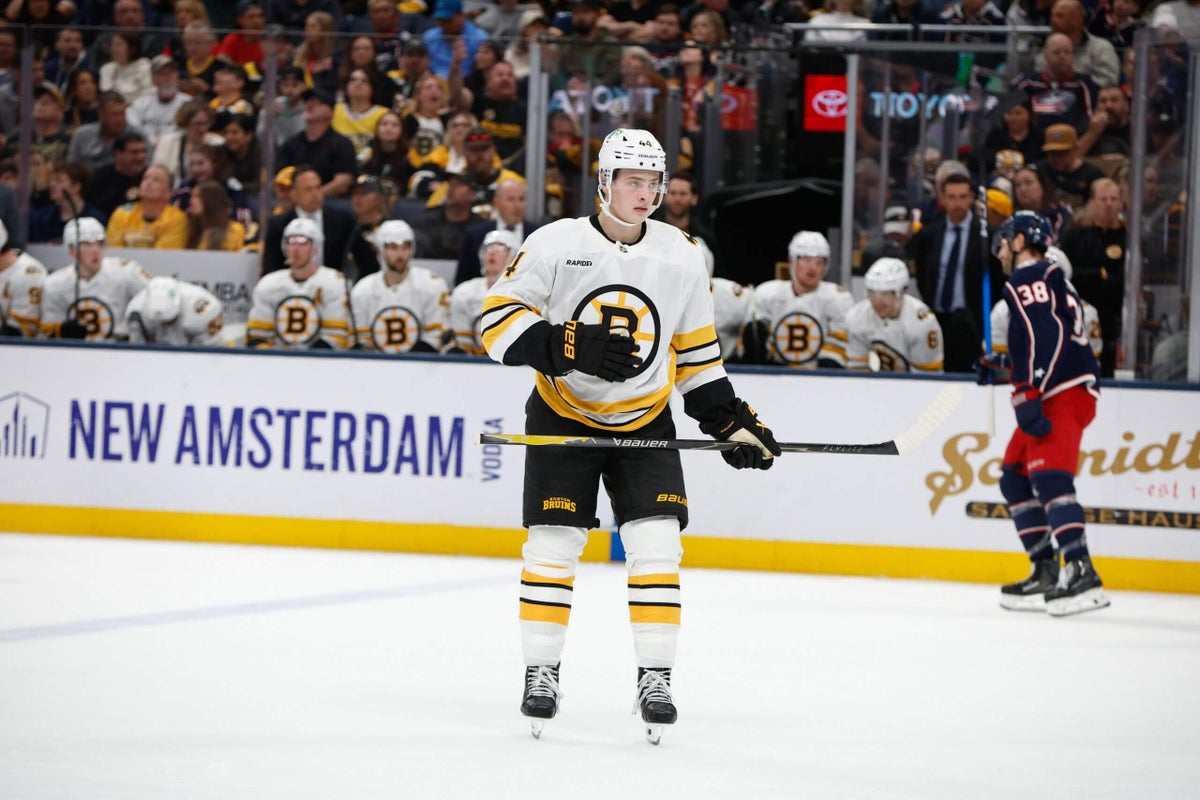
Superstars make a difference. The Boston Bruins have three of them.
Jeremy Swayman is a Vezina Trophy finalist. If not for Nikita Kucherov, David Pastrnak would be an annual selection as the league’s best right wing. Charlie McAvoy did his thing at both ends in 2025-26, even with rotten injury luck and his son’s health concerns.
As the Bruins learned in the first round against the Buffalo Sabres, though, three top-shelfers without a go-to support staff can only get you so far.
The Bruins are in good shape, especially considering where they were one year ago following their teardown. Viktor Arvidsson and Andrew Peeke are their only pending unrestricted free agents. Re-signing Jordan Harris, their lone restricted free agent-to-be, will not be complicated. They project to have about $15 million to spend under the $104 million salary cap, a threshold they always approach.
But without upgrades at multiple positions, the Bruins are at risk of regression in 2026-27. The delta between their alpha dogs and their general population is significant.
Here’s where the Bruins stand in relation to the Cup Checklist. All projected values are age-adjusted based on each player’s profile of comparable peers.

What the Bruins have
Swayman, Pastrnak and McAvoy are enviable commodities. Nobody would be surprised if Swayman approaches his 2025-26 level again next year. The 27-year-old is in the sweet spot of his career.
Pastrnak turned 30 on Monday. He played through a groin tear in 2025-26. But his talent and hockey IQ show no signs of short-term degradation.
McAvoy touched the game in all areas while being partnered mostly with Jonathan Aspirot, a 27-year-old who had never made an NHL appearance before this past season.
Lower in the lineup, Fraser Minten was a very good No. 3 center as a first-year NHLer. The Bruins can count on the ex-Toronto Maple Leaf to be a long-term fixture. The question is whether Minten can grow into a top-six presence.
The development of James Hagens could go a long way in improving the roster. The No. 7 pick from 2025 has the skill, speed and imagination to be a difference-making member of the franchise’s elite core.
It is unrealistic and unfair, though, to expect the 19-year-old to approach the peak of his powers in his first full pro season. Patience will be required.
What the Bruins need
Is there a top-six forward or dynamic offensive defenseman in the house?
At times, Morgan Geekie filled the role as Pastrnak’s No. 2 gunner. But Geekie is a hot-and-cold shooter. The Bruins will be in a better position if Geekie reduces the length of his shooting valleys.
Two years ago, the Bruins invested $54 million in Elias Lindholm with the expectation of securing a No. 1 center. In retrospect, it looks to be a purchase at a peak price. Lindholm is neither a star forward nor a shutdown forward in their elite core. In fact, the 31-year-old with two seasons of back ailments does not even drive the needle as a depth offensive forward.
The Lindholm issue could be addressed if Hagens grows into an impact forward, whether it’s at center or wing. The problem is that the Bruins do not have many other options when it comes to internal growth.
As for the defense, Mason Lohrei looked like he could grow into an offensive pace-pusher. That no longer appears to be the case. Perhaps the most realistic scenario is to trade Lohrei to a team better suited for his strengths. The corresponding hope is that Frederic Brunet (12 goals and 36 points in 65 AHL games) takes the next step. Brunet, 22, has one career NHL appearance.
The Bruins have UFA options on the back end. Darren Raddysh and Rasmus Andersson would check multiple boxes on the right side. But the Bruins would have to outspend multiple bidders. It’s a good bet either Raddysh or Andersson would become the team’s second-highest-paid defenseman after McAvoy ($9.5 million AAV).
The big question
Is the turnaround sustainable?
The Bruins took an excellent first step in 2025-26. They exceeded expectations to make the 2025-26 postseason. Coach Marco Sturm was the right man to lead the upswing.
Meanwhile, general manager Don Sweeney saw the initial stages of his investment in the future unfold. He signed Hagens. Dean Letourneau and Will Zellers had important NCAA development seasons.
But present and future growth are not guaranteed. On the varsity, there’s a whole lot of gray in the Bruins’ support and depth categories. Pavel Zacha and Casey Mittelstadt are coming off career bests in shooting percentage, which makes them regression possibilities. Things would look more promising if the Bruins re-sign Arvidsson, but that is no guarantee.
As for the picks-and-prospects category, the Bruins had bad luck when the Maple Leafs won the lottery. They may have to wait until 2028 to secure the first-rounder that was a condition of the Minten trade. They already have two 2028 first-round picks: their own and that of the Florida Panthers as part of the Brad Marchand deal. Sweeney may dip into this cluster as trade collateral for more immediate assistance.
Takeaway
The Bruins returned to the playoffs ahead of schedule in 2025-26. Heavy lifting will be required for them to make it back to the postseason in 2026-27.