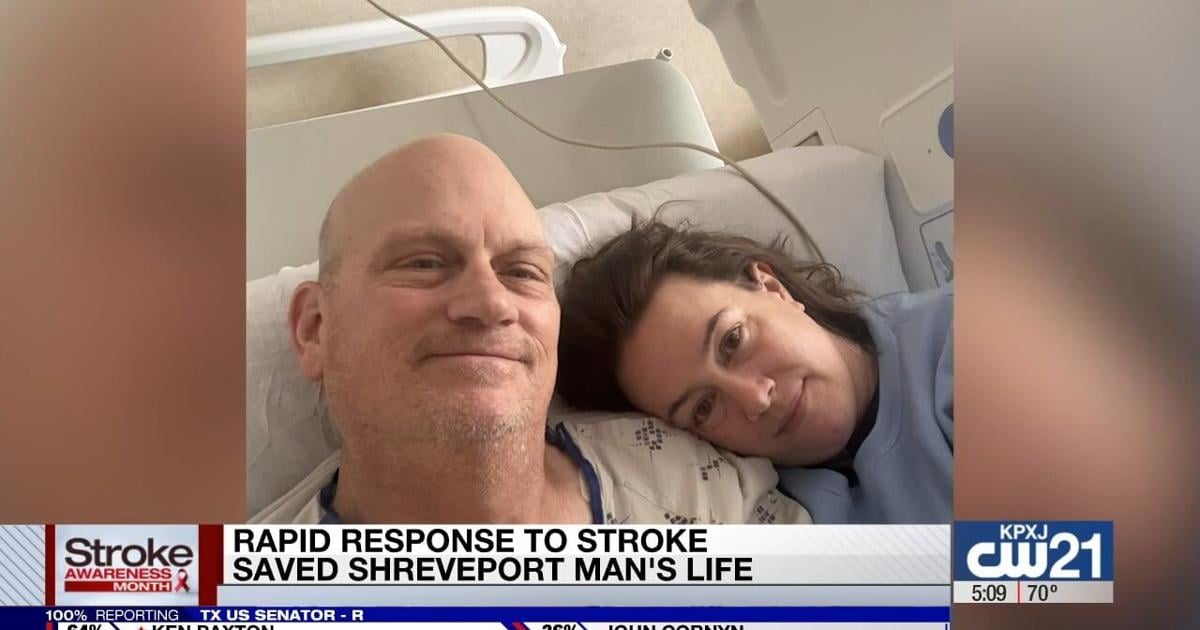
SHREVEPORT, La. — A Shreveport man is sharing his story after surviving a life-threatening stroke that doctors say carried only a small chance of survival — and he hopes others will learn how critical it is to seek help immediately when symptoms appear.
Until this past February, 56-year-old Dave Bushnell believed strokes were mainly something older people needed to worry about.
Today, he knows they can happen at any age.
Bushnell said the medical emergency began early one morning while he and his wife, Bridgett, were getting ready before their children woke up. As he stepped out of the shower, he suddenly felt weak and unsteady.
“Just held onto the countertop, and something was — I knew something was wrong,” Bushnell said.
His wife heard him call for help.
“I was like, ‘Okay, what’s going on?’” Bridgett Bushnell recalled. “And he said, ‘I just feel funny. I feel not right.’”
The couple quickly checked his blood sugar to rule out low blood sugar as the cause. Although it was on the low side, it didn’t seem enough to account for the problems he was feeling, so they called 911.
Paramedics rushed Bushnell to the nearest Willis Knighton hospital, where doctors discovered a blood clot at the base of his brainstem.
“I was slurring my words,” Bushnell said. “They figured out what was going on. I had a blood clot in my brain right at the brainstem with a 4% chance of survival.”
Bridgett Bushnell said doctors warned them the clot was in one of the most dangerous possible locations.
“The doctor came out and told me he has a blood clot at the base of his brainstem,” she said. “He said it’s the worst place to have one.”
Doctors performed an angiogram procedure to remove the clot. Despite the risks, the procedure was successful.
“Within two days, I was starting to walk,” Bushnell said. “Which they said was incredible.”
Stroke specialists say rapid treatment can make a major difference in patient outcomes.
Brittney Anderson, stroke coordinator at Willis Knighton Pierremont, said treatment options are extremely time-sensitive.
“We only have four and a half hours from the onset of symptoms to be able to give this medication to the patient,” Anderson said, referring to thrombolytic drugs used to break up blood clots.

Follow-up appointments are critical in managing stroke recovery.
Now back at work in his audiovisual business, Sound Minds, Bushnell says he has mostly recovered, though he still occasionally notices lingering effects while playing golf.
The Bushnells say they are grateful for how quickly everything happened and believe acting fast helped save his life.
“Usually strokes take six months to a year to get over,” Bushnell said. “So I’m glad to be over it as much as I am right now.”
“Thank God everything happened the way that it did,” Bridgett Bushnell added. “Everything moved fast and we were able to get all the help that he needed at that time.”
Moving forward, the couple says they are paying closer attention to diet, exercise and overall health. Bushnell will also undergo additional CT scans over the next year to monitor for any new blood clots or damage.
BE FAST is the stroke awareness slogan.
Health experts encourage the public to learn the “BE FAST” warning signs of stroke, which can include balance issues, eye or vision problems, facial drooping, arm weakness and speech difficulties. They say seeking medical help immediately can significantly improve a patient’s chance of recovery.
More information is available in the KTBS Stroke Awareness Month section.