
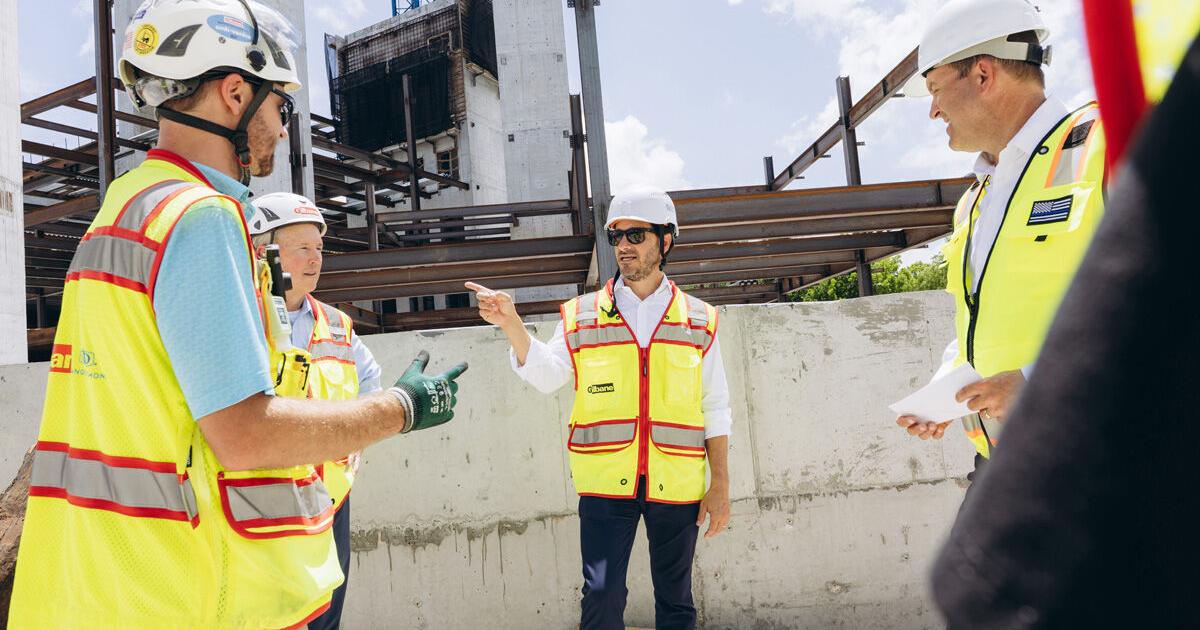

Dr. Robert Cubeddu, president of the Rooney Heart Institute at NCH, center, on a hard hat tour with senior superintendents and project managers from building partners DeAngelis Diamond and Gilbane Building Company and NCH Chief Operating Officer Jon Kling, right.
Olga Hayes
Just shy of a year after breaking ground, Naples Comprehensive Health celebrated a construction milestone on its $295 million heart and stroke facility with a topping-out ceremony May 27.
The nearly 200,000-square-foot R.M. Schulze Family Heart & Stroke Critical Care Center, located on NCH’s downtown Naples campus, is scheduled for completion in late 2027, and CEO Paul Hiltz told a crowd of about 100 staff members, donors, building partners and community members that the project remains on track.
Attendees signed the building’s top beam during the ceremony, which Hiltz described as a big turning point in the construction process.
A rendering shows the future R.M. Schulze Family Heart & Stroke Critical Care Center planned for NCH’s downtown Naples campus. The nearly 200,000-square-foot facility is scheduled for completion in late 2027.
Naples Comprehensive Health/CannonDesign
He said the ceremonial event recognized the construction teams led by Kenny Gunn of DeAngelis Diamond and Alex McIntyre of Gilbane Building Co., along with the founders, donors and broader community that contributed to the project.
“It’s to send signals of good luck, good fortune and prosperity, not only for the building, but for the people that will be working in this building for many years to come,” Hiltz said.
The facility will house the existing Rooney Heart Institute and Wingard Stroke Institute when completed.
Dr. Robert Cubeddu, president of the Rooney Heart Institute, said plans for the new facility began five years ago with the goal of creating a world-class cardiac and stroke institute for Naples and Southwest Florida.
NCH CEO and President Paul Hiltz provided an update on the $295 million project to a crowd of about 100 staff, donors, building partners and community members.
Olga Hayes
“And while medicine is about expertise and technology, this building is more than that,” Cubeddu said. “It brings technology, it brings expertise, but more importantly, it brings the trust and the confidence that our patients deserve so they don’t have to travel for care when they have a stroke or a heart attack. They have at their fingertips, here in Naples, a world-class institute.”
Cubeddu said the facility will offer a full range of cardiac care, from prevention and treatment to heart transplants. NCH announced in March the launch of an advanced heart failure and solid organ transplant program.
“I had firm belief and conviction that this [transplants] is something we can do one day,” Cubeddu said after the ceremony. “We have sent out endless numbers of patients who have end-stage heart disease and critical conditions for transplants away from their families, away from their loved ones.
“So why can’t we build it? The fact that we can do it here at home, that we have the support of a leadership team that believes in our vision and cares about quality for the community is really what’s driving us.”
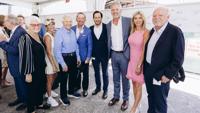
NCH CEO and President Paul Hiltz and Dr. Robert Cubeddu, center, with (left to right) Patty Baker, Kris Hiltz, Jay Baker, Brian Stock, Jennifer Rowland and NCH board president Scott Lutgert.
Olga Hayes
Addressing community concerns
The road to making those bold visions a reality wasn’t always smooth because of sometimes-contentious negotiations with the city of Naples and neighboring residents, who had concerns about noise and other issues associated with the massive two-year construction project.
NCH has responded with an outreach program, including emails and quarterly town hall meetings, designed to keep nearby residents informed about the project’s status and address concerns raised.
Jonathan Kling, chief operating officer at NCH, said the healthcare system wants to be “as good a neighbor as we can be” during the construction process.
“At the very beginning, we didn’t always have the support of our neighbors, but I think we listened throughout the design review process, City Council review process and planning and advisory board meetings, and came out of it with a better cadence with our neighbors,” he said.
Kling, who led a hard-hat tour of the site with representatives from DeAngelis Diamond and Gilbane Building Co. following the ceremony, said NCH revised parts of the original design and construction timeline to reduce the project’s impact on nearby residents. He said the parking garage was scheduled for completion first to help minimize noise and light disruptions during construction.
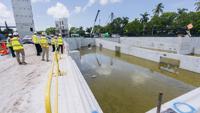
A storm trap on the heart and stroke center site, part of a required flood mitigation system.
Olga Hayes
Among the noise mitigation measures discussed during the most recent town hall meeting were replacing traditional backup beepers on concrete trucks with “swoosh” alarms, installing a noise barrier and acoustic panel enclosure around the concrete pump truck, and using battery-powered equipment instead of gas-powered machinery when possible.
During the hard-hat tour, Kling also noted a side benefit for the neighboring area: the installation of a $30 million to $40 million storm trap designed to hold a 100-year stormwater surge as part of the project’s required flood mitigation system.
“We’re doing all we can to harden our infrastructure because, at the end of the day, it’s our responsibility to be open always for our patients,” he said. “We always have been and we always will be.”
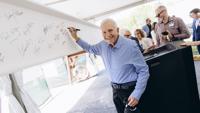
Philanthropist Jay Baker signs a beam at the May 27 topping-out ceremony for the R.M. Schulze Family Heart and Stroke Critical Care Center. Construction on the almost 200,000-square-foot facility on NCH’s downtown campus is expected to be completed in late 2027.
Olga Hayes
Project driven by philanthropy
Kling said the board-approved budget for the project remains at $295 million, with $250 million coming from philanthropic gifts. He said about $195 million of the philanthropic goal has been reached, with $35 million left to raise.
He said the remaining $45 million is coming from a public bond offering that also supported construction of the system’s orthopedic hospital, HSS at NCH, its urgent care expansion on Marco Island and a future hospital project in Ave Maria.
NCH Chief Impact Officer Mara Hammond said the current total represents 843 philanthropic gifts to date, and that momentum for community support remains strong.
“With $35 million left to go, we do anticipate closing [that gap] within the next six to 10 months, which is timed perfectly with the opening of this project,” Hammond said.
At the topping-out ceremony, Hiltz, Cubeddu and NCH board President Scott Lutgert recognized the many donors who have supported the project, including representatives of the Schulze family.
Hiltz and Cubeddu also thanked one of the newest major donors, Brian Stock, for his recent $10 million gift. Cubeddu said the outpatient cardiac clinic at the new facility will recognize Stock’s gift.
Stock, CEO of Naples-based STOCK Development, said he was excited about the opportunity to give back to the community and help keep healthcare local.
“I think that it’s great to have healthcare here locally and to see the evolution of what’s been accomplished in the last five years, and to have that level of healthcare so people can have full-service care here (in Naples),” Stock said.
In addition to Stock’s recent gift, other major gifts for the heart and stroke center have included $20 million from the Richard M. Schulze Family Foundation, $20 million from Francis and Kathleen Rooney, $20 million from Donald and Diana Wingard, $15 million from the Bill and Julia Van Domelen Foundation, $10 million from Jay and Patty Baker, $10 million from Pete and Dawn Irving and $10 million from Audrey Morean Petersen.