
Conservation groups and researchers in Florida’s Indian River Lagoon say they have surpassed a major milestone in a yearslong effort to restore one of the state’s most ecologically important estuaries, with more than 100 million clams now returned to the waterway.On Wednesday morning, Coastal Conservation Association Florida and Phillips Infrastructure deployed 3.5 million clams by drone into the lagoon near Port St. John, pushing the restoration project past the 100-million mark as part of the organization’s Billion Clam Initiative.The effort is a partnership between the Coastal Conservation Association Florida, Capt. Blair Wiggins, the Florida Fish and Wildlife Conservation Commission and the University of Florida Whitney Laboratory for Marine Bioscience.The goal is to restore water quality and habitat in the Indian River Lagoon by using clams as natural filters to remove pollutants, improve seagrass growth, and support marine life.“So we started this almost 10 years ago and the goal is to reach 1 billion but 100 million milestone is incredible and we’ve made it there today,” Frank Gidus said.The lagoon, which stretches along Florida’s east coast, was once home to vast clam populations. According to Gidus, the ecosystem has struggled to recover after decades of commercial harvesting, storms, and declining water quality.“Back in the ’90s, this area had over 10 billion clams,” Gidus said. “Most of the clams were taken commercially and then as a result, we’ve had some storms and some weather and the lagoon has not been able to recover.”Researchers and conservationists say clams play a critical role in maintaining healthy waterways because they continuously filter water as they feed.“What clams do? They’re just like oysters. Everybody knows oysters filter water,” Wiggins said. “Even when their bellies get full, they’re still filtering.”Studies cited by the project partners show clams can remove nitrogen and sediment from coastal waters, helping improve clarity and overall habitat conditions. Organizers say early signs suggest the restoration work is already making a difference.“It’s amazing — the water quality is already showing signs of recovery,” Gidus said. “Some clams that we put in five or six years ago are spawning. It’s definitely working.”The project uses drone technology to distribute the shellfish in targeted areas throughout the lagoon, a method organizers say improves survival rates and placement accuracy.“We’re able to use the drone to place the clams exactly where we want with the exact density and the exact location,” Gidus said. “This technology has been wonderful for this project.”According to organizers, a mature clam can filter up to 20 to 25 gallons of water per day.“It is really a dream come true,” Gidus said. “You multiply that by 1 billion — that’s a lot of water being filtered.”Wiggins, who has spent decades fishing the lagoon, said the restoration effort represents hope for a waterway he watched decline over much of his lifetime.“Days like today are awesome,” Wiggins said. “When I was a fishing guide right here, I saw millions of clams come out of the river and I was screaming my head off. I couldn’t do anything about it then, but I’m glad it’s finally come to fruition now that the clams are finally getting repopulated in the river.”Wiggins said he does not expect the lagoon to fully return to the pristine condition he remembers from childhood in the early 1970s, but believes restoring filter feeders such as clams and oysters could help the ecosystem sustain itself again.“If we can get back to where it’s taking care of itself — the clams are filtering and we’re getting our oysters back, the horseshoe crabs, the seagrass, all the fish — we might just have a chance of getting it back to close to what it was,” he said. “And if we can even get it close, it’s been a paradise here my entire life.”
BREVARD COUNTY, Fla. —
Conservation groups and researchers in Florida’s Indian River Lagoon say they have surpassed a major milestone in a yearslong effort to restore one of the state’s most ecologically important estuaries, with more than 100 million clams now returned to the waterway.
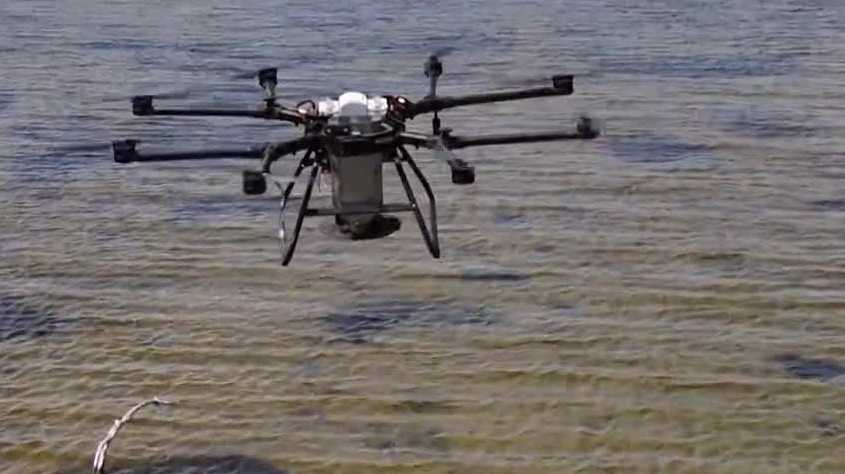
On Wednesday morning, Coastal Conservation Association Florida and Phillips Infrastructure deployed 3.5 million clams by drone into the lagoon near Port St. John, pushing the restoration project past the 100-million mark as part of the organization’s Billion Clam Initiative.
The effort is a partnership between the Coastal Conservation Association Florida, Capt. Blair Wiggins, the Florida Fish and Wildlife Conservation Commission and the University of Florida Whitney Laboratory for Marine Bioscience.
The goal is to restore water quality and habitat in the Indian River Lagoon by using clams as natural filters to remove pollutants, improve seagrass growth, and support marine life.
“So we started this almost 10 years ago and the goal is to reach 1 billion but 100 million milestone is incredible and we’ve made it there today,” Frank Gidus said.
The lagoon, which stretches along Florida’s east coast, was once home to vast clam populations. According to Gidus, the ecosystem has struggled to recover after decades of commercial harvesting, storms, and declining water quality.
“Back in the ’90s, this area had over 10 billion clams,” Gidus said. “Most of the clams were taken commercially and then as a result, we’ve had some storms and some weather and the lagoon has not been able to recover.”
Researchers and conservationists say clams play a critical role in maintaining healthy waterways because they continuously filter water as they feed.
“What clams do? They’re just like oysters. Everybody knows oysters filter water,” Wiggins said. “Even when their bellies get full, they’re still filtering.”
Studies cited by the project partners show clams can remove nitrogen and sediment from coastal waters, helping improve clarity and overall habitat conditions. Organizers say early signs suggest the restoration work is already making a difference.
“It’s amazing — the water quality is already showing signs of recovery,” Gidus said. “Some clams that we put in five or six years ago are spawning. It’s definitely working.”
The project uses drone technology to distribute the shellfish in targeted areas throughout the lagoon, a method organizers say improves survival rates and placement accuracy.
“We’re able to use the drone to place the clams exactly where we want with the exact density and the exact location,” Gidus said. “This technology has been wonderful for this project.”
According to organizers, a mature clam can filter up to 20 to 25 gallons of water per day.
“It is really a dream come true,” Gidus said. “You multiply that by 1 billion — that’s a lot of water being filtered.”
Wiggins, who has spent decades fishing the lagoon, said the restoration effort represents hope for a waterway he watched decline over much of his lifetime.
“Days like today are awesome,” Wiggins said. “When I was a fishing guide right here, I saw millions of clams come out of the river and I was screaming my head off. I couldn’t do anything about it then, but I’m glad it’s finally come to fruition now that the clams are finally getting repopulated in the river.”
Wiggins said he does not expect the lagoon to fully return to the pristine condition he remembers from childhood in the early 1970s, but believes restoring filter feeders such as clams and oysters could help the ecosystem sustain itself again.
“If we can get back to where it’s taking care of itself — the clams are filtering and we’re getting our oysters back, the horseshoe crabs, the seagrass, all the fish — we might just have a chance of getting it back to close to what it was,” he said. “And if we can even get it close, it’s been a paradise here my entire life.”