
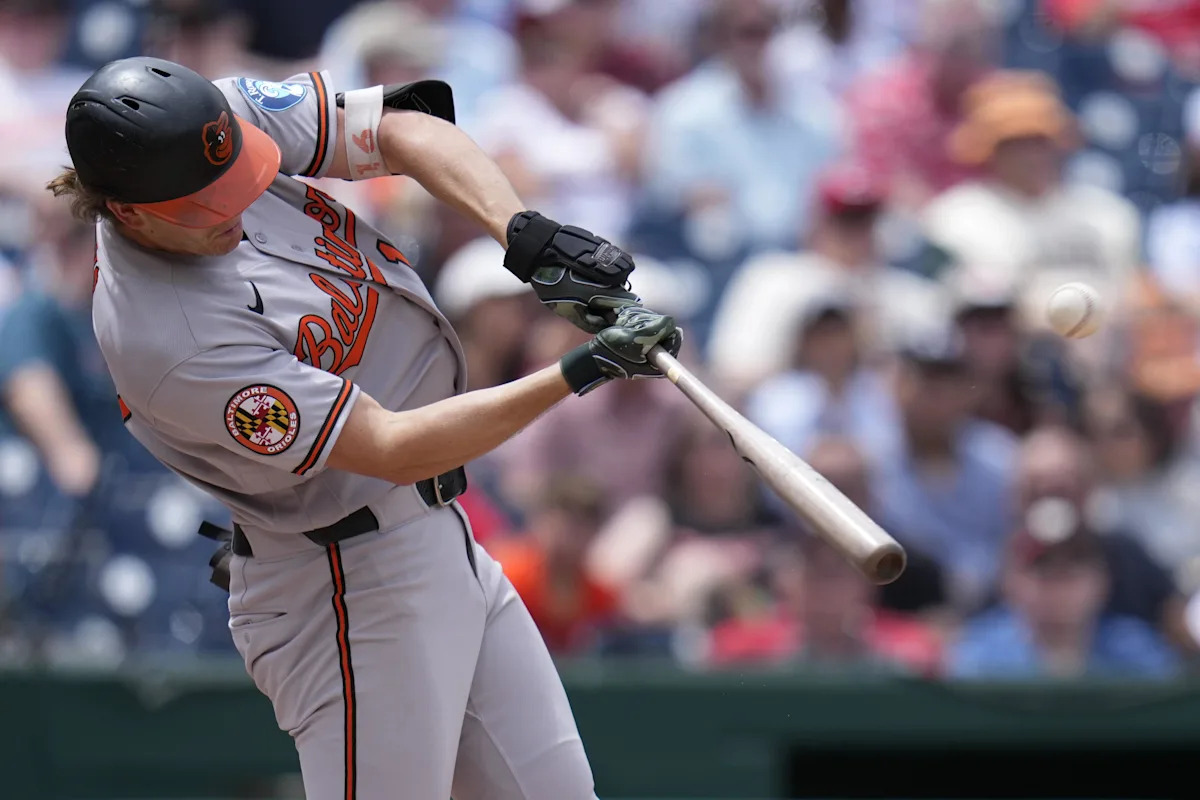
Back in February, Jordan Westburg got a double-whammy of bad news: after suffering an oblique strain, he started feeling elbow discomfort, only to learn he’d partly torn his UCL—a bad injury, under any circumstances. Most people figured that Jordan Westburg was gone for this calendar year (this even before it was announced in May that he’d have season-ending elbow surgery), and someone had to step into the void at third base.
The obvious candidate to replace him: 24-year-old Coby Mayo, a power hitter who rose through the farm system as an infielder, though he’d lately switched to first base. A career .905 OPS hitter in the Minors, Mayo had the bat to fill the gap left by Westburg, a point his Grapefruit League performance made emphatically: Mayo hit .389 with a 1.039 OPS in spring, striking out just four times in the process. Now, with Westburg sidelined indefinitely, this looked like his chance.
Advertisement
Well, just because you need a hero doesn’t always mean you get one.
This, at least, is what we were saying for the first two months of the season.
From late March to most of May, Mayo was hitting .174/.242/.321, striking out in over 30% of his plate appearances, with a 41% whiff rate on curveballs. The line was bad enough that when Westburg’s injury was upgraded to season-ending the first week of May, the news was greeted with something like dread, because at this point, the conversation around Mayo (and Colton Cowser, for that matter) suggested less that they’d be rotation saviors or stalwarts, and more that is was plausible they should be optioned. At one point in early May, Mayo had gone 4-for-35 over a 13-game stretch. The prospect bloom, it seemed, had finally and definitively come off the rose.
Yet it’s now late May, and, I’m pleased to report, something seems to have shifted in Mayo’s offensive approach.
Advertisement
Over the last 14 days, Mayo has hit .292/.393/.458, with an .851 OPS. He homered last night, the only Orioles run plated in a 2-1 loss to Toronto, and of six home runs he’s hit on the year, three have come since May 11. Over the last seven days, the numbers are even more eye-catching: .429/.500/.571 (in two games, owing to time missed with a back injury). Yes, it’s a fragile, fledgling little Oriole of a sample set. But the recent results aren’t coming out of nowhere, either.
Statcast data shows that the gap between Mayo’s surface stats and his quality of contact has been wide all year. His average exit velocity of 91.1 mph is in the 85th percentile of hitters, and his hard-hit rate of 45.3% 80th: such contact usually produces sluggers, not .195 hitters. In other words, Mayo has been hitting the ball hard into outs at an unusual rate, and the recent results may simply reflect some of that contact luck normalizing.
There’s also reason to think the improvement is at least partly behavioral, not purely luck. Mayo spent the offseason at TBT Training in Boca Raton doing something he’d never done before: grinding specifically on off-speed pitches. He and his trainers cranked a pitching machine to extreme movement profiles, using foam balls to simulate the nastiest sliders and curveballs major league pitchers could throw. “That was the first time I really went into the offseason and grinded like that with off-speed,” Mayo said in spring training.
For a while, the payoff of such work was pretty hard to see. A 41% whiff rate on curveballs told us as much. But Mayo seems to be trending in the right direction: in the month of May, his BA on breaking balls has leapt 80 points, despite seeing even more of the pitch. What’s more, nearly half of his hits this month have come on breaking or offspeed pitches. Perhaps he’s adjusting, and pitchers will conclude they can’t just feed him junk anymore.
Advertisement
Anyway, irresponsible article headline aside, we’ll need a lot more evidence before we proclaim a total rehabilitation of Coby Mayo. But at least things are looking better. The whole team, it appears, was cold at the plate in April, but they’ve hiked their batting average as a unit nearly thirty points in the last two weeks. For Mayo, the underlying tools visible in his Statcast data all year are starting to flash.
At any rate, a 6’5” right-handed hitter with plus-plus raw power, a 45% hard-hit rate, and a demonstrated willingness to do the work on his weaknesses is not a player the O’s should give up on in late May of his age-24 season, not with Westburg gone for the season and no one really knocking on the door.
The Orioles, to their credit, haven’t. Mayo’s manager Craig Albernaz has been explicit about the philosophy: “You sucked today, you’re gonna play tomorrow.” That kind of patience from a coaching staff is exactly what the young Mayo needs to break through the wall.