
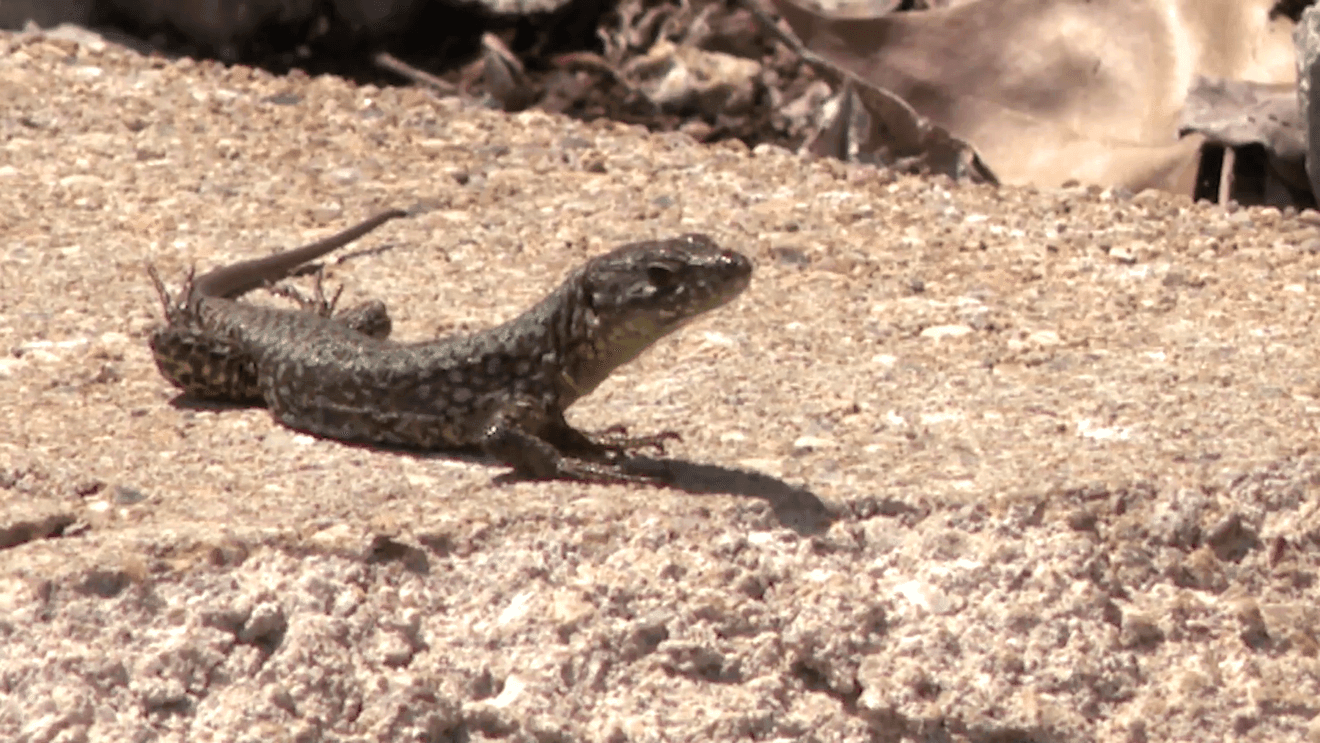
CINCINNATI (WKRC) — As temperatures climb and sunshine returns to the Tri-State, Cincinnati’s famous Lazarus lizards are once again emerging to bask on sidewalks, retaining walls, and driveways.
The small reptiles have become a familiar sight in many neighborhoods, but some residents say they’re spotting more of them than ever before.
“They are a nuisance,” said Sharonville resident Buck Wilkins.
As temperatures climb and sunshine returns to the Tri-State, Cincinnati’s famous Lazarus lizards are once again emerging to bask on sidewalks, retaining walls, and driveways. (WKRC)
Wilkins has lived in Sharonville for more than a decade but said he only started noticing the lizards around his property last year. This spring, he said, they’ve become a regular part of his daily routine.
“This year they’ve been more prevalent and just running up and down the driveway and coming up the ramp,” said Wilkins.
The lizards’ presence in Greater Cincinnati can be traced back more than 70 years.
According to University of Cincinnati Assistant Professor of Biology Dr. Allison Rickfelder, a young member of the Lazarus family brought several wall lizards back from a trip to Lake Garda, Italy, in the 1950s.
“When he was there, he put a handful of lizards, somewhere between three and 10, in a sock and brought them back here to Cincinnati,” Dr. Rickfelder said. “He released them into his backyard. Ever since then, they have lived here and proliferated, and they’re everywhere.”
The species became known locally as the Lazarus lizard and has steadily expanded beyond its original Cincinnati neighborhood.
Dr. Rickfelder recently analyzed population estimates and said the data suggests the lizards may not necessarily be increasing in number, but they could be spreading into new areas.
“In the parks where it’s more forested, there are significantly fewer lizards,” Dr. Rickfelder said. “But on the rock walls in the parks, right next to these forested areas, you have a ton of lizards.”
The findings align with historical observations.
“So, probably not growing too much in abundance, but maybe spreading out a little bit,” Rickfelder said.
She says the expansion is often aided by people. The lizards can be transported intentionally, but they can also spread when eggs are unknowingly moved in landscaping materials such as rocks, mulch, or soil.
Rickfelder said there is not much research on the negative impact the lizards are having on the ecosystem, but she also says there is not anything abundantly obvious. In fact, homeowners may benefit from having them around.
“The main thing they’ll eat are insects, spiders, things like that,” Dr. Rickfelder said.
She added that the lizards pose no threat to people or pets. The reptiles are especially fond of stacked rock retaining walls.
As for Wilkins, he may continue shooing the tiny visitors away from his driveway, but he isn’t too concerned about sharing his yard with them.
“I think there are other things in life that are more of a nuisance,” Wilkins said. “At least they eat some bugs and stuff.”