
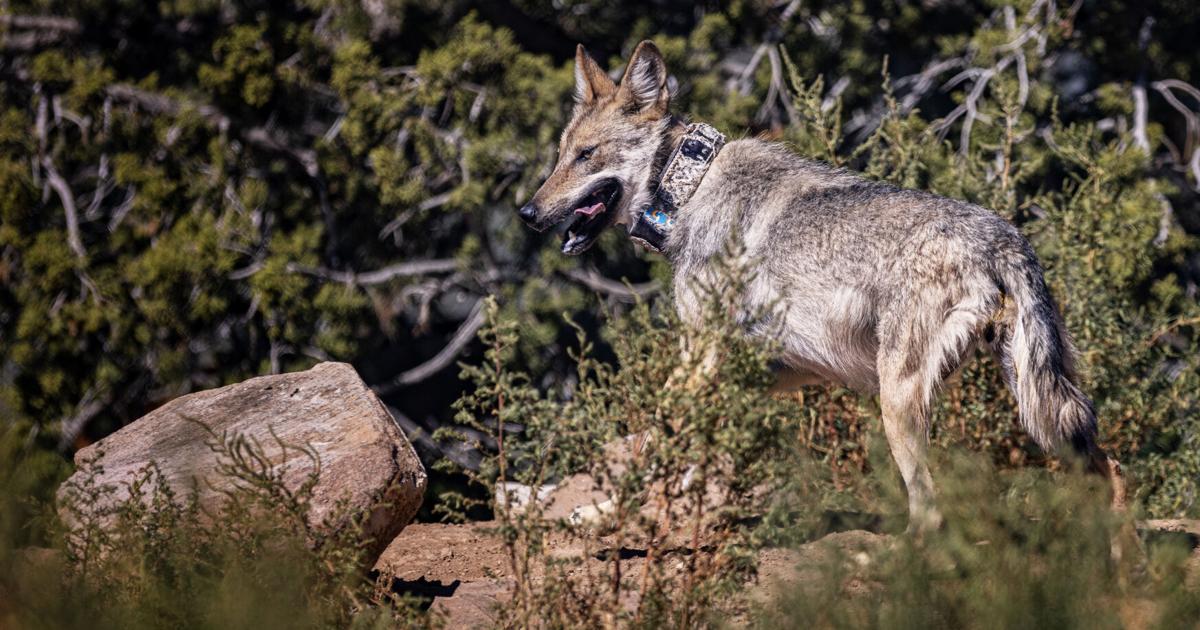
Top officials at the U.S. Interior Department delayed the release of a Mexican gray wolf known as Asha in response to public pressure, records obtained by The New Mexican show.
The Fish and Wildlife Service planned to release the wolf — officially F2754 — from New Mexico’s Sevilleta Wolf Management Facility along with her mate and month-old cubs in June 2025.
The release was timed to coincide with elk calving season so the pups could learn how to hunt wild prey. The location was to be Ladder Ranch, a 156,000-acre property in Sierra County in south central New Mexico that media mogul Ted Turner dedicated for conservation.
But internal communications and documents obtained by The New Mexican through a July 9 public records request show top Interior Department officials expressed alarm about the plan, leading to its delay. Emails and other documents show tension between agency recommendations for a release date and pushback from local communities.
Asha and her pack were eventually released in early August in Sierra County. But the delay underscores increasing pushback to the wolf reintroduction program from rural and ranching communities in both New Mexico and Arizona as the number of wolves on the landscape grows.
Counties in both states have declared states of emergency over wolves, and federal legislation to delist the Mexican gray wolf entirely recently passed its first committee.
Just a few weeks after Asha, her mate and pups were released in Sierra County in August, county commissioners adopted a resolution declaring a “public safety disaster.” The resolution cited the release of the pack as one of the reasons for the measure.
Asha the wanderer
Asha captured hearts around New Mexico as she repeatedly wandered north of Interstate 25, the northern barrier of the Mexican wolf experimental population area.

Asha, a Mexican gray wolf also identified as F2754, runs around her pen as Mexican wolf technicians approach her enclosure to feed her and her mate at the Sevilleta Mexican Wolf Management Facility outside Socorro in September 2024.
Gabriela Campos/New Mexican file photo
After being captured and brought to the Sevilleta Wolf Management Facility, she found a mate and gave birth to a litter of five pups.
The U.S. Fish and Wildlife Service announced the June release plan, but wolf advocates started getting antsy when it didn’t happen.
In July, dozens of conservation groups signed a letter requesting the release of Asha, her mate Arcadia and five pups.
Largely successful release
In a background document on the release, federal and state officials wrote it was important the pack be released between June and July, not only to align with elk calving season but also to increase the chances the pups would stay close to their release site, too young to set off on their own.
Asha, the background document said, didn’t have a history of preying on livestock or menacing people — which they wrote decreased the likelihood of human conflict.
“F2754’s wild experience should lead to reduced chance of nuisance behavior that is often observed with initial release animals during the first few months following release,” according to the document.
A Mexican wolf pup is given a health check by a member of the Mexican wolf interagency field team. Asha and family were released onto the 244-square mile Ladder Ranch, a conservation-managed property adjoining the Aldo Leopold Wilderness in the Gila National Forest.
Facebook photo/U.S. Fish and Wildlife Service
Currently, a map updated by the Fish and Wildlife Service shows Asha is located near the Black Range. The map shows one of Asha’s pups has split off and traveled north to near the San Mateo Mountains.
A spokesperson for the Fish and Wildlife Service wrote in an email to The New Mexican the Quartz pack, made up of Asha, her mate and her pups, has been associated with one livestock kill since their release. The attack was investigated in April this year.
But the release was largely successful, despite the delay, they added. All but one of the pups born in 2025 have stayed close to their mother on Ladder Ranch, and Asha whelped another litter this spring.
“We successfully released the pack when the pups were young enough to keep the adults from dispersing from the area,” the spokesperson wrote. “Mexican wolf pups do not disperse from their natal pack until they reach 1-2 years of age.”
Intervention from above
Emails obtained by The New Mexican show that in early June, the Fish and Wildlife Service requested to release the pack onto Ladder Ranch. Agency officials were drafting a news release about the planned release, and a public information officer was coordinating a media trip to Sevilleta National Wildlife Refuge in Socorro County to document the pack’s travels.
But days before the scheduled release, high-ranking officials at the Department of the Interior flagged the plan.
“After the big meeting we had, I just found out that the FWS is going to move Mexican wolves onto the Ted Turner ranch days before the Secretary goes to New Mexico for Western Governor’s Association meeting —— and we want to issue a press release?” wrote Associate Deputy Interior Secretary Karen Budd-Falen in an email requesting information on the release. “Those wolves will not stay on Ted Turner’s ranch.”
That same day, Brady McGee, Mexican wolf recovery coordinator, wrote in an email the Fish and Wildlife Service would no longer be releasing the pack on Ladder Ranch as planned the following week.
“Again, sorry for this mess, but it’s coming from the top 2 people in the Secretary’s office,” McGee wrote.
Interior Secretary Doug Burgum visited Santa Fe last summer for a meeting of the Western Governors’ Association. A spokesperson for the Fish and Wildlife Service confirmed the meeting Budd-Falen was referring to was a June meeting of the New Mexico Cattle Growers’ Association held in Ruidoso. “Cowboy lawyer” Budd-Falen is a fifth-generation rancher herself.
In July, McGee wrote in an email Fish and Wildlife Service officials met with Budd-Falen. In that meeting, “it was decided that the Quartz pack (Asha, her mate and pups) will not be released into the wild because the counties oppose it.” Other communications indicated locals were concerned the release site was too close to nearby cattle grazing allotments.
In response to questions from The New Mexican about what led to the pack’s eventual release, an agency spokesperson wrote in an email the postponement was taken in order to answer questions and address concerns from Sierra and surrounding counties.
Ranchers’ fears
But Sierra County Commissioner Jim Paxon said the consideration of county concerns was “cursory.” Paxon, who also sits on the County Livestock Loss Authority as well as an interagency team focused on the Mexican gray wolf, said he protested the planned release on Ladder Ranch.
“They acknowledged our protest, ran it through their legal department, released the wolves,” Paxon said. “That’s about how that went.”
Just a few years earlier, another wolf pack — the Seco Creek pack — was released onto Ladder Ranch and subsequently blamed for several livestock attacks. Paxon said one rancher on the grazing allotment closest to the pen on Ladder Ranch where the wolves were initially released decided to close up shop as a result of attacks.
He worries about cultural changes as producers face thin margins, made thinner by animal losses.
“That was just a pretty tough deal on the ranchers in Sierra County,” Paxon said. “Because of what happened with the Seco pack, the county opposed that release [of the Quartz pack].”
Asha, a wild wolf, doesn’t have a history of preying on livestock, Paxon said. But her mate, a captive-bred and “naive” wolf, might pose more of a problem when it comes to livestock attacks, he said, due to his lack of experience hunting fast-moving elk. Research generated by the wolf recovery program has shown Mexican gray wolves subsist largely on a diet of elk.
Since release, the Quartz pack hasn’t behaved like the Seco Creek pack, Paxon said, and the U.S. Fish and Wildlife Service has attributed just one confirmed livestock kill to the pack. But he said the pack could be responsible for a handful of probable kills that have been attributed to a lone male wolf also in the area.
Three counties — Socorro, Sierra and Catron — pooled resources to pay out losses deemed “probable” wolf kills, Paxon said.
And, he said, costs are rising: A calf that in 2023 was worth $900, is now worth $2,800. On top of that, Paxon said compensation doesn’t address indirect losses, like the impact of stress on cattle weight, or the loss of future calves from a lost heifer.
“It’s really a tough situation,” Paxon said. “Those ranchers lose a lot more than the value of that animal at that point in time.”
Federal criticism
At an annual meeting of the National Association of Farm Broadcasting, Budd-Falen seemed to agree. She said depending on the specific species’ endangered status, wolf management can vary around the country. She said the Department of the Interior is evaluating going “farther” with wolf management to protect livestock and people.
“Wolves in Wyoming, quite frankly, have been shot at so many times because they’re under state management, they are afraid of people,” Budd-Falen said at the April meeting. “They stay in Yellowstone … and there hasn’t been a cow in Yellowstone National Park in forever.”
She added, “Wolves that don’t have that kind of active management are not near as afraid, and if you look at the current maps with regard to wolf kills and residences, it’s quite frankly, really scary.”
Budd-Falen’s comments aren’t the only indication the current federal administration is critical of the management of endangered species. In a post on X, Burgum compared the endangered species list to the Eagles song “Hotel California” — once an animal or plant is on the list, he wrote, they never leave.
Anti-wolf sentiment
Claire Musser, executive director of the Grand Canyon Wolf Recovery Project, said over the past three years she’s seen an upswing in pushback on the Mexican gray wolf program. She’s seen several counties adopt emergency resolutions relating to wolf activity and several groups critical of the program take trips to Washington, D.C.
She added the recovery project, which wants to see wolves repopulate the Grand Canyon region and other areas in the West, has received an increasing amount of “hate” on its social media platforms compared to previous years.
“These communities are gaining traction,” Musser said. “They’ve definitely got more of an ear in the White House than they had before.”
Additionally, Musser said as the number of wolves on the landscape increase, wolf proponents and opponents alike are both thinking about what downlisting or delisting the wolf species might look like.
“Everyone’s gearing up for what would delisting look like, from every side of the debate,” Musser said.
Musser said she thinks there are ways to better mitigate conflict between livestock, people and wolves. The recovery project works with Project Guarding the Respective Interests of Predators and Animals, or Project GRIPH, started by range rider Daniel Curry. Removing wolves when there are livestock attacks can disrupt the pack structure and cause fractured packs to take bigger risks, Musser said.
She thinks educating communities before wolves arrive and offering preventive measures is critical.
“When there are depredations, you’re paying for failure at that point,” Musser said. “So, what would it mean if we invested more upfront to prevent that even happening?”