
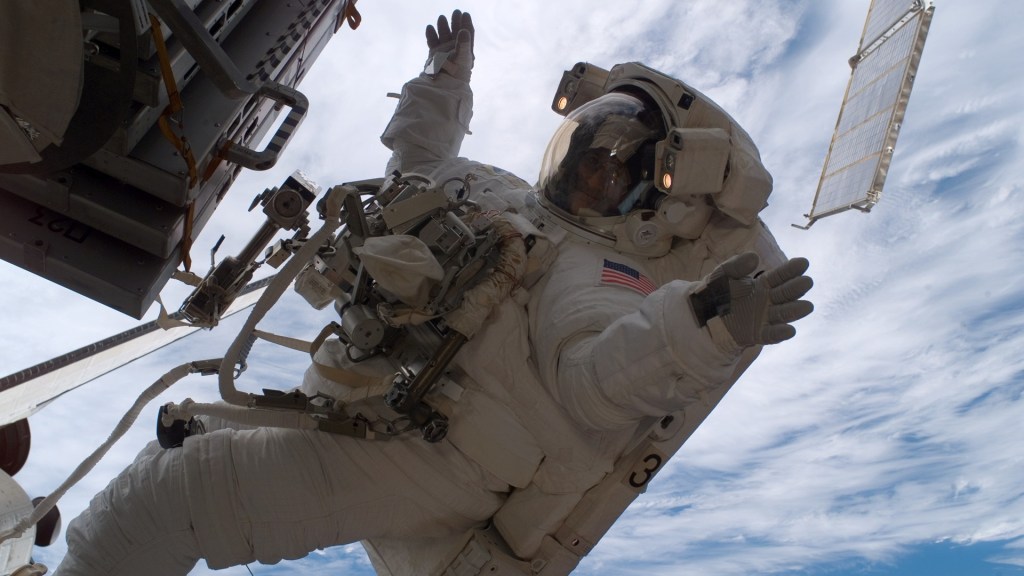
Every astronaut who comes home from a long stay on the ISS is measurably taller than when they launched. A six-foot person gains up to two inches. The extra height disappears within weeks, sometimes days — Scott Kelly lost almost all of his two-inch gain within 48 hours of landing — but while it lasts, it is real, measurable, and a direct product of what gravity has been doing to the human spine every day since birth.
On Earth, body weight continuously presses down on the spinal column. The vertebrae, and the soft discs between them, are under constant compression. That is part of why a person is measurably shorter in the evening than first thing in the morning — a full day upright squeezes a little height out of the system. In orbit, that load is removed entirely. An astronaut on the ISS is in continuous free fall, and the spine is no longer compressed by body weight. Freed of that load, it lengthens.
What is actually expanding
The familiar explanation is the intervertebral discs — the fluid-rich pads between the vertebrae that, in theory, take on fluid when compressive load is removed and push the vertebrae apart. That picture is not wrong, but it is incomplete. Research using ultrasound imaging conducted on the ISS has revealed that the paraspinal muscles — the deep muscle columns that run alongside the spine and normally work constantly against gravity — also change in microgravity. They relax in ways they cannot on Earth, contributing to the overall spinal elongation beyond what disc expansion alone would produce.
The result looks the same from the outside: the astronaut gets taller. But the mechanism is more distributed than the simple disc-fluid story, and that distinction matters for understanding what comes next.
What comes next is the harder part
The height gain is the easy part to notice and the least important part in itself. What it marks is a spine doing months of work in conditions it was never built for, and the changes that accumulate are not all reversible on the same timeline as the height.
Astronauts lose between 1% and 1.5% of bone density in weight-bearing areas — hips and legs — per month in space. NASA has documented that some of this loss has not fully recovered after a year back on Earth. The paraspinal muscles show fatty infiltration after long missions that persists well beyond the return to normal gravity. Former astronaut Frank Rubio, who spent 371 days on the ISS, reported significant lower back pain after landing — the spine, he said, was simply not used to maintaining posture every moment of the day after months of effortless floating.
Why this matters beyond ISS
The practical stakes rise sharply with mission length. A flight to Mars would keep a crew in reduced or zero gravity far longer than any ISS rotation. The spinal changes would be proportionally greater, and the recovery timeline proportionally longer — assuming full recovery is even achievable.
There are also plain engineering consequences. If crew members are measurably taller and shaped differently in flight, that affects the sizing of spacesuits, seats, and the confined spaces they must fit into. Spacecraft designed around pre-launch body dimensions need margins built in for a crew that will be two inches taller three months into the mission.
The temporary height gain, in other words, is a useful signal. What it points toward is a body undergoing a sustained physiological negotiation with an environment it was never designed to inhabit — and the return to Earth is not a reset button so much as the beginning of a second negotiation, one that can take a year or more to complete.