
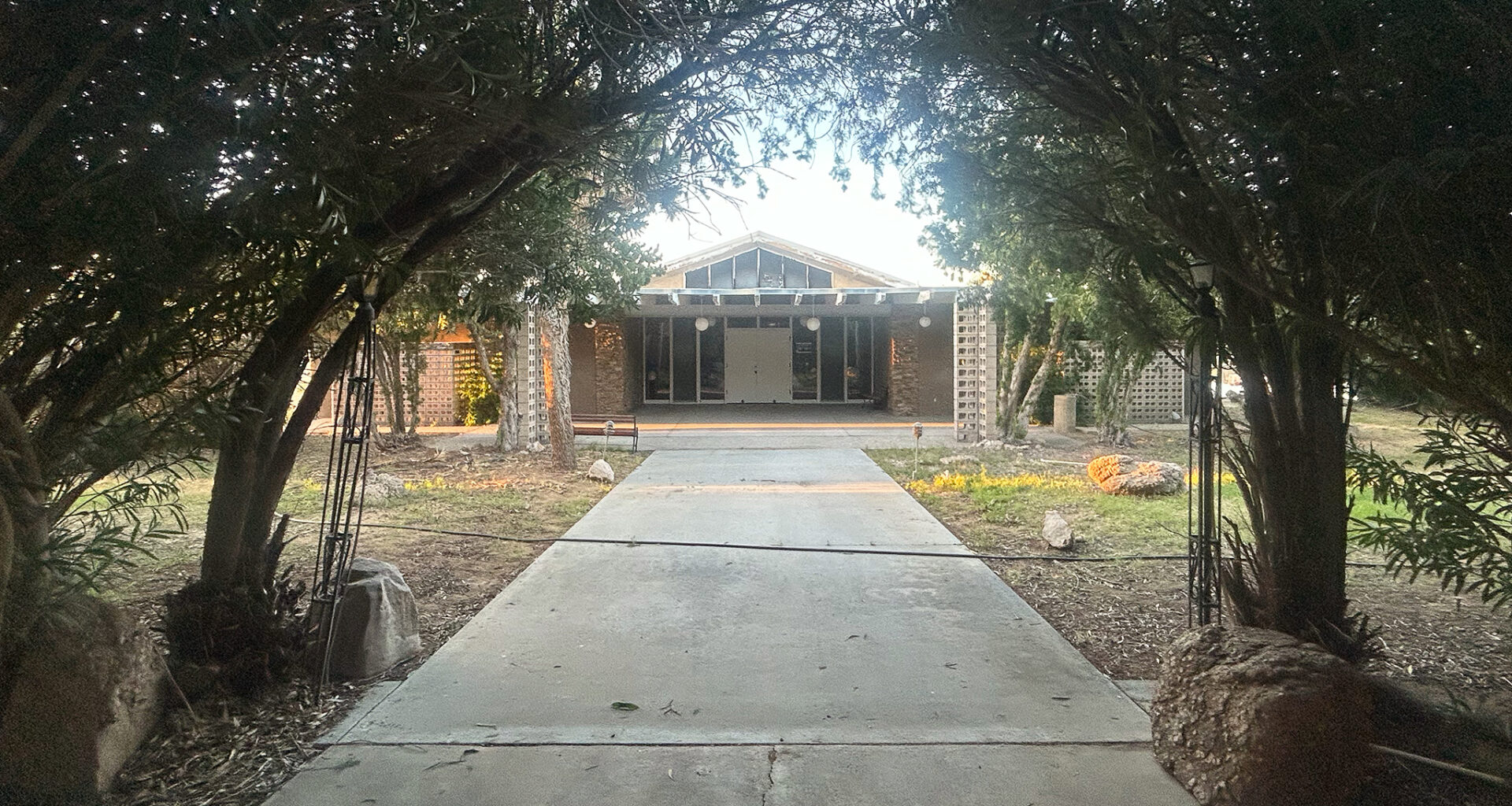
In the tranquil unincorporated community of Joshua Tree, shortly before turning off the main highway toward the town’s eponymous national park, an unusual campus appears to materialize from the sparse desert landscape. Whimsical pyramid and looping sculptures jut from the ground, surrounded by a smattering of angular buildings and a structure with a huge steeple.

Known as the Joshua Tree Retreat Center, the property offers classes with a metaphysical bent — i.e., sound baths, yoga and breath work — and operates as a meeting ground for high desert mystics. But before it was a roadside curiosity and spiritual retreat center, the campus was just one piece of renowned architect Lloyd Wright’s plan to build a full-tilt community called the New City of Mentalphysics: a place where acolytes of the mentalphysics movement, a practice that took off in the 1930s, could live, study and coexist.
In Lloyd Wright’s proposed pseudo-utopian desert colony, practitioners could seek enlightenment in a self-sustaining community with its own shops and schools, as well as crops via an “Agricultural Experimentation Station.” Every structure in the New City would be built in the organic architecture tradition — a style that sees buildings in conversation with their immediate environs, such as orienting toward the sun to naturally heat and cool the interior. But bad timing and money troubles doomed the New City’s ambitious plans.
Article continues below this ad
The Joshua Tree Retreat Center campus in Joshua Tree, Calif., on March 24, 2026.
Paula Mejía/SFGATE
The Joshua Tree Retreat Center campus in Joshua Tree, Calif., on March 24, 2026.
Paula Mejía/SFGATE
The Joshua Tree Retreat Center campus in Joshua Tree, Calif., on March 24, 2026.
Paula Mejía/SFGATE
Although it was ignored within the pantheon of organic architecture when it was first built, it’s now listed in the National Register of Historic Places and is especially significant, given that it’s the largest collection of Lloyd Wright buildings in a single location. The grounds have since come to be appreciated as an idiosyncratic example of how alternative spiritual movements enmeshed themselves with design in the mid-20th century; it’s a frequent spot for tours during Palm Springs Modernism Week.
Article continues below this ad
More recently, the 152-acre property has drawn in another kind of person besides spiritual practitioners, curious drivers and gobsmacked architecture heads: those grieving a loss. Last year, two people installed a wind phone on the property — on a site that overlooks an especially scenic stretch of the desert landscape — to commune with the dead.
‘Mail-order spirituality’
As with other spiritual movements that emerged in the early 20th century, mentalphysics was conjured by an outsider seeking spiritual relief in Southern California. In this case, it was an Englishman named Edwin John Dingle.
Article continues below this ad
The Joshua Tree Retreat Center campus in Joshua Tree, Calif., on March 24, 2026.
Paula Mejía/SFGATE
The Joshua Tree Retreat Center campus in Joshua Tree, Calif., on March 24, 2026.
Paula Mejía/SFGATE
Born into a newspaper family, Dingle made his way to Singapore and then China, living and working in Asia around the turn of the century. Dingle then set out to walk through China on foot while documenting his travels. During this yearslong pursuit, Dingle contracted malaria and dysentery — ailments that nearly killed him, said Daniel Paul, an architectural historian who wrote the Joshua Tree Retreat Center’s National Register application. After Dingle made his way to the U.S. in 1918, landing in New York City and then Oakland, he began shaping what would eventually become the practice of mentalphysics. The Oakland years, which seemed to “have been a time of deep transformation for Dingle,” as Paul writes, involved Dingle doing pranayama breath work exercises, keeping a strict diet and meditating — practices that he credited with mitigating his waning eyesight and saving his life.
In 1927, Dingle first began lecturing about breath work and meditation around the U.S. He claimed that he’d garnered these spiritual practices by being one of the first Westerners to make their way into Tibet, even changing his name to “Ding Le Mei” to fully sell the persona as a “spiritual and wellness Master with rarified Eastern knowledge,” as Paul writes. (Paul notes that “presently available research — including archives, primary source materials, and Dingle’s own timeline in ‘Across China on Foot’ — shows no evidence Dingle ever set foot in the Tibet Autonomous Region, nor the heart of Tibet.”)
Article continues below this ad
People do yoga poses with a view of Joshua trees in the background during Saraswati Markus’ workshop during Bhakti Fest at the Joshua Tree Retreat Center in Joshua Tree, Calif., on Sept. 5, 2014.
Allen J. Schaben/Los Angeles Times/Getty Images
The Joshua Tree Retreat Center campus in Joshua Tree, Calif., on March 24, 2026.
Paula Mejía/SFGATE
A few years later, Dingle decided to set up the first official Institute of Mentalphysics in Los Angeles in present-day Koreatown. He wrote prolifically in pamphlets and magazines, which helped him amass a following — particularly with older Midwesterners. “From that point, with his journalism background, he starts doing almost like a mail-order spirituality where people can mail in and get these beautifully designed printed guide books for breath work,” Paul told SFGATE.
Dingle was making enough through donations and funds from the mail-order catalogues that he began envisioning something bigger for his growing movement. In 1941, he bought an abandoned a crop of buildings in Joshua Tree, once intended to become a roadside motel, and then approached architect Frank Lloyd Wright about building the New City of Mentalphysics as a place people could visit for spiritual evolution. But Wright wasn’t having it. “Apparently they met up, and Frank Lloyd Wright was not interested in dealing with Dingle,” Paul said. The elder Wright then passed the project along to his architect son, Lloyd Wright.
Article continues below this ad
Lloyd Wright took it on, proposing a huge site that stretched over 1,500 acres on both sides of Highway 62. There, practitioners could get their car fixed, drop their kids off at school, swim in a hexagonal pool and play sports close to home in between breath work sessions. He didn’t get far, building a few cottages before the wartime economy made new construction projects scant and pricey.
The Joshua Tree Retreat Center campus in Joshua Tree, Calif., on March 24, 2026.
Paula Mejía/SFGATE
The Joshua Tree Retreat Center campus in Joshua Tree, Calif., on March 24, 2026.
Paula Mejía/SFGATE
Dingle and Wright slowly built other structures for the New City over the next 15 years, including duplex and triplex cottages, a building for meetings and a structure called the Caravansary of Joy, which cut a familiar figure to the elder Wright’s legendary studio, Taliesin West.
Article continues below this ad
In a turn away from the trendy hallmarks of European modernism, Lloyd Wright took care to reference elements of nature — including geodes and honeycombs — in these designs, said Kevin Parkhurst, a restoration consultant who worked on the retreat center decades later. “In those elements of nature, in those objects, you have a lot of diagonals, you have a lot of unusual angles,” he explained.
During the New City’s slow construction, Dingle held meetings and retreats for his growing flock on-site while churning out publications so he could shore up the funds to keep building it. Ram Dass came through at one point, as apparently did actress Shirley MacLaine. But eventually, Dingle’s money ran out; Lloyd Wright likely left the project incomplete because he wasn’t being paid.
After building just a few other structures there, Dingle eventually sold off part of the land that would comprise a big part of the New City. Although at one point he had over 200,000 acolytes, the movement waned after Dingle died in 1972.
The Joshua Tree Retreat Center campus in Joshua Tree, Calif., on March 24, 2026.
Paula Mejía/SFGATE
The Joshua Tree Retreat Center campus in Joshua Tree, Calif., on March 24, 2026.
Paula Mejía/SFGATE
Article continues below this ad
A new life for a failed utopian colony
The New City never quite lived up to its intended potential as a utopian colony. But it has since gotten a new life in the 21st century via a series of overlapping projects.
Parkhurst and Hannah Wear, his creative and life partner, consulted on a building restoration a decade ago to ensure that the campus’s historic elements were kept intact. A central building, with an angular roof gesturing toward the outdoors, is open to the public as the Food for Thought Cafe. And a few years ago, LA designer Brad Dunning renovated several on-site bungalows and converted them into an upscale modernist hotel.

Stay informed, and entertained.
By signing up, you agree to our Terms Of Use and acknowledge that your information will be used as described in our Privacy Policy.
Those seeking enlightenment still come through, either to take a class or to simply walk through the serene grounds. Mentalphysics is still taught as a practice on campus.
Article continues below this ad
The Joshua Tree Retreat Center campus in Joshua Tree, Calif., on March 24, 2026.
Paula Mejía/SFGATE
The Joshua Tree Retreat Center campus in Joshua Tree, Calif., on March 24, 2026.
Paula Mejía/SFGATE
The Joshua Tree Retreat Center campus in Joshua Tree, Calif., on March 24, 2026.
Paula Mejía/SFGATE
Others come to make their way to the wind phone, a disconnected rotary phone with a table and a chair looking out toward the mountains. People can call their late loved ones and have a conversation — and perhaps receive a sense of closure. Colin Campbell and Gail Lerner first installed the project in their backyard as a way of assuaging their grief after their two children were killed by a drunken driver. After more and more people flocked there day and night, they opted to move the wind phone to a more public location.
Article continues below this ad
Seeing the wind phone now, it’s hard to believe that it was ever situated elsewhere. “I just thought that it seemed like a great confluence of intention,” Campbell said. “It just seemed like a spiritual place that I thought would be mutually beneficial because people might go to the retreat center for other purposes and then discover the wind phone, and then it’s right there for them.”