
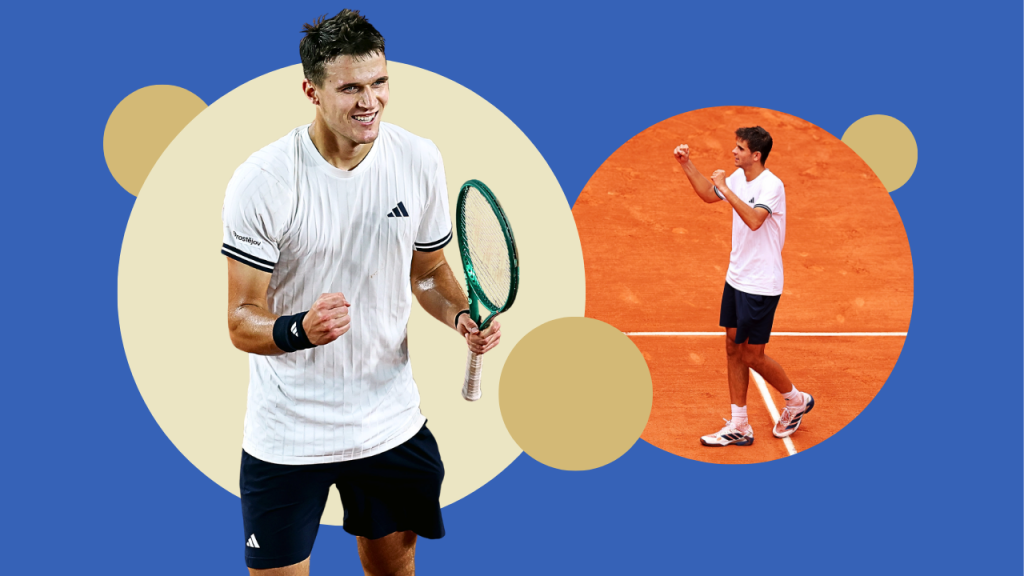
If you’re a casual men’s tennis fan, there’s a decent chance you can’t name any of the players still in contention as the French Open hits its second week.
Some of the sport’s biggest stars—including Jannik Sinner, Novak Djokovic, Daniil Medvedev and Ben Shelton—wilted in the searing heat during the first few rounds. Carlos Alcaraz missed the tournament entirely. This is the first Grand Slam since 1959 (!) that doesn’t have a prior major winner playing in the men’s fourth round.
What’s left is a hodgepodge of youngsters that could soon be stars and older players who have yet to win titles on the sport’s biggest stages. It has presented Roland Garros and men’s tennis—plus the sport’s biggest broadcasters, sponsors and partners—with an unprecedented opportunity to gauge the popularity and health of the sport overall, when it’s not carried by its most enduring spokesmen.
To be clear, this is not an opportunity that French Open organizers want to have. All sports rely on their stars, but among individual sports, men’s tennis has always had an advantage over its peers. While it’s not uncommon for golf majors to reach Sunday with a leaderboard devoid of top-tier stars, that’s historically been unheard of in modern men’s tennis. It’s been more than 20 years since fans had a fourth round at a men’s Grand Slam that didn’t feature Sinner, Alcaraz, Djokovic, Rafael Nadal or Roger Federer. In fact, in that 87-Slam span, there have only been two Slams that didn’t feature one or more of them in the semifinals. The five players ultimately won 77 of those tournaments.

But if it’s not ideal, the business takeaways might be fascinating. There’s no number of focus groups or polling that could replicate what Roland Garros is about to find out—what if we just held the event without any stars?
There are already signs that organizers are concerned. On Monday night the primetime match at the French Open’s main court will be a showdown between two multi-time women’s Grand Slam champions, Naomi Osaka and Aryna Sabalenka. That is—shockingly—the first time in more than three years that Roland Garros put a women’s match in the night session. Lingering in the background of the men’s draw is another potential turnoff for some: the current favorite, world No. 3 Alexander Zverev, is disliked by many fans due to prior allegations of domestic abuse.
That said, for those willing to pay attention to lesser-known players, this tournament has had a few great storylines and some epic matches. American Francis Tiafoe, a fan favorite, has repeatedly overcome early deficits to reach the fourth round. Zachary Svajda, the only other American man left, is 11-26 in his career ATP singles matches. Spanish teenager Rafael Jodar is considered by many to be a future megastar, and Jakub Menšík may soon draw similar hype. On Saturday, five different men’s matches went the full five sets, including three that ended in deciding tiebreakers.
Is that enough to keep fans tuning in? The tournament’s early signs were encouraging. In the U.S., TNT’s coverage of the first two days at Roland Garros saw a 36% audience lift versus last year. (The most watched men’s matches, however, were early wins by Djokovic and Shelton.) A WBD exec told Sportico last week that ads for the two-week event were effectively sold out.
That tracks with a broader commercial growth in top tier pro tennis. This French Open drew 138,000 fans for its Opening Week, the highest in the event’s history. The U.S. Open has also made its pre-event week its own commercial juggernaut. Most Grand Slams are experiencing a flood of fans and record revenue overall, much of that helped by the emerging dominance of Sinner and Alcaraz, who could build their budding rivalry for another decade or more.
It’s unclear if this star-less Grand Slam is an aberration or a sign of a more egalitarian era emerging in men’s tennis. The companies that pay hundreds of millions to broadcast the sport are certainly hoping for the former. While the French Open’s finances aren’t readily available online, its peers’ numbers are. Wimbledon made about $270 million (about £200 million) from media rights in 2024; the U.S. Open brought in about $145 million.
On the Sporticast podcast, we frequently debate what makes college football and college basketball so popular—whether it’s the school brands, or the players themselves. If Alabama’s roster could play Georgia’s roster in anonymous uniforms in a neutral stadium at the same time as anonymous players faced off in Crimson Tide and Bulldogs uniforms at Bryant-Denny Stadium, which would fans turn on?
That experiment, of course, is impossible. The one underway right now at Roland Garros? Turns out that was just highly improbable.