
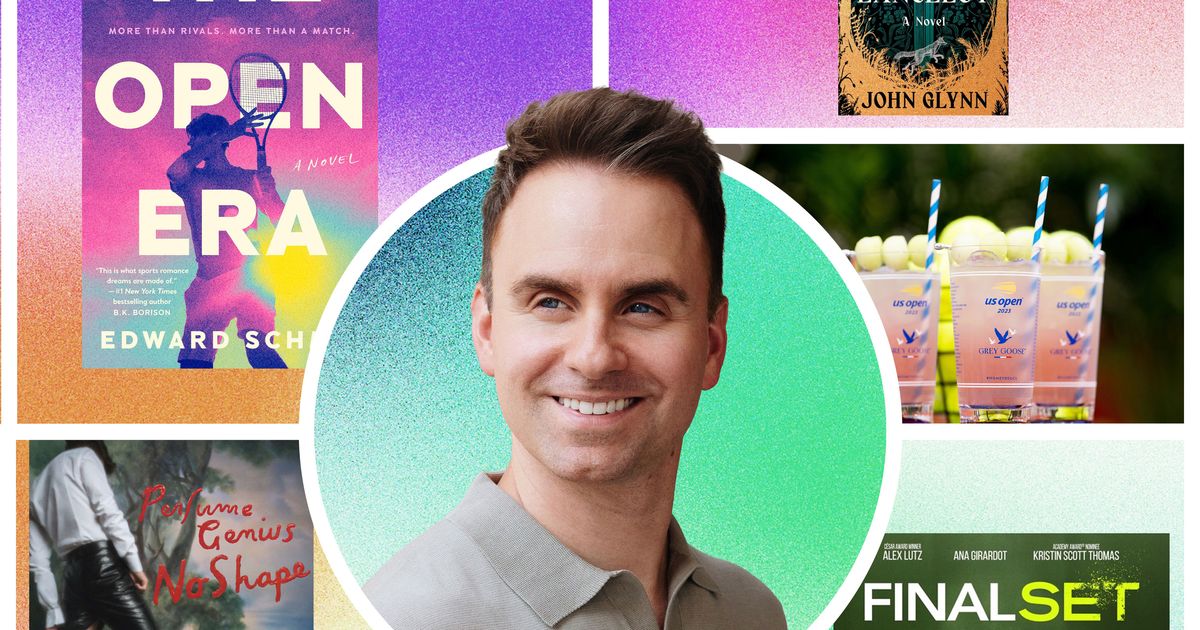
What is “good taste” anyway? Allow your favorite actor, musician, celebrity, or comedian to let you in on what they’re watching, reading, and consuming.
Photo-Illustration: by The Cut; Photos: Erin Burniston, Getty Images, Retailers
The game of tennis could use a narrative that is tender, witty, and ripe with sexual tension. Early hype for The Open Era, a queer tennis romance set amid the late summer two-week stretch of the U.S. Open, has whirled around the idea that the sport may be getting its “Heated Rivalry moment.” When I ask the author, Edward Schmit, how he’s feeling about the buzz, he invokes The Bachelor and laughs. “Everyone on that show is always saying they’re nervous and excited. It’s always both at the same time.” (He doesn’t mind the cliché; its emotional truth is vital enough that it makes a cameo in his book.)
The Open Era’s protagonist, professional tennis player named Austin Hardy — middling until he isn’t — embarks on a whirlwind Cinderella run at the U.S. Open. In Schmit’s fictional universe, Austin is the first openly gay male player on tour, and his winning streak at the tournament is beset by anxiety, self-loathing, and obtuse questions from the press. Austin wants to play tennis, but first he must speak about what it means to be gay. Off-court, a love story awakens with a comely would-be rival named Diego Cruz (ranked world No. 2 to Austin’s 239th), but also between Austin and his chosen sport.
Schmit previously dabbled in writing screenplays (“and an obsession with the specifics of formatting and structure: the hero’s journey, Save the Cat!, all of those,” he says), but The Open Era is his first foray into book-writing. Ahead of the book’s release, Schmit spoke with The Cut about his own tennis background, overpaying for cocktails, and willing the real-life story he longed for into existence.
Did you play tennis as a child?
I was a theater kid growing up. I didn’t give a shit about sports. I was watching Spring Awakening; I wasn’t watching Roger Federer. I think I was even at a Federer match once in Arthur Ashe Stadium and barely remember it. I have regrets.
I fell in love with tennis in 2021, when I was looking for outlets to work on my mental health. Being a New Yorker for many years now, I would go to the U.S. Open mostly for the vibes and the Honey Deuces, but that year, I caught myself paying attention to the actual matches and feeling engrossed in the competition. I had this realization of, I like watching tennis. I think I might like playing it, too. So, I found a coach. I found clinics. I met strangers online to hit with randomly in parks. Tennis became my entire personality.
I started looking for queer players to support and follow. In the time since I’ve written the book, there have been a couple male tennis players who’ve come out; the highest-ranked is world No. 202 João Lucas Reis da Silva, from Brazil. His Grand Slam debut was at the qualifying rounds of the U.S. Open in 2025. Some of the things that he said during his press conferences mirror Austin’s internal monologue. It’s a lot of pressure to put on someone who just wants to play tennis.
Are there parts of The Open Era that are autobiographical?
There was nothing that I could pull from in terms of being a terrific tennis player to form Austin — that part was my complete imagination. But in terms of his mental health, so much of that experience was informed by my own. He has generalized anxiety disorder, and a lot of his symptoms are similar to mine.
When you started working on this book, were the Heated Rivalry novels on your radar?
They existed, but I had not read them. I got very lucky because when I was in the middle of my first draft, the trailer for Challengers dropped. I was sending my manuscript out to agents during the heat of that film. Challengers showed the world how sexy tennis can be, and it carved out an opportunity for me. And now, I’m moving towards my publication date with the popularity of Heated Rivalry in the background. Romance readers have known forever how wonderful queer love stories are; Heated Rivalry helped others catch up. I’m so happy there are people hungry for more of that pure joy.
If The Open Era gets the Heated Rivalry treatment, who do you want to see play Austin and Diego?
Here’s what I love about Heated Rivalry: The guys that were cast were relatively unknown, and we got to get to know them for the first time in the show. Austin and Diego are both very young. I don’t think we know them yet as actors. I can’t wait to find them.
What’s your favorite onscreen portrayal of a tennis player?
Can I Google something?
Yes.
Found it. There is a French film from 2020 called Final Set. It’s about an older player — well, old for tennis; he’s 37 — who decides to compete in the qualifying rounds of the French Open for one last real attempt on tour. I thought that portrayal was really nuanced and inspiring.
What about your favorite tennis books?
A friend gave me Open by Andre Agassi for Christmas one year. It sat on my coffee table for a while, as they do, but I picked it up one day and was completely gripped by the first chapter. I texted him immediately. He said, “It’s been four months. What have you been doing?” It’s an incredible autobiography. Agassi famously says he hates tennis. He was conditioned from a very young age to be a champion, and he did, but it seems like it all came at quite a cost.
Where do you get your book recommendations?
Growing up, my mom listened to NPR in the car, and it helped me take many naps. Now, I listen to NPR almost every day, and I love it. They have wonderful author interviews, and I get a lot of recommendations that way. I just started reading a beautiful novel called The Lost Book of Lancelot by John Glynn. It’s a queer retelling of the legend of Sir Lancelot. I don’t know if John has been on NPR, though. I discovered that book, like most people, on Instagram.
When you were working on The Open Era, did you have particular rituals that helped you along the way?
I was scared that if I didn’t stick to a strict routine I would never finish the book. So, even now, my alarm goes off at 5:45 a.m. every morning to get a solid two hours of writing or editing in before the day starts. That wake-up time hurt for about a week, but now it’s my favorite part of the day. I pregamed with a song from the book’s playlist on my walk to the coffee shop. For The Open Era, that was usually “Slip Away” by Perfume Genius. I love the lyric, “Baby, let all those voices slip away.” It’s great advice for the main character.
As a former theater kid, what are the Broadway shows you recommend?
Go see Taylor Trensch in anything he possibly does. He’s one of the smartest, funniest people I’ve ever met.
What’s the best piece of writing advice you’ve received over the years?
I took a writing course when I first started working on this book, because I wanted to make sure I was doing it the right way. I thought that I had a pretty solid foundation, having taken a playwriting class in college and written and directed a short film. But I got a big reality check from the course’s teacher. Her name is Catherine Johnson, and she said, “You are not starting in the right place. We need to understand who he is first, and then we can celebrate him. Find somewhere else to start.”
I needed to hear that. We all need an ego check every once in a while.
Do you have any guidance for someone who wants to write a version of the world they wish existed?
I think that what worked for me in writing this book was the obsession. I was just obsessed with tennis, but the missing piece of the puzzle that really birthed the book was that we didn’t yet have an openly gay male tennis player. I had to get that story out of my head. If there is something that won’t leave your mind, take it and write about it.
Lastly, any tips for a first-time U.S. Open attendee?
The Honey Deuce is expensive, but it’s worth it, and it’s also super easy to make at home. Buy one at the Open, then just buy the ingredients for your watch party later. And fan week, the qualifying week before the main draw, is the best hack in tennis. It’s completely free, and you can see top-ten players practice up close. It’s one of my favorite weeks of the year.
This interview has been edited and condensed for clarity.
Related