
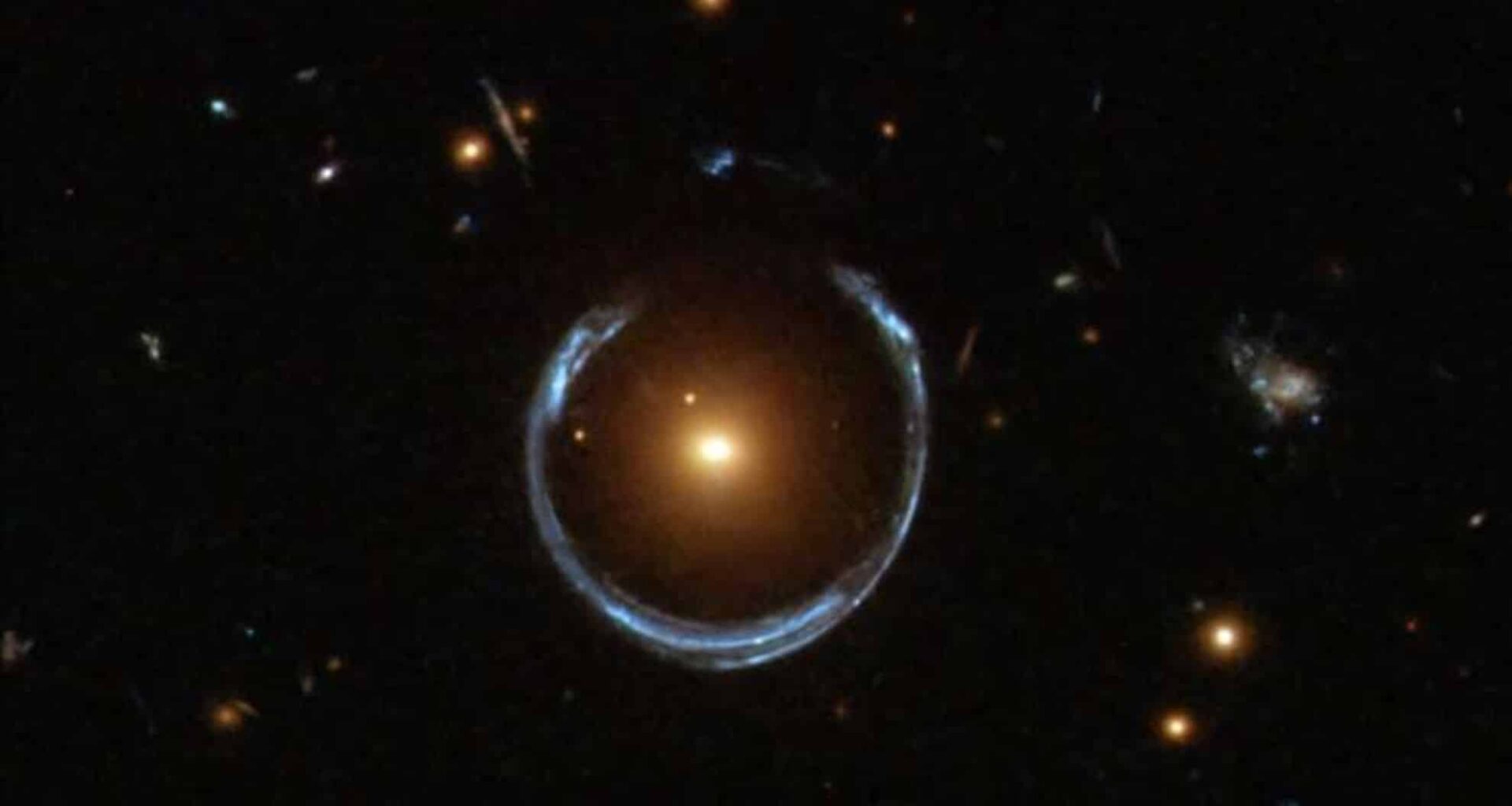
In a groundbreaking discovery published in Monthly Notices of the Royal Astronomical Society, astronomers have identified a black hole within the Cosmic Horseshoe galaxy that challenges everything we thought we knew about the scale and potential of black holes in the universe. Situated approximately 5 billion light-years away from Earth, this black hole, weighing an astounding 36 billion solar masses, could very well be the largest ever detected. This article delves into the significance of this discovery, the innovative methods used for detection, and the potential insights it provides into the fundamental workings of galaxies and black holes.
The discovery of this ultramassive black hole has already begun reshaping our understanding of the relationship between galaxies and their central black holes. Astronomers have long hypothesized that larger galaxies tend to harbor more massive black holes at their centers, but the sheer scale of this black hole, compared to those found in other galaxies—including our own Milky Way—raises questions about the limits of black hole growth. In particular, this discovery is an exciting step forward, not just for the size of the black hole, but for the cutting-edge methodology used to measure it, which could lead to new revelations about dormant black holes scattered across the universe.
A Black Hole Beyond Measure: The Cosmic Horseshoe’s Surprise
The Cosmic Horseshoe galaxy has long been a subject of interest for astronomers due to its extraordinary size and gravitational properties. This galaxy’s immense mass distorts the fabric of spacetime, creating a phenomenon known as gravitational lensing. This effect bends the light from a distant background galaxy into a horseshoe shape, hence the name “Cosmic Horseshoe.” However, it is the galaxy’s central black hole that has garnered the most attention, as recent measurements suggest it could be one of the largest to date. As Professor Thomas Collett from the University of Portsmouth explains, “This is among the top 10 most massive black holes ever discovered, and quite possibly the most massive.”
What makes the discovery of this black hole even more remarkable is the method used to measure its mass. Traditional techniques for estimating black hole masses often rely on indirect measurements, which come with considerable uncertainties. In contrast, the combination of gravitational lensing and stellar kinematics has allowed for a much more precise calculation of the black hole’s mass. “Most of the other black hole mass measurements are indirect and have quite large uncertainties, so we really don’t know for sure which is biggest. However, we’ve got much more certainty about the mass of this black hole thanks to our new method,” Collett adds. This breakthrough in methodology could revolutionize how astronomers study distant black holes.
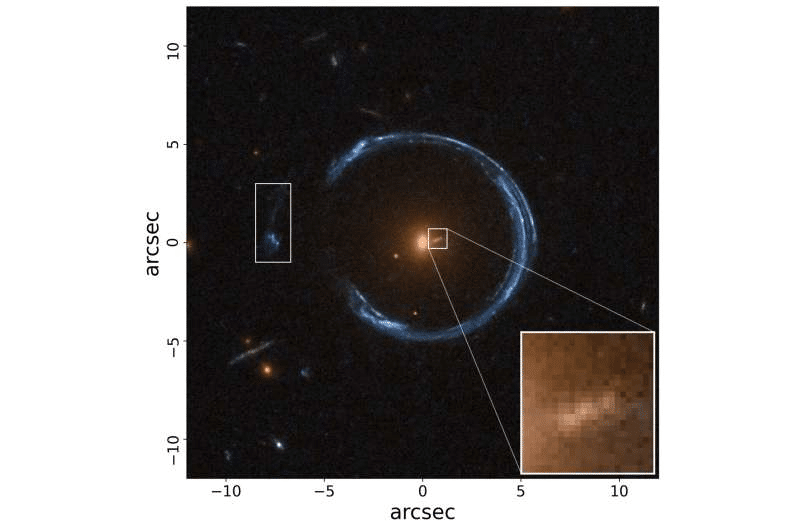 Another image of the Cosmic Horseshoe, but with the pair of images of a second background source highlighted. The faint central image forms close to the black hole, which is what made the new discovery possible. Credit: NASA/ESA/Tian Li(University of Portsmouth)
Innovative Detection Techniques: Gravitational Lensing and Stellar Kinematics
One of the most fascinating aspects of this discovery is the dual technique used to detect the black hole. Astronomers utilized both gravitational lensing and stellar kinematics to measure the black hole’s mass with unprecedented precision. Gravitational lensing occurs when the immense gravity of the black hole distorts the path of light from a more distant object, bending it into a ring shape as seen from Earth. In addition, by studying the motion of stars in the inner regions of the host galaxy, scientists observed how the black hole’s gravitational pull is influencing these stars, causing them to move at speeds close to 400 kilometers per second.
Lead researcher Carlos Melo of the Universidade Federal do Rio Grande do Sul (UFRGS) in Brazil emphasizes that “we detected the effect of the black hole in two ways—it is altering the path that light takes as it travels past the black hole and it is causing the stars in the inner regions of its host galaxy to move extremely quickly (almost 400 km/s).” The combination of these two measurements provided the necessary evidence to confirm the existence of this ultramassive black hole. “By combining these two measurements we can be completely confident that the black hole is real,” Melo asserts, highlighting the robustness of the findings.
Dormant Black Holes: Silent Giants in the Universe
What makes this discovery even more extraordinary is that the black hole in question is not currently active. While many of the largest black holes observed are actively accreting material, which makes them easier to detect, this particular black hole was detected without such accretion activity. Melo explains, “This discovery was made for a ‘dormant’ black hole—one that isn’t actively accreting material at the time of observation. Its detection relied purely on its immense gravitational pull and the effect it has on its surroundings.” The ability to detect and measure the mass of dormant black holes, especially those that are not actively emitting radiation, opens up a new avenue for understanding the silent giants that exist throughout the universe.
Furthermore, this method of detecting dormant black holes could have significant implications for future astronomical studies. Traditionally, black hole mass measurements are only possible when the black hole is active, as it is emitting energy from the matter it is consuming. However, the new approach combining strong lensing with stellar dynamics provides a more direct and reliable method for studying black holes, even when they are not actively accreting material. As Melo points out, “Typically, for such remote systems, black hole mass measurements are only possible when the black hole is active. But those accretion-based estimates often come with significant uncertainties. Our approach, combining strong lensing with stellar dynamics, offers a more direct and robust measurement, even for these distant systems.”