

At the 24% federal bracket, a $250,000 position in Realty Income (NYSE: O | O Price Prediction) throws off roughly $13,150 a year at the current 5.3% yield. Held in a taxable brokerage, about $3,156 of that goes straight to the IRS every year. Held in a Roth, zero does. That is the entire premise of this article.
Why Realty Income Is a Textbook Roth Holding
Real estate investment trust (REIT) distributions are non-qualified ordinary income. They are taxed at your marginal bracket, full stop, with no access to the 15% or 20% qualified-dividend rate. Realty Income has now declared 671 consecutive monthly dividends and posted its 114th consecutive quarterly increase, with a monthly payout of $0.2705 and an annualized rate of $3.246. That is a high-frequency, fully taxable income stream. The Roth wrapper is the difference between keeping all of it and giving a chunk back every April.
The Tax Delta: Roth Versus Taxable at the 24% Bracket
Using the current yield of 5.3% and the 24% bracket (single filers with income over $105,700, married filing jointly over $211,400 for 2026):
Position Size
Gross Annual Dividend
Net in Taxable (24%)
Net in Roth
Annual Roth Advantage
$50,000
$2,630
$1,999
$2,630
$631
$100,000
$5,260
$3,998
$5,260
$1,262
$250,000
$13,150
$9,994
$13,150
$3,156
On the $250K tier, that represents a $31,560 cumulative 10-year advantage before any compounding, based solely on account placement.
The Bracket Multiplier
The same $100,000 Realty Income position, generating $5,260 in gross dividends, produces dramatically different after-tax outcomes depending on bracket.
Bracket
Tax Owed (Taxable)
Net in Taxable
Roth Advantage
22%
$1,157
$4,103
$1,157
24%
$1,262
$3,998
$1,262
32%
$1,683
$3,577
$1,683
37%
$1,946
$3,314
$1,946
A 37% bracket investor loses nearly twice as much per year on the same shares as a 22% bracket investor. The higher the bracket, the more urgent the Roth placement.
The Insight Most Readers Miss
The Roth advantage compounds: that delta reinvested into more Realty Income shares generates more monthly dividends, all tax-free. On a $250,000 position at the 24% bracket, the $3,156 annual delta reinvested monthly at the current 5.27% yield approaches roughly $41,000 over 10 years and north of $110,000 over 20 years before any share-price appreciation. That is the permanent, realized cost of holding Realty Income outside a Roth. Monthly compounding matters here. Realty Income pays 12 times per year versus four for most blue-chip dividend payers, so reinvested distributions begin earning their own dividends a quarter sooner.
What to Do
If Realty Income or any other REIT sits in your taxable account, calculate the annual tax cost at your marginal bracket before your next filing. With Q1 2026 AFFO of $1.13 per share and full-year guidance of $4.41 to $4.44, the income stream is durable enough to justify running the numbers.
Run the Roth conversion math on Realty Income shares held in a traditional IRA. Compare the one-time conversion tax against the lifetime stream of $0.2705 monthly distributions sheltered permanently.
For investors still contributing, the math favors placing Realty Income inside the Roth bucket while qualified-dividend payers can sit in the taxable account, where the 15% to 20% rate already applies.
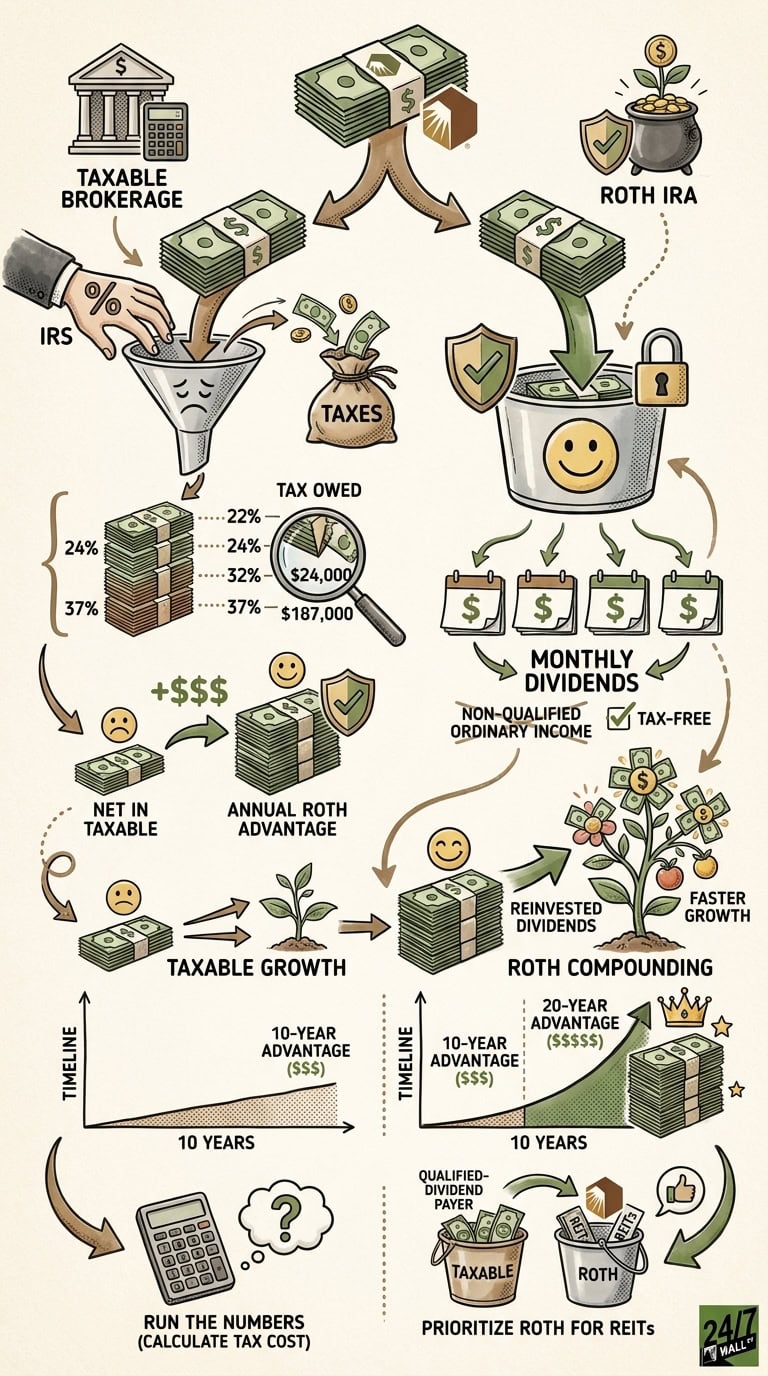 24/7 Wall St.Your REIT dividends are getting shredded by ordinary income taxes. Here is the blueprint to keep every cent and supercharge your compounding.