
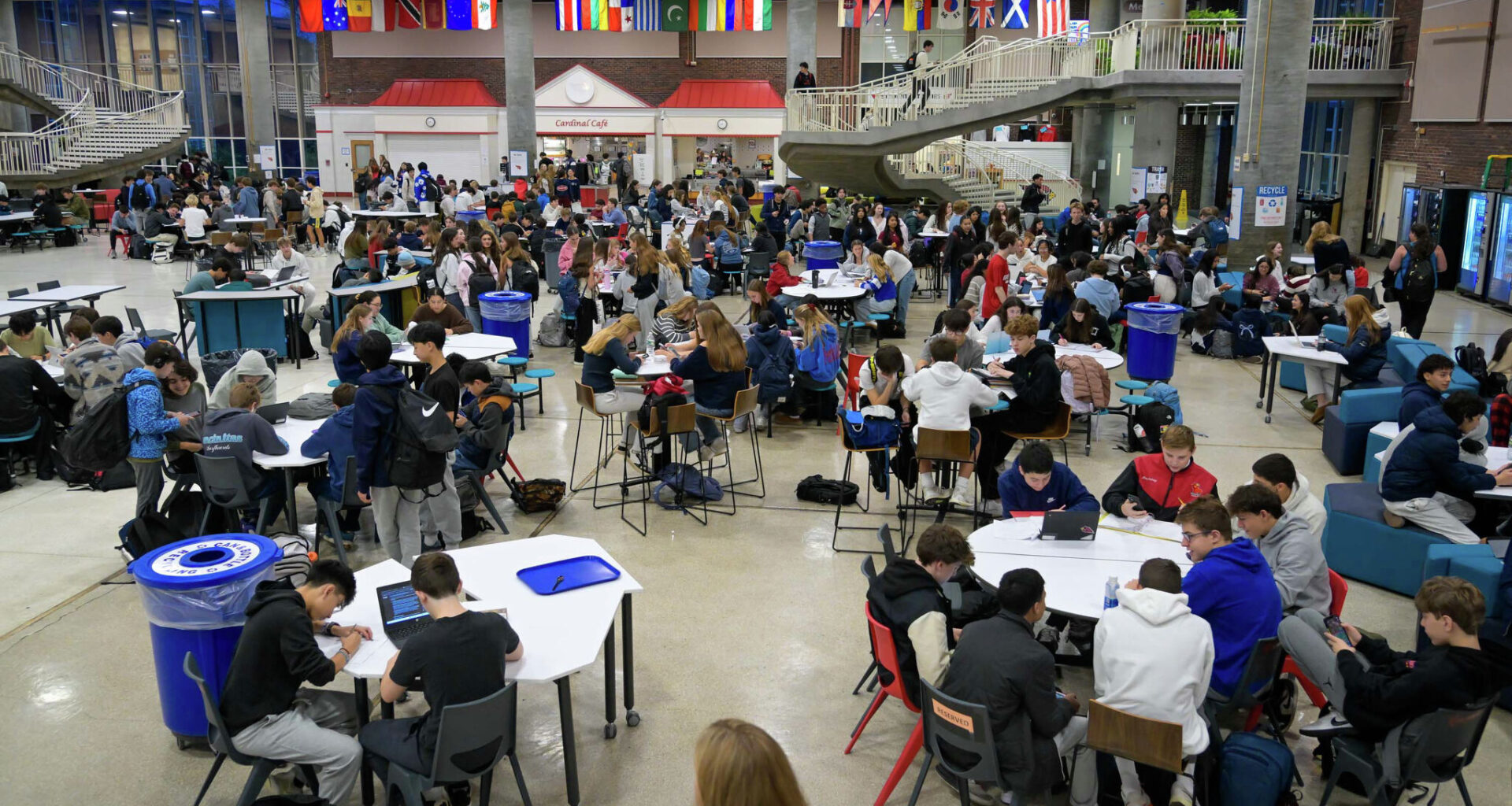
Students gather in the cafeteria during breakfast at Greenwich High School in October 2025. School officials are weighing a bell-to-bell ban of student cellphones for the 2026-27 school year.
Jim Shannon/Hearst Connecticut Media
GREENWICH — Cellphone restrictions at Greenwich High School were met with resistance two years ago, but the district’s leader said she believes times may have changed.

Superintendent Toni Jones shared recent school survey data that shows 60% of faculty support a bell-to-bell ban of cellphones, which would be stricter than the current policy that calls on students to turn off and store their phones only during instructional time.
Article continues below this ad
“Our community is in a different place than we were two years ago because I think our parents are much more tuned into the mental health challenges and they’ve been watching other school districts who have implemented very, very restrictive policies,” Jones said during a Greenwich Board of Education meeting on May 28.
Jones told the board nearby communities such as Wilton and New Canaan have successfully implemented bell-to-bell bans at their high schools.
“They feel their kids are healthier, happier – they’re talking more to one another,” Jones said.
Article continues below this ad
She urged the Board of Education to give her feedback about a possible alteration to the district’s cellphone regulations, which could be updated for the 2026-27 academic year.
Recently, the topic of cellphones in schools was debated at the state level, where the General Assembly stopped short of approving a statewide ban on the devices, instead encouraging districts to develop local policies.
The Greenwich Board of Education appeared similarly torn on the topic. Some members, including Chair Michael-Joseph Mercanti-Anthony and Vice Chair Sophie Koven, expressed enthusiasm about stricter regulations, while members Wendy Vizzo Walsh and Karen Hirsh shared reservations about taking phones away from students.
Article continues below this ad
“I think the thinking around cellphone use has evolved so quickly,” Koven said, adding that cellphones are a distraction for students at the high school.
Mercanti-Anthony agreed, saying Greenwich High School should have banned them two years ago.
“We had the opportunity to get out ahead of this and now we’re playing catch-up,” he said.
Walsh, on the other hand, advocated for letting students keep their phones and give them guidance on how to use them responsibly.
Article continues below this ad
“I think it’s actually developmentally inappropriate for high school students to take it away from them,” she said. “Our own regulation states that students in high school must learn to self-regulate their cellphone usage before graduating. A bell-to-bell ban removes the opportunity to practice the skills they eventually need for college, for work, for adult life.”
Hirsh worried that a ban would create a stigma for special education students who rely on electronic devices and likely would be exempt from the restriction.
Walsh also brought up student safety, a common issue for those who oppose a full cellphone ban. Many detractors have brought up school shootings as situations where students should be allowed to communicate with parents.
However, there are downsides to that sort of communication, said Peter Schwarzstein, the father of three Greenwich Public Schools students. He argued that phones can distract students from focusing on directions from teachers during emergency scenarios, and students communicating with their parents could lead to parents rushing to the school, which could create delays and obstacles for emergency responders.
Article continues below this ad
“Greenwich should heed the advice of school safety experts and adopt a true bell-to-bell phone policy,” he said.
Margaret Jackins, president of the Greenwich Education Association, the teachers union, also advocated for a ban.
“A strong and consistently implemented policy regarding cellphone use is an important beginning in addressing the excessive amount of screen time being experienced by our students,” she said.
Article continues below this ad
Jackins also noted that making students put their phones away during instruction doesn’t stop them from communicating digitally.
“Let’s face it, many of those cellphones now being left in pockets and classroom wall (phone holders) or in backpacks are also linked to laptops students are using in class, making texting and social media available right at their desks,” she said.