
Greetings, everyone. I wrote most of this mailbag on my Tuesday flights to Oklahoma City, where I’m about to cover my first Women’s College World Series. I can’t tell you how exciting it is to take on a new, albeit brief, career challenge after all these years.
Therefore, I decided to mostly lay off the 24-team College Football Playoff questions this week. (There’s one at the end.) I’m in too good a mood to make myself angry all over again. Not to mention there are so many more uplifting college football stories these days, like a pouty major conference threatening to take its ball and go home.
Questions may have been lightly edited for length and clarity.
Do you think it’s fair to say that recent talk from the SEC about breaking away and having its own Playoff is nothing but Greg Sankey hanky-panky? — Colin M.
It’s not Sankey driving that conversation. But he’s got a lot of presidents and athletic directors in his conference frustrated with the current landscape (the lack of rules, much more than the Playoff), racking their brains for a way to break the cycle. I’d contend that the simple solution would be, “Follow the rules that you yourselves created,” but of course, taking responsibility is never the answer. Easier to blame the NCAA, the College Sports Commission, the other conferences, etc., for whatever your current predicament.
And so, you’ve got folks such as Georgia president Jere Morehead claiming they’d solve all their problems by self-governing. Because they do such a great job of maintaining intraconference harmony now, what with LSU stealing Ole Miss’ coach during the season, everyone stealing everyone else’s players, Texas’ coach ripping another school’s academics, etc. But if it’s the SEC’s rules, not the NCAA’s or CSC’s, I’m sure everyone would suddenly be on their best behavior.
And there’s a real sentiment by some, though not all, that the SEC has such a superior product — on the field, in the ratings, in the stands — that it would do just fine on its own. Play out the season, determine their own champion, and if the Big Ten wants to hold a one-game Super Bowl with its own champ, away we go. Keep printing money.
Realistically, they can’t pull off a standalone breakaway. At the very least, they need the Big Ten, Notre Dame and probably Miami, Florida State and Clemson before anyone deems the best of those schools a legitimate national champion. I’ve been saying for 10 years that a Super League is coming, likely by the early 2030s, and the current model has grown only more unstable.
There are just two itty-bitty problems: 1. The Big Ten and SEC can’t stand each other right now, so joining forces seems unimaginable. 2. As we speak, the Senate is going to the mat for a new bill specifically crafted to head off a Big Ten/SEC breakaway. In fact, the Big Ten and SEC came out Tuesday afternoon and said they “do not support the Protect College Sports Act as drafted.”
If you missed it, MAC commissioner Jon Steinbrecher recently went scorched earth on his Power 4 colleagues during a public appearance, saying, “I am tired of listening to the complaints of the autonomy conferences who believe they know the best way to run the organization. I’m not sure if the right response to all of this is, ‘Be careful for what you ask for because you may get it’ or, B, ‘Karma’s a b—h,’ because we’re now living with what happens when the autonomy conferences make the rules.”
And now one of the autonomy conferences is suggesting it might set its own rules. In the words of Jerry Seinfeld, “Good luck with all that.”
How do you see the Big Ten race shaking out this season? Dane Brugler’s Mock Draft was loaded with Oregon players, and the Ducks appear stacked. Indiana brings back a surprising number of key pieces. There’s a lot of optimism around USC, Washington and Michigan. And of course, Ohio State will be well coached and have some key pieces back, but their schedule is brutal. — Mike T.
If you read my updated Top 25, you know I consider it a toss-up among my top three teams: No. 1 Indiana, No. 2 Oregon and No. 3 Ohio State. Then I have a big drop-off to No. 12 USC, No. 15 Washington and No. 17 Michigan.
But as we know, things rarely go as predicted. My guess is that at least one of Indiana, Oregon or Ohio State falls well short of the conference championship. Maybe new QB Josh Hoover isn’t up to the task in Bloomington, or Curt Cignetti’s Hoosiers are less cohesive without those core JMU players from the past two years. Maybe losing both coordinators proves too much change at once for Dan Lanning’s Ducks. Or maybe losing 25 draft picks in two years finally catches up to Ryan Day’s Buckeyes. Mind you, even then, it’s hard to imagine that program completely imploding after 13 straight full seasons with double-digit wins, but it will happen at some point.
And if that’s the case, someone from the next group down will likely take its place. I have USC ranked highest because of my confidence in QB Jayden Maiava and the fact the Trojans should be strong on both lines. But let’s be honest, Lincoln Riley is not the most confidence-inspiring coach these days. Michigan has an all-time great in Kyle Whittingham, but he’s making a major adjustment after 20-plus years at Utah and is bringing a completely different culture to Ann Arbor. Of the three, I’d be least surprised if Washington takes a big step forward in Year 3 under Jedd Fisch, though the Huskies do have some key playmakers to replace.
Now more than ever, in an 18-team conference, these things may come down to who draws the most favorable matchups. In addition to the six aforementioned teams, I have Penn State in the 20s and Iowa as my first one out. Here’s who plays whom among those top eight:
Indiana (4): Ohio State, at Michigan, USC, at Washington
Oregon (4): at USC, at Ohio State, Michigan, Washington
Ohio State (5): at Iowa, at Indiana, at USC, Oregon, Michigan
USC (5): Oregon, Washington, at Penn State, Ohio State, at Indiana
Washington (5): at USC, Iowa, Penn State, Indiana, at Oregon
Michigan (5): Iowa, Penn State, Indiana, at Oregon, at Ohio State
Penn State (3): USC, at Michigan, at Washington
Iowa (3): at Michigan, Ohio State, at Washington
So it looks as if we should go ahead and book a Penn State-Iowa Big Ten championship game. Kidding. My main takeaway is that Indiana’s schedule sets up quite nicely, Oregon’s is manageable, but Ohio State’s is in fact brutal — not even counting its game at Texas.
Hey Stewart, the SCORE Act failed to pass the House, but the Cantwell-Cruz legislation (the Protect College Sports Act) seems to have a much stronger legal footing. It seems this could be the best chance we’ll get to codify college football reforms through Congress. If passed, how closely will the final bill look compared to the one that was first announced? Do you see the two governing conferences agreeing to its terms? — Lucas A.
At first glance, the new legislation seemed more likely to gain bipartisan support than the SCORE Act, which was never going to get Democratic support in the Senate because it prevents athletes from ever becoming employees. Not that politicians are pushing for that, but permanently removing the possibility does not sit well with pro-labor organizations. Case in point, every major pro sports player union has voiced objections to it.
There are also quite a few low-hanging-fruit elements to the Cantwell-Cruz bill. I don’t think it would take much convincing to push through common-sense measures such as the one-time transfer rule and age-restricted eligibility. And of course, the “Lane Kiffin Rule,” which says a coach can’t start working at a new school before his current school’s season ends. Whether they’d hold up in court if challenged by affected coaches or athletes, who knows, but you could at least get them signed into law to begin with.
The more controversial aspects: 1. It would effectively make it illegal for the Big Ten and SEC to add more schools from other conferences, which seems … unrealistic. 2. Revising the Sports Broadcasting Act of 1961 to allow conferences to pool their media rights and, theoretically, spike their collective value, aka Cody Campbell’s baby.
Though the Big Ten and SEC cannot be required to surrender their media rights, they’re still unlikely to support that part. Although the two conferences have no formal say in the legislation, they could go on a lobbying tear to try to convince congressmen in their footprints to get it squashed.
Joint statement on the Protect College Sports Act: pic.twitter.com/0sRlWCSvGY
— Southeastern Conference (@SEC) June 2, 2026
But forget college conferences. There are a few much more powerful entities that might oppose this bill: Disney, Paramount, Comcast, Fox, Netflix and Amazon. Mind you, the SBA is the same law that currently precludes the NFL from playing on Saturdays before mid-December. If it’s suddenly up for revision, everything becomes fair game. Could those companies push for more flexibility on when they air their NFL games? Or put it in writing that colleges can’t hold their Playoff games opposite the NFL’s? Or some other big-media bully thing I’m not considering.
I’m not a congressional reporter. I only play one on TV, so I couldn’t possibly predict what a revised bill might look like. I do find it overly optimistic that, after five years of D.C. inertia, this bill will become law by August, as Cruz has suggested. But I can’t knock them for trying. No one on either side of the aisle likes the status quo.
Why do you always disrespect my team in your Top 25?
C’mon, you know the answer. I disrespect everyone’s team.
Stew: It is the offseason. How about answering something fun that will get everyone mad at you? Select only one coach who is known for the following: (no repeats except question 7) — Daniel B.
Sounds good, I’m in. Here are Daniel’s categories.
1. Superior initial game plans: Curt Cignetti. Coaches across the sport marvel at how well prepared Indiana is for an opponent’s tendencies and how rarely the Hoosiers screw up.
2. Winsome recruiter: Dan Lanning. That guy seems to get everyone he wants. Of course, it helps to have that Nike money.
3. Unrivaled at in-game adjustments: Kirby Smart. How many times have we seen Georgia play an ugly first half, come out after halftime and bludgeon its opponent? Might be waning, though.
4. Epic motivator: Ed Orgeron. I get to include him now that he’s back in college football, right?
5. Brightest future: Jon Sumrall. I’m getting in early on a guy who’s only in his early 40s and has started his career 43-12.
6. Unwavering integrity: No answer. I’ll say the same thing I do about Heisman voting: I don’t know these guys very well, if at all. I’m not qualified to judge their integrity.
7: You would like to coach your kid (may repeat): Same answer as No. 6. Though I do have quite a few answers to “would never want to coach my kid.” No, I’m not publishing them.
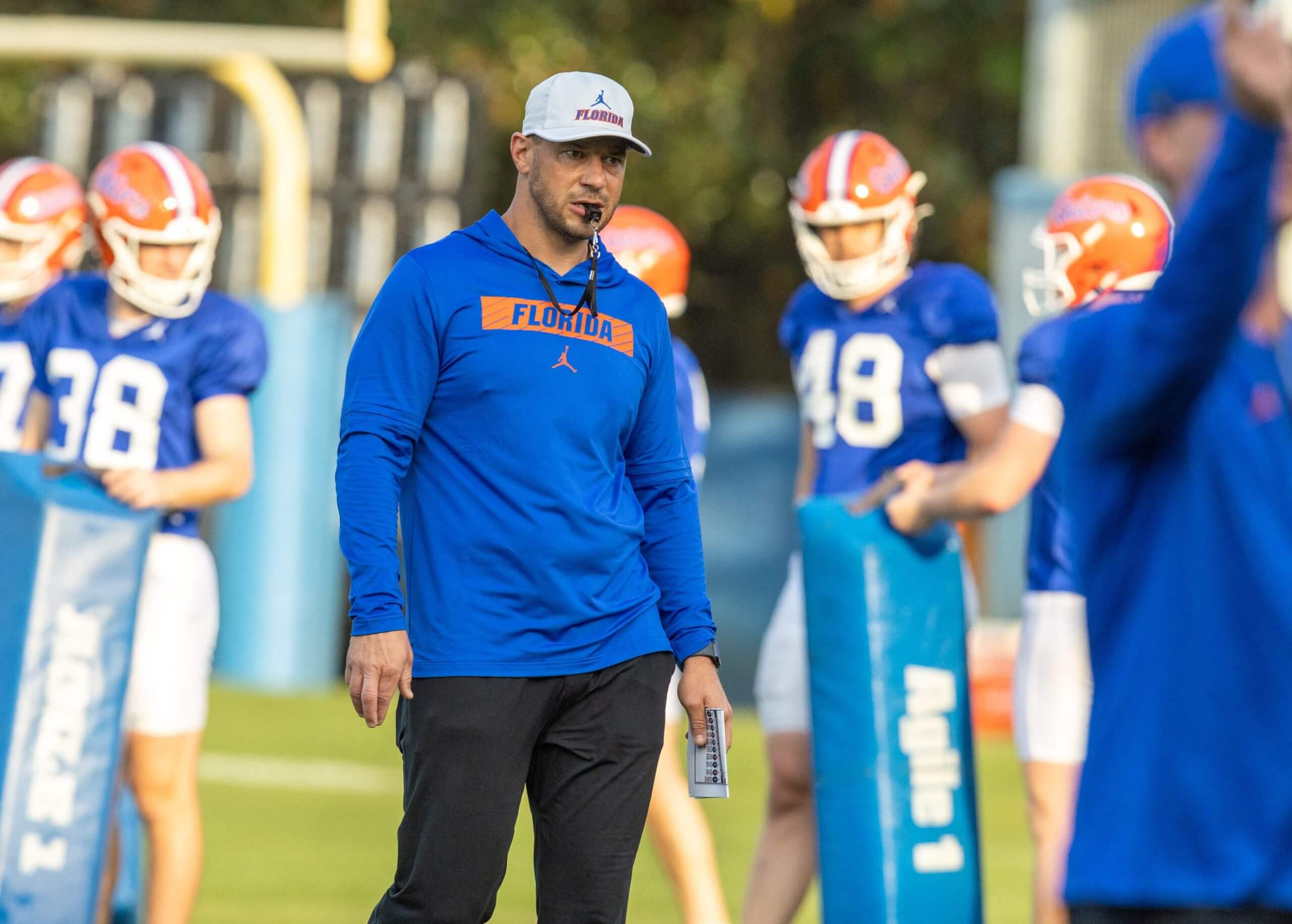
Jon Sumrall has had a lot of early success in his head-coaching career. Will it carry over to Florida? (Alan Youngblood / Imagn Images)
Now that you’ve updated your premature Top 25, what’s your outlook for last year’s SEC disappointments and disasters? Will the needle move for woeful Arkansas and Mississippi State? Will Tennessee bounce back or fall flat? How about Kentucky and Auburn? — Charles B.
The middle of the pack in the SEC is difficult to forecast because so many teams have new coaches and/or completely rebuilt rosters. Tennessee is an obvious exception. Josh Heupel will be riding with a mostly homegrown offense, led by either redshirt freshman George MacIntyre or true freshman Faizon Brandon. It feels almost quaint these days for a major program to start an unproven young quarterback, but hey, Ohio State’s Julian Sayin, Notre Dame’s CJ Carr and BYU’s Bear Bachmeier all led their teams to double-digit wins last season.
Meanwhile, it’s tempting to jump on the Auburn bandwagon because new coach Alex Golesh brought a proven QB from USF, Byrum Brown. The dual-threat senior is coming off a spectacular 2025 season in which he threw for 3,158 yards and rushed for 1,008, producing 42 total TDs. That said, he had a few clunkers, most notably in the Bulls’ 49-12 loss to Miami in Week 3. I won’t be surprised if Auburn goes to a bowl game, but I’m not confident picking much more than that.
The sub.-500 team that intrigues me most is Kentucky. The school gave new coach Will Stein a healthy budget to flip the roster, and he landed a top-10 portal class. Notre Dame transfer QB Kenny Minchey took Carr to the wire for the starting job in preseason camp last year and should benefit from a coach who mentored Bo Nix, Dillon Gabriel and Dante Moore at Oregon. And Kentucky landed some sought-after offensive linemen. Don’t be surprised if the Wildcats go from 5-7 to a Top 25 team.
And you probably know how I feel about Florida, 4-8 last season, which I had in my Top 25 in January and now I have just missing. Jon Sumrall has already shown he’s a great coach. The Gators had more talent than Billy Napier could get out of them, and they return a bunch of it. Frankly, I put them in a different class from any of the other disappointments last season.
I’ve got nothing for you on Mississippi State or Arkansas, other than they’re both currently undefeated.
One take I don’t understand about the 24-team CFP is the idea that teams with three or four losses are automatically a bunch of losers. Take Florida State three years ago. What if they lose Jordan Travis at the beginning of the year for three to four games, then he comes back, and they roll? Or Texas last year, which took a few games to pull it together but would have absolutely had a chance to win it all. — Joel
Sure, but isn’t the 12-team CFP already creating those opportunities? Miami lost two games midseason last year and would have been done in a four-team world, but it got much better down the stretch, got in and proved its worthiness. Two-loss Notre Dame probably would have joined them in the field if the Irish had played anyone with a pulse after the first two games. And Ohio State, the year before that, had enough margin for error to overcome its worst performance in the last game of the season, get in and remind everyone just how talented it was all along.
But 2024 Ohio State and 2025 Miami were still top-10 teams. Injuries or not, if you can’t finish the regular season in the top 20, I’m sorry, but you’re just not that good. The only way I could see a team that low getting hot enough to play for the national title is if it’s an Ohio State- or a Georgia-caliber program that sleepwalked through the regular season. No offense to last year’s Arizona, Virginia, Houston or Georgia Tech teams, all ranked between 17 and 24, but they were never on that level and were never going to morph into 2025 Indiana in the middle of December.
As I wrote last week, I don’t think teams 13 through 16 would feel all that different from teams 9 through 12 in a 16-team Playoff. Once you get below that, though, you’re going to see a lot of games between a legit national championship contender and a barely legit Alamo Bowl contender.
My primary concern is not the worthiness of the Playoff teams; it’s the idea of turning college football’s sacred regular season into a three-month exhibition.
Do The Athletic reporters get a bonus for pimping the really dumb 24-team CFP proposal? — G M M.
Gosh, I hope not. If so, I’ve been costing myself a lot of money.