
The Minnesota Wild had never been a serious Cup contender until this past season, and it changed in a hurry.
Trading for defenseman Quinn Hughes transformed the franchise, putting it in win-now mode more than it had been in its 25-year history.
“We’re in a window now,” Wild president of hockey operations and general manager Bill Guerin said. “We want to make sure that we don’t just open the window three-quarters of the way. If there’s a chance to get better, we will.”
That will make it a fascinating offseason as Minnesota will still have a loaded division in 2026-27.
The Wild thought they could have beaten the Presidents’ Trophy-winning Colorado Avalanche in the second round — the absences of Jonas Brodin and Joel Eriksson Ek clearly cost them — but clearly they need more than just the regular roster churn.
It’s hard to imagine them re-signing all eight of their unrestricted free agents. Who stays and who goes will play a part in determining what holes they need to fill.
What holes should they be most determined to fill?
To help assess how the team measures up to a championship standard, let’s look at it in relation to the Stanley Cup checklist.
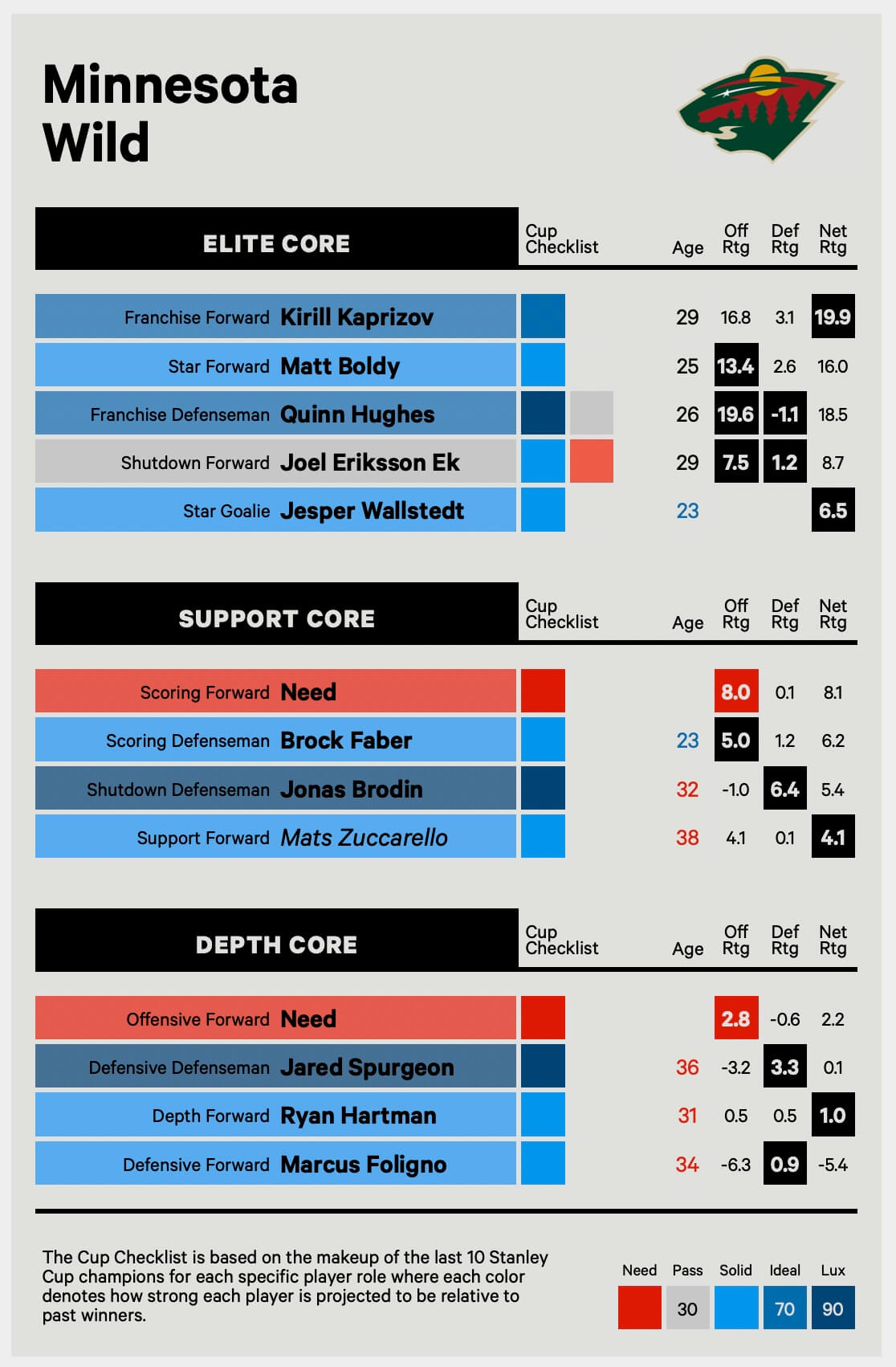
Projecting some of the team’s more likely offseason moves (re-signing Mats Zuccarello, for example), here’s where things stand. All projected values are age-adjusted based on each player’s profile of comparable peers.
What the Wild have
The Wild’s star power is what makes them a contender. The combination of Kirill Kaprizov and Matt Boldy up front, plus Hughes and Brock Faber on the back end, is outright dynamic.
Kaprizov’s 2025-26 wasn’t as dominant as seasons past, but he is still an electric, franchise-caliber winger. He drives play despite not having a ton of help down the middle.
Boldy leveled up this year, in the regular season and in the big moments. And at 25, he’s peaking in what should be Minnesota’s window. That makes for a strong one-two punch at wing.
Eriksson Ek rounds out the core forward group, but he is considered only passable in his role. There’s a high threshold for a player as a contender’s top 200-foot shutdown forward, and Eriksson Ek’s defense wasn’t nearly as stout this past season, when Minnesota actually allowed a higher expected-goals rate in his five-on-five minutes, relative to his teammates, for the first time in his career. If he can rebound to his usual shutdown heights, it’ll solidify the top of the lineup.
Hughes was the missing piece in Minnesota’s core — a game breaker who brings a pace, puck moving and an elite possession game to the back end. He’s elevated Faber’s play — and his presence knocks Faber down to a more-fitting No. 2 spot.
That has a ripple effect down the depth chart. Brodin as a shutdown threat in the supporting core is a luxury, as is Jared Spurgeon as the No. 4 on the blue line.
The strength on the back end trickles into the blue paint. Filip Gustavsson has shown he can be a very solid No. 1, but Jesper Wallstedt’s breakthrough rookie season relegated him to the bench for all but one game in the playoffs. If the 23-year-old Wallstedt can build on that, especially with Gustavsson having hip surgery this summer, it should lock him in as the starter for years to come.
What the Wild need
Guerin didn’t hide from the obvious.
“The talk here is always No. 1 center,” Guerin said.
The Wild can learn how important that is from this season’s Cup finalists. The Vegas Golden Knights have an embarrassment of riches up the middle — led by Jack Eichel, Tomas Hertl and William Karlsson — and the Carolina Hurricanes have a star No. 1 in Sebastian Aho, Logan Stankoven at 2C and captain Jordan Staal right behind.
It’s not that Minnesota doesn’t have quality centers. Eriksson Ek, at his best, is a Selke Trophy-caliber pivot. Ryan Hartman can complement high-end play drivers. And rookie Danila Yurov could grow into a solid two-way guy. But Eriksson Ek’s absence in the Avalanche series only exacerbated the team’s lack of depth at that pivotal position. Teams can’t predict injuries, but true contenders have to be better prepared for them.
So, yes, the Wild will be big-game hunting for a No. 1 center, which could fill their need for a scoring forward.
But there’s room for improvement beyond that.
Zuccarello is expected to re-sign and has aged well enough to fit the support forward slot even at 38 years old.
But what about “offensive forward”? We don’t know yet if unrestricted free agents Marcus Johansson, 35, or Vladimir Tarasenko, 34, will be back. Even if one is, he may not fit the criteria. And in general, the ages of the supporting cast would be a concern. Long playoff runs are a grind, which creates issues within the second layer. Here, the Wild could try to learn from Carolina. Staal and Jordan Martinook still play important roles, but the Canes also have that next wave of Jackson Blake and Stankoven rising up the ranks to balance the top-nine burden.
So maybe it’s worth looking elsewhere for younger players.
Could Ross Colton, 29, who has one year left at $4 million average annual value with Colorado, be a trade fit? Someone who can play wing or center, has won a Stanley Cup championship and adds youth and speed to the bottom six?
Or will the Wild keep the focus on trying to re-sign UFA Michael McCarron after moving a second-rounder for him at the deadline? McCarron won’t check any boxes in the Wild’s depth core, but his penalty killing and faceoffs were a plus in the playoffs.
Minnesota could also try to find the next rising star, à la Stankoven. But that’s easier said than done. With a thin free-agent class and rising costs around the middle class, the best bet for getting younger and more skilled at a reasonable cost could be looking within.
Bobby Brink, 24, acquired from the Philadelphia Flyers in the David Jiricek trade at the deadline, showed flashes of speed and skill and had 15 goals this past season. He’ll be battling for a top-nine spot, and if he follows in the footsteps of a Kris Versteeg or a Yanni Gourde, he could become an important part of the supporting cast. But there’s a chance he becomes the next Jordan Weal or Erik Condra and doesn’t ever move out of the bottom six.
Then there’s Hunter Haight, who looked as if he belonged in his few callups last year. Coming off his second pro year, he’s a relentless forechecker and a strong skater, and he can chip in goals.
The Wild would have given a look to 2023 first-rounder Charlie Stramel late in the season after his career with Michigan State ended had he not gotten injured in the NCAA Tournament. Stramel should make a push in camp.
But those players have to make the Wild’s decisions hard.
That extends to the blue line, too.
Daemon Hunt may have played his way into a spot on the blue line next season with his playoff performance. And the Wild could use his youth in the second pair. They were among the oldest teams in the league to end the season and showed it when Jake Middleton got exposed against the Avalanche. Just look at how much stronger Carolina’s blue line is with K’Andre Miller in place of Dmitry Orlov.
“We’ll probably have to add, but I do believe we have some younger players that can start pushing for a more regular role,” Guerin said. “We need that. We need younger players that are ready to come in and contribute and kind of kick the door in. I always say, ‘This is not an easy business. This is a cutthroat business, whether you’re in management, coaching or a player. You have to take someone’s job.’
“The problem that you run into in today’s day and age is that every young player wants something. They want it. They want to be given something. Their agents want 10 games for an opportunity, 20 games for an opportunity. We don’t have time to do that. What we need is young players that come in and say, ‘I’m here. I’m willing to do anything. I’m willing to play on the fourth line or penalty kill, block shots, and this and that.’ We want guys that are ready to come through the door and say, ‘I’ve arrived.’”
The Big Question
Can the Wild elevate into the top team in the West?
This question looms large even now, as you can bet Hughes will think about it long and hard before he decides whether to sign an extension in Minnesota when he’s eligible July 1.
If the Wild brought back the same team — with Eriksson Ek and Brodin healthy — they’d like their chances against anyone. But they still won only five playoff games — 11 short of their goal.
Every player would also be another year older and under even more pressure until there’s certainty on the Hughes situation. So clearly, upgrades are needed, and perhaps some more maturity in their approach, to maximize this next season.
Coach John Hynes said after the season that his team struggled after emotional wins during the regular season and that it carried over into the playoffs, when the team no-showed in Game 4 against Colorado after dominating Game 3.
Playoff scars could help with that. The Hurricanes, after knocking on the door for several years, finally broke through, playing a clinical, consistent series against the Montreal Canadiens. The Golden Knights left no doubt in dusting the Avalanche in four games. Experience can matter in that respect.
But as Vegas and Carolina showed, there has to be high-caliber play to match that experience — and a willingness to move on veterans if the latter fades.
So the Wild’s big focus, as ever, will be on an upgrade up the middle, and there’s no shortage of big names that will be bantered about, from Auston Matthews to Robert Thomas to Nico Hischier to Mathew Barzal to Vincent Trocheck.
Takeaway
The Wild have only a certain amount of trade assets, and that’s the tricky part. After sending out many of their top prospects and picks to acquire Jiricek and Hughes, the best of what’s left are Wallstedt, Yurov, Stramel, Haight and Adam Benak. And with Gustavsson sidelined, it’s more unlikely (not impossible) that Wallstedt is moved this offseason. So Guerin will have to get creative and may have to dip into his core for another franchise-altering type of move.
“There’s always a way,” Guerin said. “There’s always a deal to be made.”
There’s no time to waste, though. Cup windows aren’t open forever.