
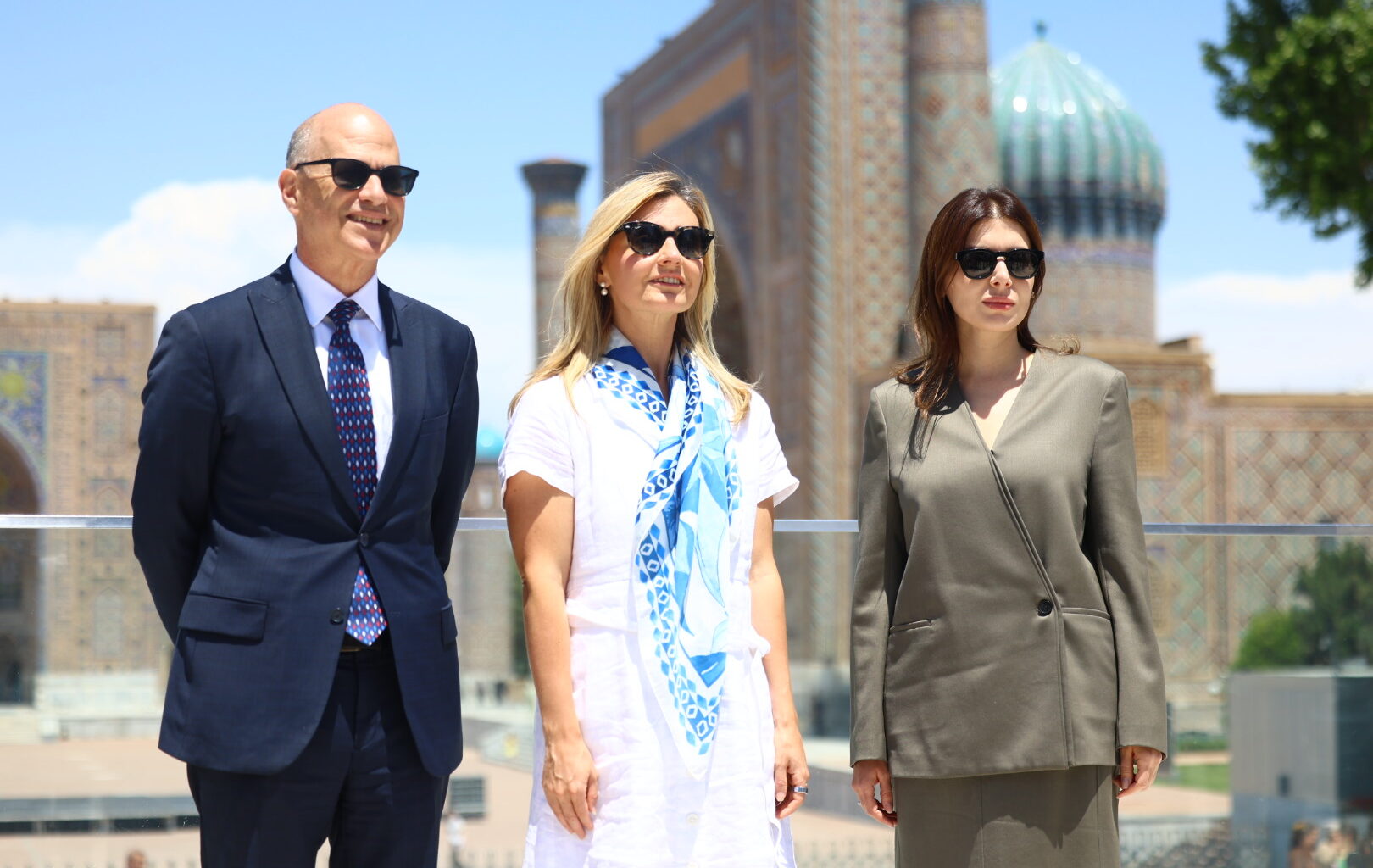
Under Secretary of State for Public Diplomacy Sarah Rogers, Head of the Department of Creative Economy and Tourism of the Administration of the President of the Republic of Uzbekistan Gayane Umerova, and U.S. Ambassador Jonathan Henick marked the dedication of the largest grant ever awarded in Uzbekistan through the Ambassadors Fund for Cultural Preservation.
SAMARKAND, UZBEKISTAN — June 3, 2026 — The United States and Uzbekistan today marked the restoration of the Sherdor façade at Samarkand’s Registan Square. The project, which is being implemented between 2025 and 2028, is supported by a grant of US$500,000 from the U.S. Ambassadors Fund for Cultural Preservation (AFCP) — the largest AFCP award ever granted in Uzbekistan.
The ceremony was led by Under Secretary of State for Public Diplomacy Sarah Rogers, Head of the Department of Creative Economy and Tourism of the Administration of the President of the Republic of Uzbekistan Gayane Umerova, and U.S. Ambassador to Uzbekistan Jonathan Henick.
The AFCP grant supports the restoration and conservation of Sherdor’s iconic façade and its intricate decorative elements, including the elaborate tilework, mosaics, carved inscriptions and ornamental details that have characterized the monument for centuries. The works encompass the conservation of the main portal and tympanum, the restoration of damaged mosaic and majolica cladding, the repair of decorative marble elements, and the restoration of sections of the dome and minaret.
A central component of the project is the recreation and replacement of the Kufic calligraphy on the main entrance façade, which had suffered significant deterioration and contained inaccuracies resulting from Soviet-era restoration works. Recreated using traditional techniques and carefully aligned with the monument’s historic design, the inscription represents one of the most distinctive and technically demanding aspects of the restoration. The project relies on highly specialized conservation methods to preserve exceptional examples of traditional Central Asian craftsmanship and artistic expression while ensuring the monument’s long-term structural stability.
In addition to the physical conservation works, the project supports research and documentation, the application of enhanced conservation methodologies, and the training of local specialists in international heritage preservation standards.
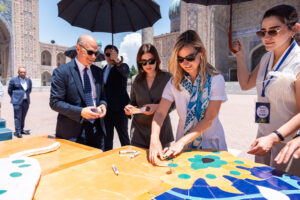
During the visit, the delegation was given a guided tour of the Sherdor Complex by the craftsmen and technical experts involved in the restoration. They viewed the conserved sections of the façade and learned about the techniques being employed at each stage of the project.
A Partnership Rooted in Shared Heritage
The restoration of the Sherdor Complex is the largest of 14 projects supported by the U.S. Ambassadors Fund for Cultural Preservation in Uzbekistan, representing approximately US$1.5 million in total support. Established by the U.S. Congress in 2001 and administered by the U.S. Department of State, the AFCP has funded more than 1,200 cultural preservation projects worldwide, ranging from the conservation of historic monuments and archaeological sites to the safeguarding of museum collections and traditional cultural expressions.
The Sherdor project is being implemented through a partnership between the U.S. Embassy in Tashkent, which provides funding and oversight; the Uzbekistan Art and Culture Development Foundation (ACDF), which facilitates coordination among participating institutions; the Cultural Heritage Agency of Uzbekistan, which leads the restoration works and engages local specialists; and the International Institute for Central Asian Studies (IICAS), which contributes technical expertise and fosters collaboration with the international research community.
The project brings together local craftsmen and conservation specialists, ensuring that traditional techniques are preserved while contemporary conservation standards are applied. In addition to restoring a monument of exceptional cultural significance, the initiative is strengthening Uzbekistan’s long-term capacity for heritage preservation by providing local experts with practical experience in internationally recognised conservation practices.
“We are grateful to the United States Embassy and the Ambassadors Fund for Cultural Preservation for their partnership and shared commitment to safeguarding cultural heritage. Together, we are preserving not only one of the world’s most remarkable architectural ensembles, but also the traditions and craftsmanship that give it meaning.
For centuries, the Registan has stood as a symbol of knowledge and cultural exchange. This project reflects those same values and demonstrates the potential of international cooperation grounded in mutual respect and a shared responsibility to protect our common heritage,”
stated Head of the Department of Creative Economy and Tourism of the Administration of the President of the Republic of Uzbekistan and Chairperson of the Uzbekistan Art and Culture Development Foundation Gayane O. Umerova.
A Broader Bilateral Framework
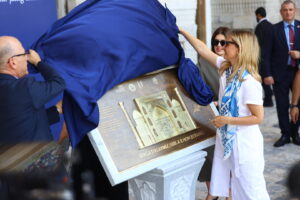
The restoration project forms part of the broader Cultural Heritage Protection Agreement signed between Uzbekistan and the United States in 2023. The agreement reflects a shared long-term commitment to safeguarding Uzbekistan’s cultural heritage and establishes a framework for expanded cooperation through a multi-year Action Plan. During the dedication ceremony, Ambassador Jonathan Henick and Gayane Umerova exchanged a letter of intent reaffirming their commitment to advancing the Action Plan and strengthening bilateral cooperation in the field of cultural heritage preservation.
“The Sherdor site has stood for four centuries as a testament to the ingenuity and artistry of the people of Central Asia, particularly Uzbekistan. Our role here is not to define that legacy — it is to help protect it. The craftsmen working on this restoration are not simply repairing tiles and mosaics; they are acquiring skills and techniques that will enable them to preserve Uzbekistan’s landmark monuments for generations to come, long after this project has been completed.
That is the kind of partnership the United States believes in: one that builds capacity, respects local expertise, and delivers lasting results. It reflects the depth of the U.S.–Uzbekistan relationship and our shared commitment to ensuring that Uzbekistan’s extraordinary cultural heritage remains in Uzbekistan’s hands — celebrated here, preserved here, and passed on to future generations of Uzbek artists, scholars, and craftsmen,”
said U.S. Ambassador to Uzbekistan Jonathan Henick.
Previous AFCP-supported initiatives in Uzbekistan include the conservation of the Tash-Hauli Palace in Khiva and the restoration of the 15th-century Langar Ota Complex in the Kashkadarya region — projects that have helped protect important sites while supporting local economies and reinforcing Uzbekistan’s position as a global cultural destination. A new AFCP project launching in 2026 will bridge cultural heritage and innovation in the digital realm through the Eternal Registan project. This initiative incorporates the use of U.S.-developed artificial intelligence and virtual reality tools to create 3D digital images of the Registan that can be used for virtual tourist experiences.
About the Sherdor Complex
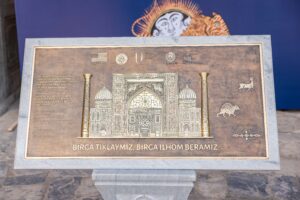
The Sherdor site forms part of the Registan Square ensemble in Samarkand, a UNESCO World Heritage site and one of the most iconic landmarks of the historic Silk Road. The complex is celebrated for its monumental façade and intricate tilework and remains among the most photographed monuments in Central Asia.
About the Ambassadors Fund for Cultural Preservation
Established by the U.S. Congress in 2001 and administered by the U.S. Department of State, the Ambassadors Fund for Cultural Preservation (AFCP) supports the preservation of cultural sites, cultural objects, and forms of traditional cultural expression in countries around the world. Since its founding, AFCP has supported more than 1,200 projects globally and has become one of the most visible expressions of U.S. cultural diplomacy.
About Uzbekistan Art and Culture Development Foundation
The Uzbekistan Art and Culture Development Foundation (ACDF) preserves, promotes and nurtures Uzbekistan’s heritage, arts and culture. Positioned at the forefront of Uzbekistan’s cultural development, ACDF is committed to fostering the cultural ecosystem of the country, driving the creative economy, and providing opportunities for practitioners on a local, regional and global stage. ACDF believes that culture and heritage are vital in shaping society, uniting communities, bridging generations, and facilitating cross-cultural conversations.
ACDF is overseeing the Centre for Contemporary Arts Tashkent (CCA Tashkent), which is poised to become a new cultural hub for the region, and is driving the construction of the new National Museum of Uzbekistan, designed by Tadao Ando, set to become an architectural and symbolic landmark in the heart of Tashkent. It also commissioned the inaugural Bukhara Biennial in 2025, which welcomed more than one and a half million visitors to the city, connecting the world with the local community of Bukhara, its artists and artisans. ACDF spearheaded the first Aral Culture Summit in 2025, bringing together global experts to work towards ecological and cultural renewal for the region. The second edition is planned for September 2026. In Samarkand, ACDF hosted the 43rd session of the UNESCO General Conference (30 October – 13 November 2025), a landmark decision for UNESCO. ACDF has also launched “Tashkent Modernism XX/XXI”, an ongoing research project documenting and protecting the city’s modernist architecture, highlighted by two significant publications in collaboration with Rizzoli New York and Lars Müller Publishers.
To date, ACDF has reached over 5 million visitors through landmark exhibitions across 17 countries: from the Louvre and Arab World Institute in Paris to the Uffizi in Florence, the British Museum in London, and the Palace Museum in Beijing. With projects presented across Europe, Asia, and the Gulf, and collaborations with over 40 international museums and cultural institutions, the Foundation is amplifying Uzbek voices and stories in the world’s most influential cultural arenas.