
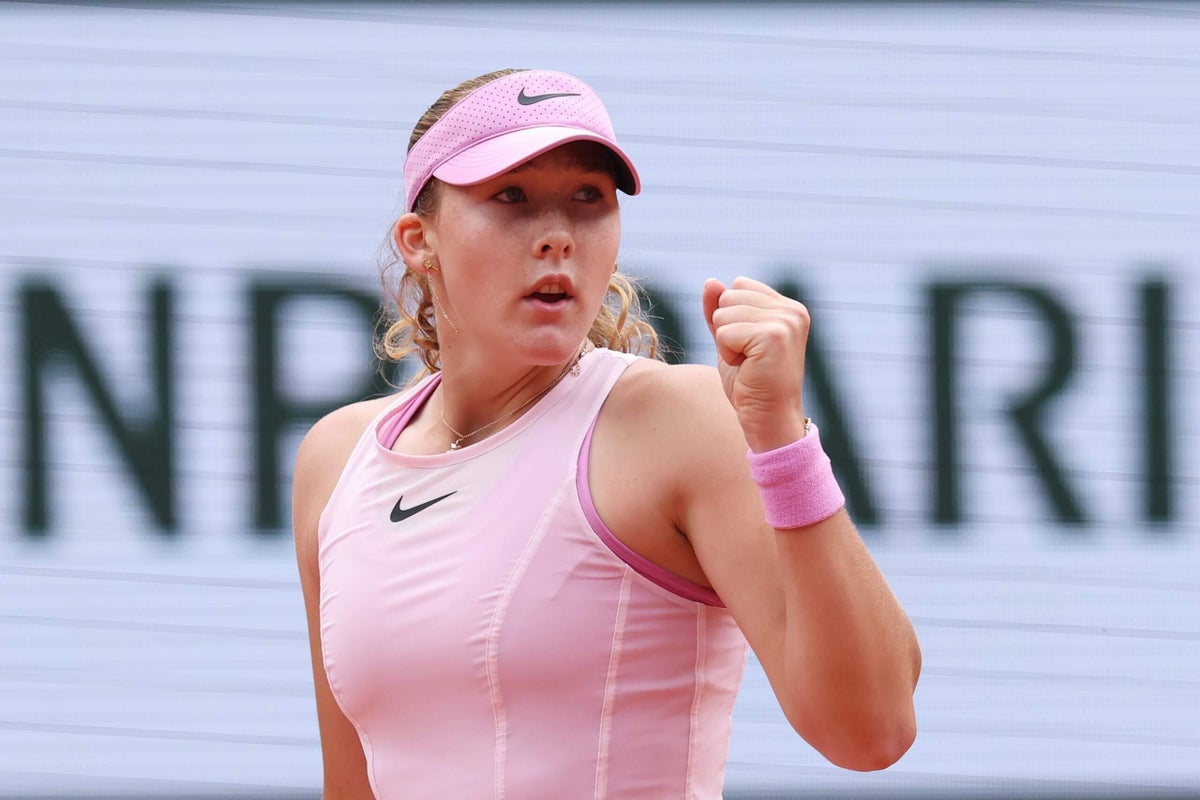
PARIS — Mirra Andreeva is heading to the French Open final.
On a breezy, cool day in Paris, the 19-year-old Russian took advantage of a tight and nervous version of Marta Kostyuk, the 23-year-old from Ukraine who had not lost a match in more than two months.
Andreeva did what quality players do when they see an opponent decomposing 80 feet away. She kept her foot on the gas, kept the ball in the court and cruised to a 6-1, 6-3 win in just shy of 80 minutes.
For nearly five weeks of the clay-court season, Kostyuk appeared to have finally blossomed into the fully-formed star she seemed destined to become when she started winning matches on the WTA Tour eight years ago.
She had a command of the ball and her emotions in a way she had never had before. As her country, Ukraine, continues to be attacked by Russian forces, she has spoken about the meaning of her victories, her hopes for her country and the tennis dreams she was finally fulfilling. Kostyuk, no matter the result in Paris Thursday, had grown up.
On Thursday though, the teenage Andreeva was the adult on the court, at least in pure tennis terms. Andreeva said she was so focused she could see the small yellow hairs on the ball, not just for a few points or games, but for the whole match.
She sloughed off some early nerves, finding the level she needed and the groove she wanted to stay in to make it to her first Grand Slam final, a little more than three years after her breakout, when she was just 15, and two years after she made her first Grand Slam semifinal here.
Back then she couldn’t believe she was playing in a Grand Slam semifinal. Now she does, and she’s gone one stop further.
“This is the number one goal in my life, the number one dream,” she said in her news conference. “I would not think I would be very close to them. Now I am.”
For Kostyuk, the match was ugly from the start, a cascade of errors, tentative swings, and balls pelting the middle of the net. She double-faulted twice in the first game, the second time on break point. She made 17 unforced errors in seven games in the first set.
“Maybe next time I’m playing in the semifinals I will feel better, different,” Kostyuk said in her news conference.
For Andreeva, prevailing meant little more than pushing at an open door. She appeared tight in her first service game, going down 0-40, but then Kostyuk made three consecutive errors. Andreeva held serve and was off to the races, when Kostyuk could have turned the first two games into a nervy aberration lost to history.
Rarely has a top player had to do so little to accomplish something so big, especially against the hottest player in the sport.
Kostyuk carried a 17-match winning streak into the semifinal. She mostly stormed through her five matches at Roland Garros. Even when she lost sets, she was battling and effective. In the round of 16, she beat Iga Świątek, a four-time French Open champion she’d not previously beaten in three tries, then she knocked out her compatriot, Elina Svitolina, who had been on a similar vein of form on the red dirt.
Heading into the semis, Andreeva was the higher seed — and the highest seed left in the draw, at No. 8 — but Kostyuk felt like the favorite, given her form and her beating Andreeva to win the Madrid Open in April.
She offered a glimmer of hope in the second set. Raindrops began to fall and the roof started to close when she was serving at 1-4. As she closed the game, the crowd got loud behind her. She held serve, then jumped ahead of Andreeva and broke her. She was back on serve and Court Philippe-Chatrier had come alive, chanting her name.
It was just the kind of atmosphere Andreeva had tried to avoid. The noise under the roof had doomed her a year ago in her quarterfinal against Loïs Boisson, a hometown favorite.
Not this time. She broke Kostyuk right back, then held with little resistance, a final Kostyuk forehand flying long.
There are few things in tennis hopeless than a top player walking onto the biggest stage of their life for the first time, and then finding that they can’t gain any feel for the ball. It happened to Coco Gauff in her first Grand Slam final here four years ago. It happened to Amanda Anisimova in the Wimbledon final last year. Both came against Świątek, in her most ruthless form.
Gauff had spent the morning of that final crying. Anisimova found herself in a daze once she stepped onto the court, feeling unable to move her legs where she wanted them to go.
Kostyuk, who had already taken out a less devastating version of Świątek, had never played in a Grand Slam semifinal. From the start, she seemed unable to make solid contact with the ball. Unable to find the dangerous parts of the court without hitting long or wide or into the net, she decelerated her swing to try to keep the ball safe, which had the opposite effect.
By then, Andreeva had gotten over her early jitters. She saw Kostyuk’s balls falling in the neighborhood of the service line, stepped in and put them away without even having to scare the lines. She hit to big targets with pace. Kostyuk, edgy and so much slower than she had been earlier in the week when she defended the court like a gazelle, gave chase but too often it was for naught.
The match grew awkward after 12 minutes, when Kostyuk lost her serve for a second consecutive time. Three minutes later, with Kostyuk desperate to get her teeth into the match, Andreeva rolled in a serve at deuce that Kostyuk tried to play with, but she popped a backhand long. She turned to her coach and confidant, Sanda Zaniewska and glared, then barked some words in frustration for the first time.
Andreeva watched, then smacked her next serve at Kostyuk’s backhand once more. This time Kostyuk meekly blocked it back. Andreeva moved into the court and put the ball away.
Everything seemed to go Andreeva’s way. When her balls ticked the net they rolled over. She found the outside edges of lines on balls that looked like they might fly out.
“She was retrieving all the balls, and I felt like I needed to go for more,” Kostyuk said.
The only way she wasn’t going to beat Kostyuk on this day was if she did not beat herself. Andreeva can do that on occasion, but generally it only occurs when her opponent begins to apply some pressure.
By the time Kostyuk did that, it was too little too late, and coming on a day when she couldn’t sustain it.
“I tried to come back and keep going,” Kostyuk said. “The crowd was amazing today, of course, supporting me. But, yeah, it just didn’t work.”